Best Andon Display Board Features
In today's highly competitive manufacturing industry, every second of production time matters. Machine failures, material shortages, quality defects, and delayed maintenance responses can quickly impact production schedules and operational costs. To overcome these challenges, manufacturers need an efficient visual communication system that delivers real-time production information to everyone on the shop floor. This is where an Andon Display Board becomes an indispensable tool.
An Andon Display Board serves as the central communication hub for manufacturing operations by displaying live production alerts, machine status, maintenance requests, downtime information, and key performance indicators (KPIs). Instead of relying on manual reporting or verbal communication, operators and supervisors receive instant visual updates, allowing them to respond to production issues immediately.
However, not all Andon display boards offer the same capabilities. As factories adopt Industry 4.0 technologies and Industrial Internet of Things (IIoT) solutions, manufacturers require advanced display systems that integrate with PLCs, Manufacturing Execution Systems (MES), Enterprise Resource Planning (ERP), SCADA platforms, and cloud-based monitoring software.
Understanding the most important Andon display board features helps manufacturers select a solution that improves communication, minimizes downtime, and supports long-term digital transformation.
What is an Andon Display Board?
An Andon Display Board is a digital visual management system that displays real-time manufacturing information collected from machines, PLCs, sensors, operator stations, and production monitoring software. It allows operators, maintenance teams, supervisors, and production managers to monitor factory conditions from a centralized display.
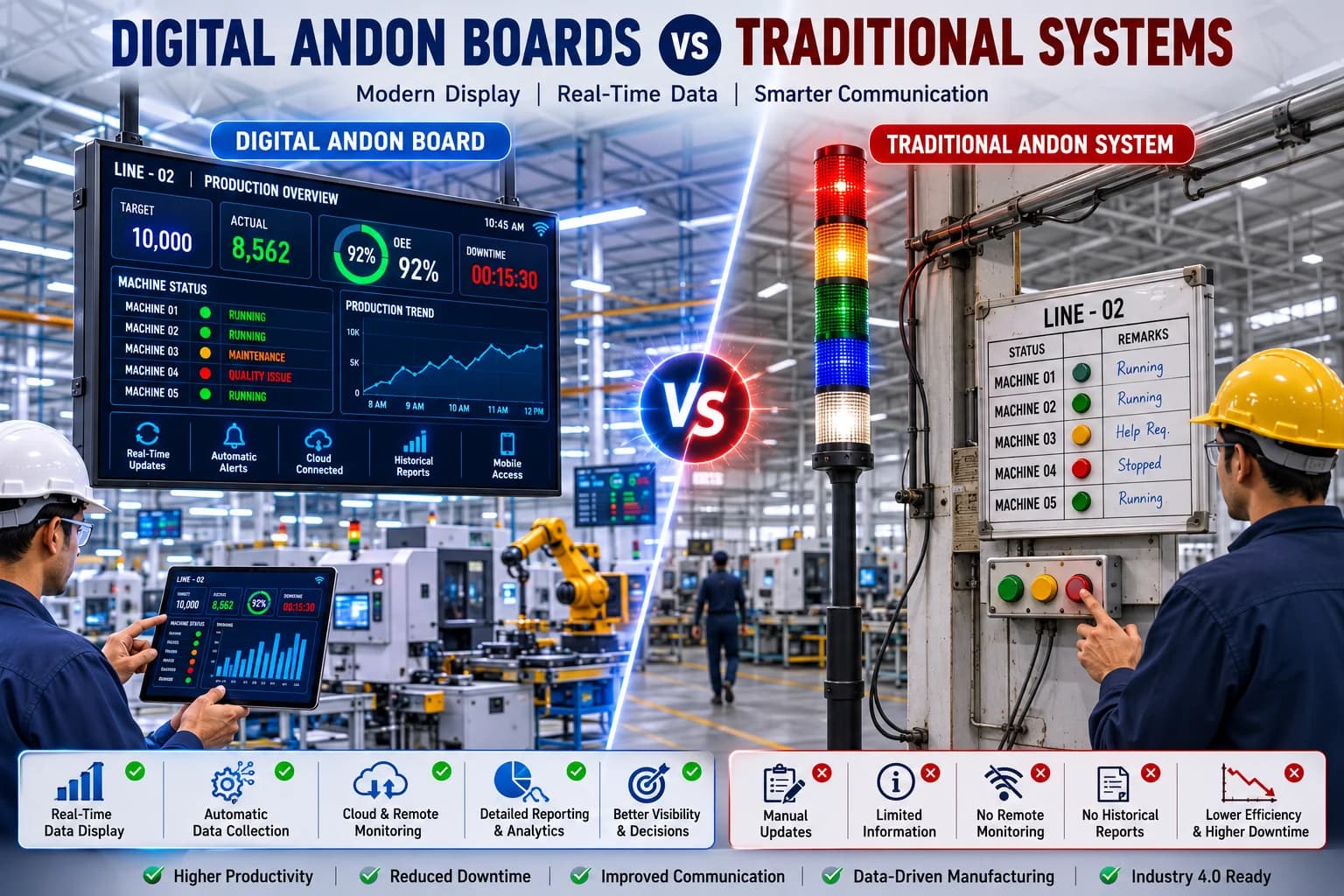
Unlike traditional notice boards or manually updated production charts, an Andon display board automatically refreshes whenever new production information is received.
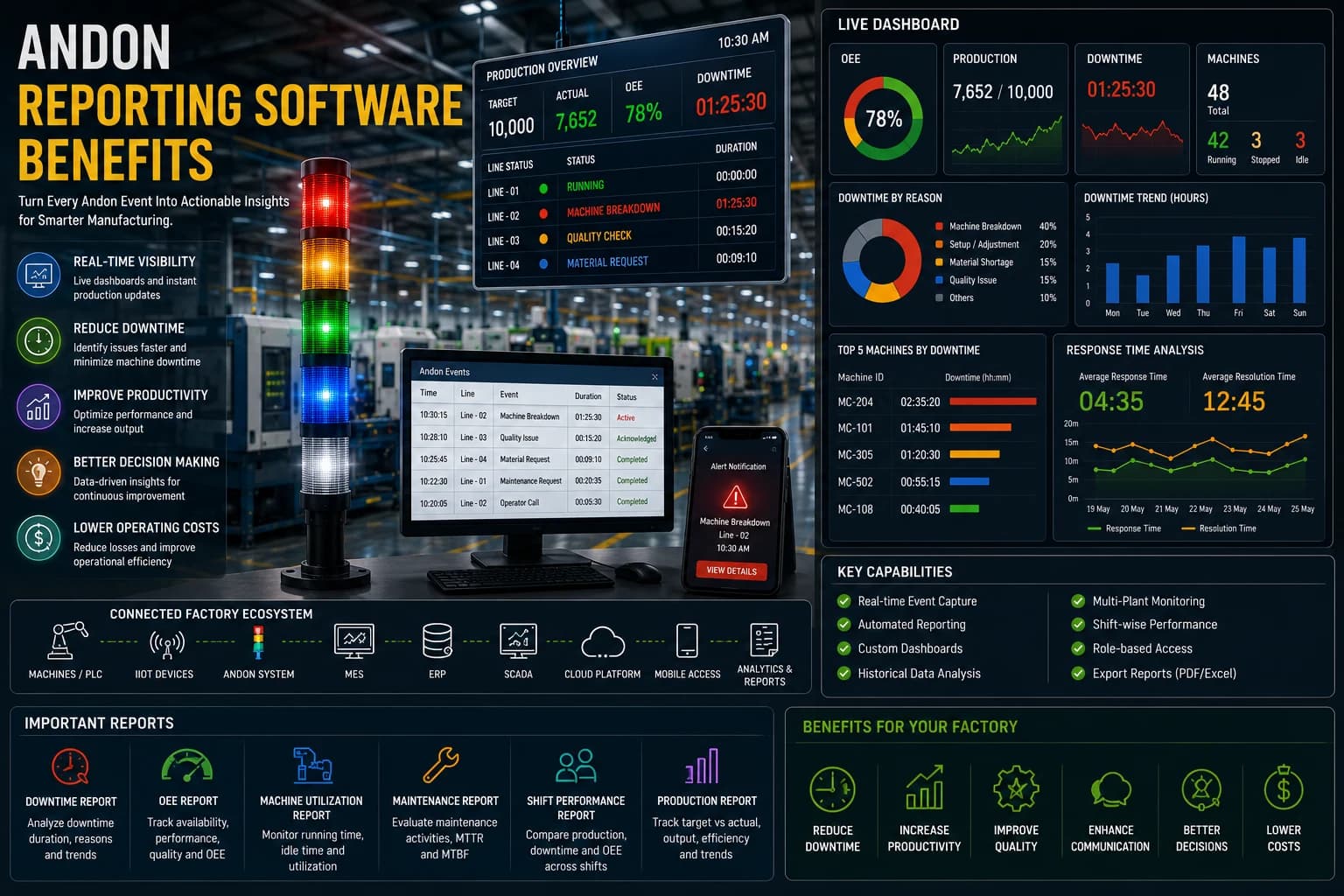
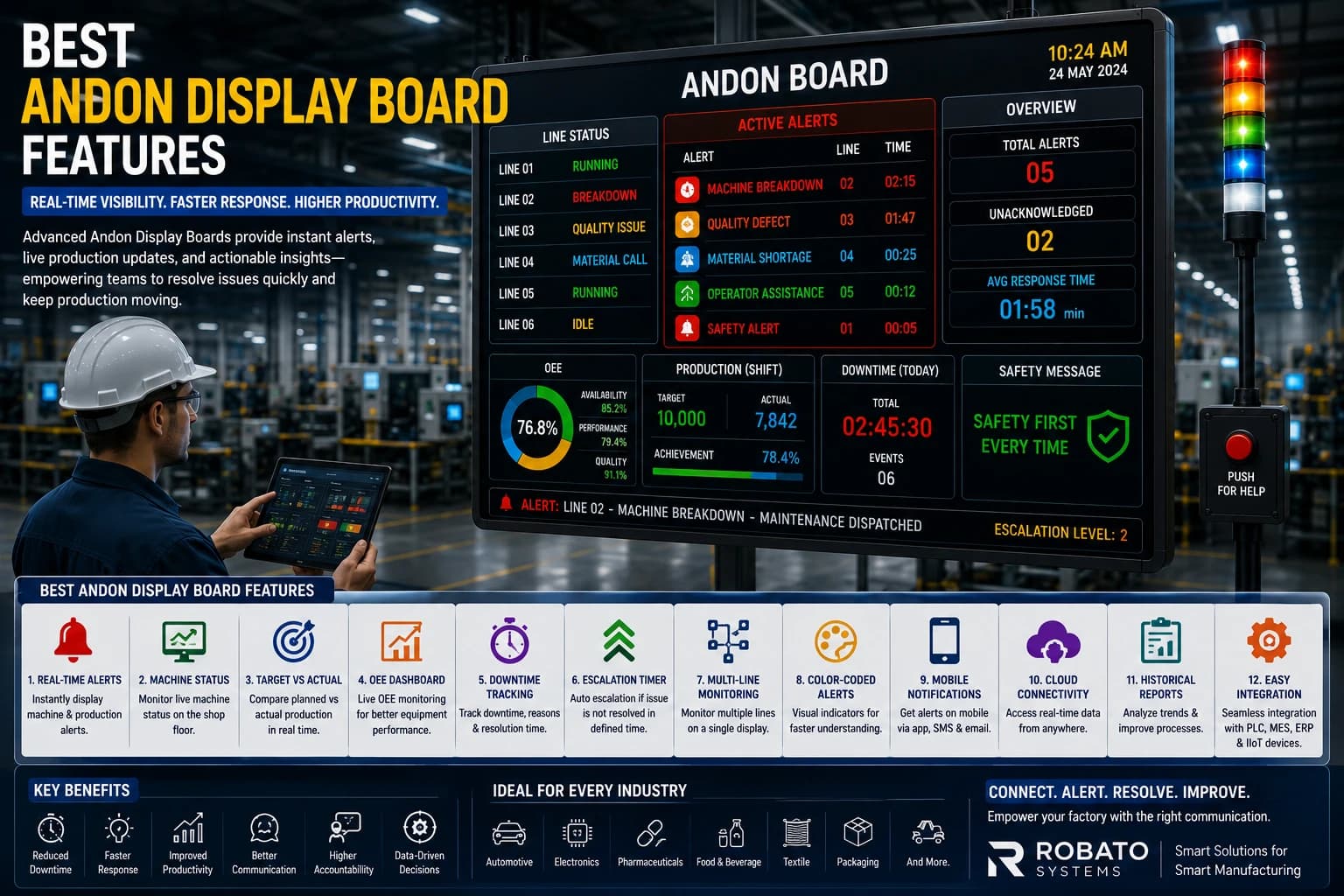
Typical information displayed includes:
- Machine status
- Production line status
- Active machine alerts
- Maintenance requests
- Operator assistance calls
- Downtime duration
- Target vs actual production
- Overall Equipment Effectiveness (OEE)
- Shift performance
- Quality alerts
- Safety notifications
- Escalation status
The primary objective of an Andon display board is to ensure that production issues become visible immediately, enabling rapid response and minimizing operational disruptions.
Why Features Matter When Choosing an Andon Display Board
The effectiveness of an Andon display board depends largely on its capabilities. A basic display may provide simple alert notifications, while an advanced solution offers real-time analytics, automated escalation, cloud connectivity, and seamless integration with manufacturing systems.
Choosing a feature-rich Andon display board enables manufacturers to:
- Improve production visibility
- Accelerate maintenance response
- Reduce machine downtime
- Increase production efficiency
- Support Lean Manufacturing
- Improve workforce communication
- Enable data-driven decision-making
Investing in the right features ensures the system remains valuable as manufacturing operations continue to grow.
Essential Andon Display Board Features
1. Real-Time Alert Display
The most important feature of an Andon display board is the ability to display production issues instantly.
Alerts may include:
- Machine breakdowns
- Quality defects
- Material shortages
- Maintenance requests
- Operator assistance calls
- Safety incidents
Real-time visibility allows support teams to respond immediately.
2. Machine Status Monitoring
The display should continuously monitor equipment conditions, including:
- Running
- Idle
- Setup
- Maintenance
- Breakdown
Machine status monitoring helps supervisors identify production bottlenecks without manually inspecting equipment.
3. Target vs Actual Production Display
Comparing planned production with actual output enables supervisors to monitor production progress throughout each shift.
Production delays become visible before delivery schedules are affected.
4. Overall Equipment Effectiveness (OEE) Dashboard
An advanced Andon display board should display live OEE metrics:
- Availability
- Performance
- Quality
These KPIs provide valuable insights into equipment productivity and manufacturing efficiency.
5. Downtime Tracking
Automatically display:
- Machine stopped
- Downtime duration
- Downtime reason
- Maintenance status
- Time to resolution
Downtime visibility helps maintenance teams reduce equipment inactivity.
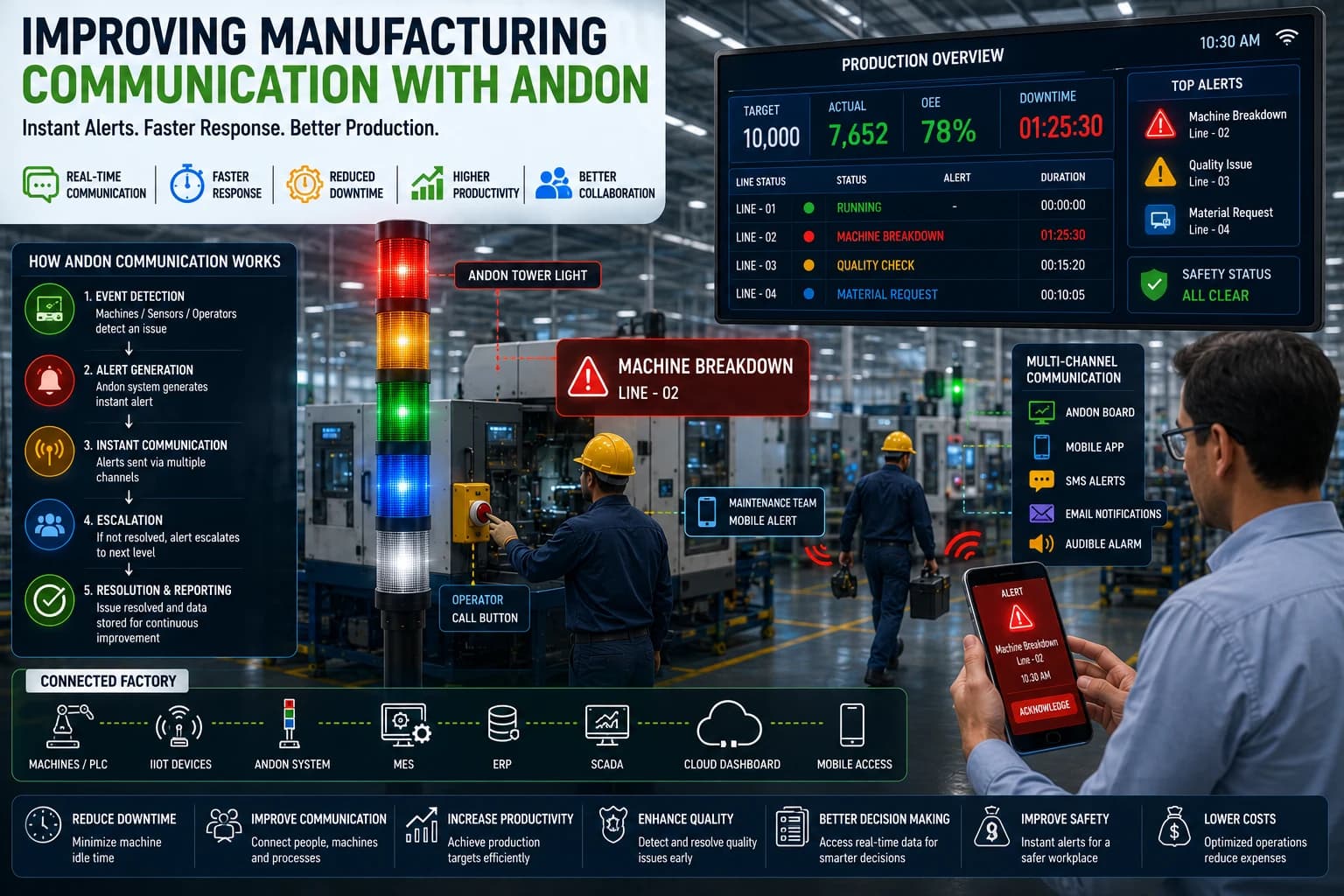
6. Automated Escalation Timer
If a production issue is not resolved within predefined response times, the system should automatically escalate the alert to higher-level supervisors or maintenance managers.
This feature ensures no critical issue is overlooked.
7. Multi-Line Production Monitoring
Manufacturers with multiple production lines should be able to monitor all lines from a single centralized display.
This improves operational oversight across the entire facility.
8. Color-Coded Alert System
Color-coded visual indicators allow operators to understand equipment status instantly.
Typical colors include:
- Green – Running normally
- Yellow – Warning
- Red – Breakdown
- Blue – Material request
- White – Operator assistance
Clear visual signals improve response speed.
9. Mobile Notification Integration
Modern Andon systems should notify personnel through:
- Mobile applications
- SMS
- Push notifications
This enables maintenance teams to respond even when away from production lines.
10. Cloud Connectivity
Cloud-based Andon systems allow plant managers to monitor factory operations remotely.
Benefits include:
- Multi-plant monitoring
- Remote troubleshooting
- Cloud reporting
- Real-time dashboards
11. Historical Reporting
Every alert should be stored for future analysis.
Reports may include:
- Downtime history
- Alert frequency
- Response time
- Resolution time
- Machine utilization
- Escalation records
Historical data supports continuous improvement.
12. PLC Integration
The display board should communicate directly with PLCs to detect machine faults automatically.
Supported industrial protocols may include:
- Modbus
- Modbus TCP
- OPC UA
- MQTT
- Ethernet/IP
- Profinet
13. ERP and MES Integration
Integration with ERP and MES enables synchronization of production planning, work orders, inventory, and manufacturing performance.
14. Industrial IoT Connectivity
Modern Andon display boards should connect with Industrial IoT devices for real-time machine monitoring and predictive analytics.
15. User-Friendly Dashboard
The dashboard should include:
- Large fonts
- Color-coded KPIs
- Easy navigation
- Customizable widgets
- Intuitive layouts
Simple interfaces improve usability for operators and supervisors.
Benefits of Advanced Andon Display Boards
Improved Production Visibility
Everyone can monitor factory conditions in real time.
Faster Decision-Making
Production issues become visible immediately, allowing rapid corrective action.
Reduced Downtime
Maintenance teams receive instant notifications whenever equipment problems occur.
Better Communication
Visual alerts replace slow manual communication methods.
Increased Productivity
Operators remain focused on production while support teams respond to alerts.
Enhanced Quality Control
Immediate quality alerts prevent defective products from progressing through production.
Greater Accountability
Response times and issue resolution become measurable.
Support for Lean Manufacturing
Visual management reduces waste and improves operational efficiency.
Applications Across Manufacturing Industries
Andon display boards are widely used in:
Automotive Manufacturing
Monitor assembly line performance and equipment health.
Electronics Manufacturing
Track production interruptions and quality inspections.
Food & Beverage Processing
Display packaging, bottling, and filling equipment status.
Pharmaceutical Manufacturing
Monitor batch production and quality compliance.
Textile Manufacturing
Track weaving, knitting, and spinning operations.
Plastic & Injection Molding
Monitor molding machines and production efficiency.
Packaging Industry
Display packaging line performance and machine availability.
Andon Display Boards and Industry 4.0
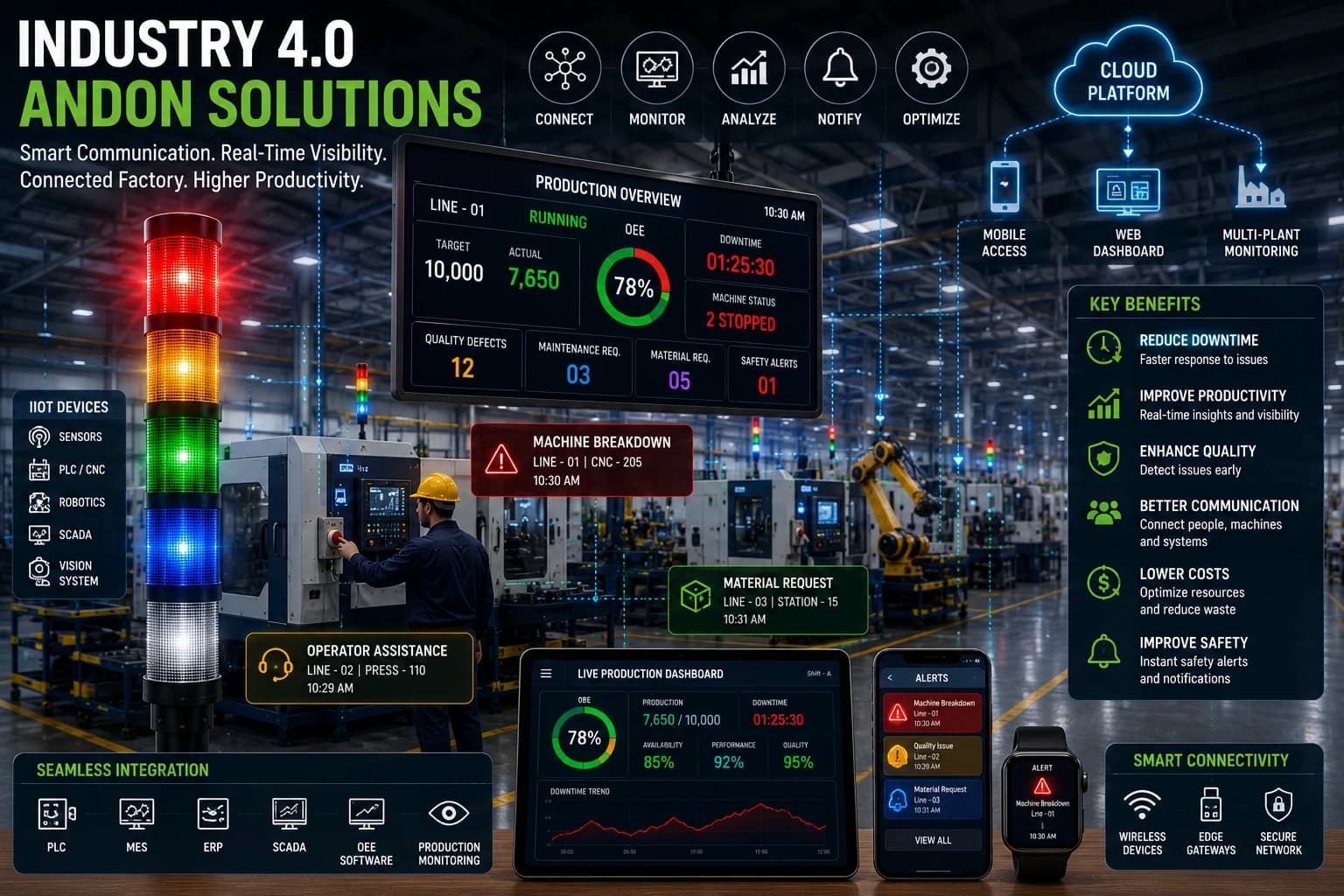
Modern Andon display boards integrate with:
- Industrial IoT (IIoT)
- PLCs
- MES
- ERP
- SCADA
- Production Monitoring Systems
- Cloud dashboards
- Mobile applications
These integrations create intelligent manufacturing environments with complete operational visibility.
Best Practices for Implementation
Automate Alert Generation
Use machine signals and sensors to trigger alerts automatically.
Display Actionable Information
Focus on information that requires immediate action.
Install Displays Strategically
Ensure visibility across production areas.
Configure Escalation Rules
Prevent unresolved issues from being ignored.
Train Employees
Operators should understand every alert category and response procedure.
Review Reports Frequently
Analyze recurring issues to improve manufacturing processes.
Common Challenges
Legacy Machine Integration
Older equipment may require retrofit sensors or communication gateways.
Excessive Alerts
Configure priorities to reduce unnecessary notifications.
Network Reliability
Stable industrial networking ensures uninterrupted communication.
Employee Adoption
Proper onboarding encourages effective system usage.
Future Trends
Andon display boards continue evolving with advanced digital manufacturing technologies.
Artificial Intelligence
AI will prioritize alerts based on operational impact.
Predictive Maintenance
Machine learning will predict equipment failures before breakdowns occur.
Digital Twins
Virtual production environments will synchronize with real-time manufacturing data.
Edge Computing
Production data will be processed locally for faster response times.
Advanced Analytics
Manufacturers will gain deeper insights into production trends and recurring issues.
These innovations will make Andon display boards even more valuable for smart factories.
Why Choose Robato Systems for Andon Display Boards?
Robato Systems delivers advanced Andon Display Board solutions that provide manufacturers with complete real-time visibility across production operations. Our display systems integrate seamlessly with PLCs, Industrial IoT devices, MES, ERP, SCADA, and production monitoring software to display machine status, downtime, maintenance requests, production alerts, and operational KPIs.
Our customizable Andon display boards support automated escalation, mobile notifications, cloud dashboards, historical reporting, and multi-line monitoring, enabling manufacturers to improve communication, reduce downtime, increase productivity, and accelerate Industry 4.0 transformation.
Whether your facility operates a single production line or multiple manufacturing plants, Robato Systems offers scalable display solutions tailored to your operational needs.
Conclusion
An Andon Display Board is one of the most valuable visual management tools available for modern manufacturing. By providing real-time visibility into machine status, production alerts, downtime, quality issues, and operational performance, these systems enable manufacturers to respond faster, improve communication, and increase productivity.
Choosing an Andon display board with advanced features such as automated escalation, cloud connectivity, mobile notifications, PLC integration, and historical reporting ensures long-term operational benefits and supports smart factory initiatives.
As manufacturing continues to embrace Industry 4.0, investing in a feature-rich Andon display board helps build a more connected, efficient, and data-driven production environment.
Frequently Asked Questions (FAQs)
What is an Andon display board?
An Andon display board is a digital visual management system that displays real-time production alerts, machine status, maintenance requests, and manufacturing KPIs.
What features should an Andon display board have?
Essential features include real-time alerts, machine monitoring, OEE dashboards, downtime tracking, automated escalation, cloud connectivity, mobile notifications, and PLC integration.
Can Andon display boards integrate with ERP and PLC systems?
Yes. Modern Andon display boards integrate with PLCs, ERP, MES, SCADA, Industrial IoT devices, and cloud-based monitoring platforms.
How do Andon display boards improve manufacturing?
They improve communication, reduce downtime, enhance production visibility, support faster decision-making, and increase operational efficiency.
Which industries use Andon display boards?
Automotive, electronics, pharmaceuticals, food processing, textiles, plastics, packaging, logistics, and many other manufacturing industries.