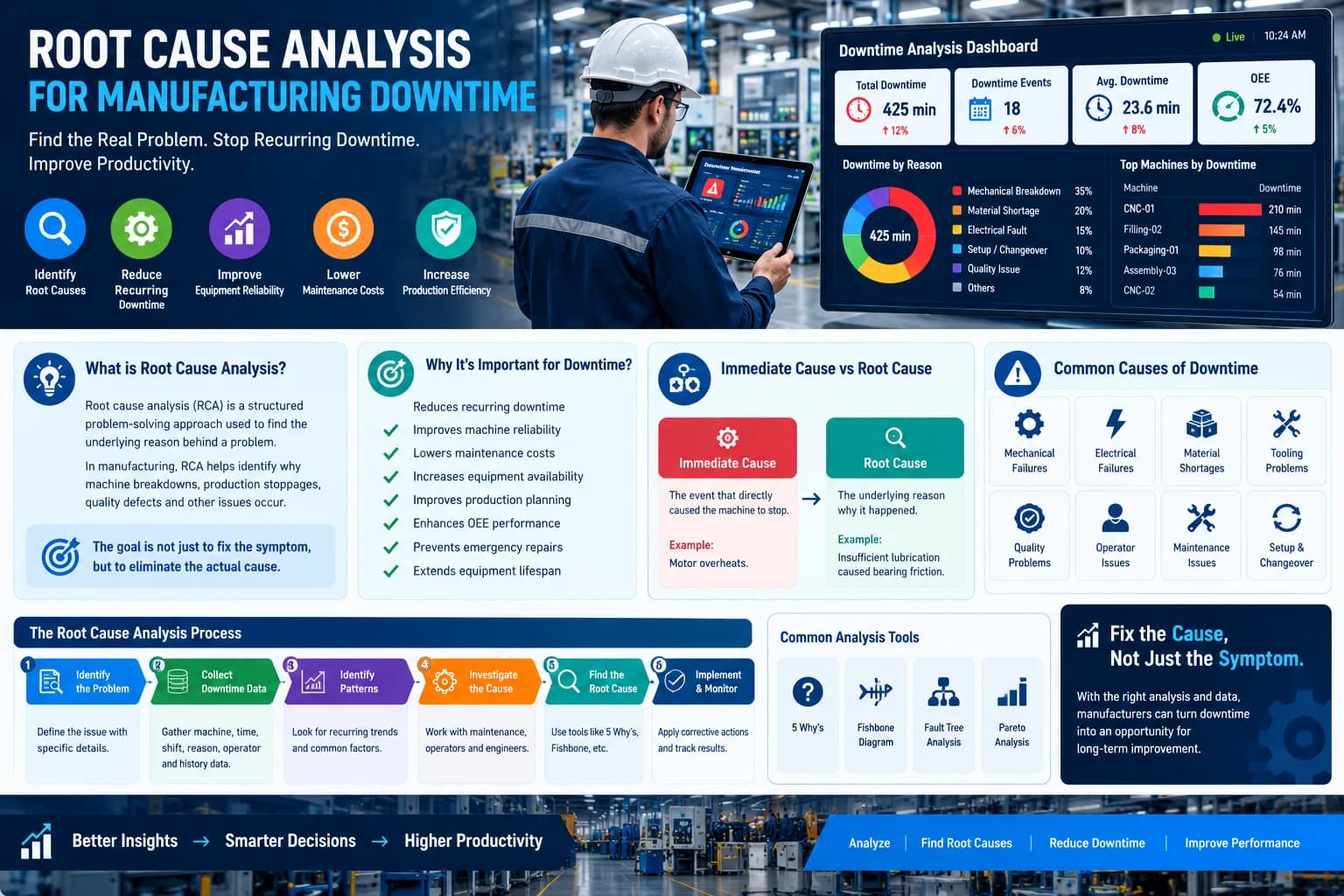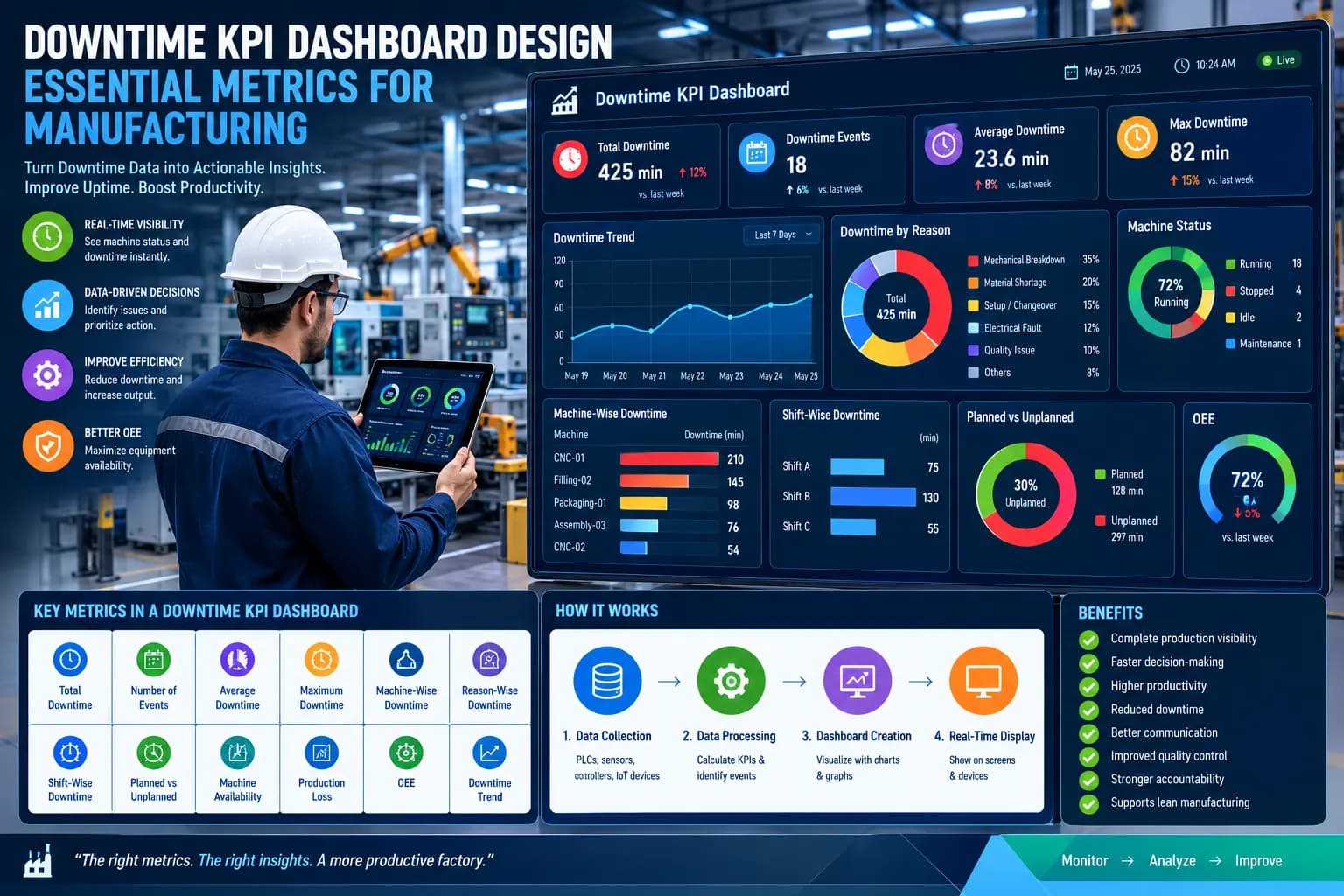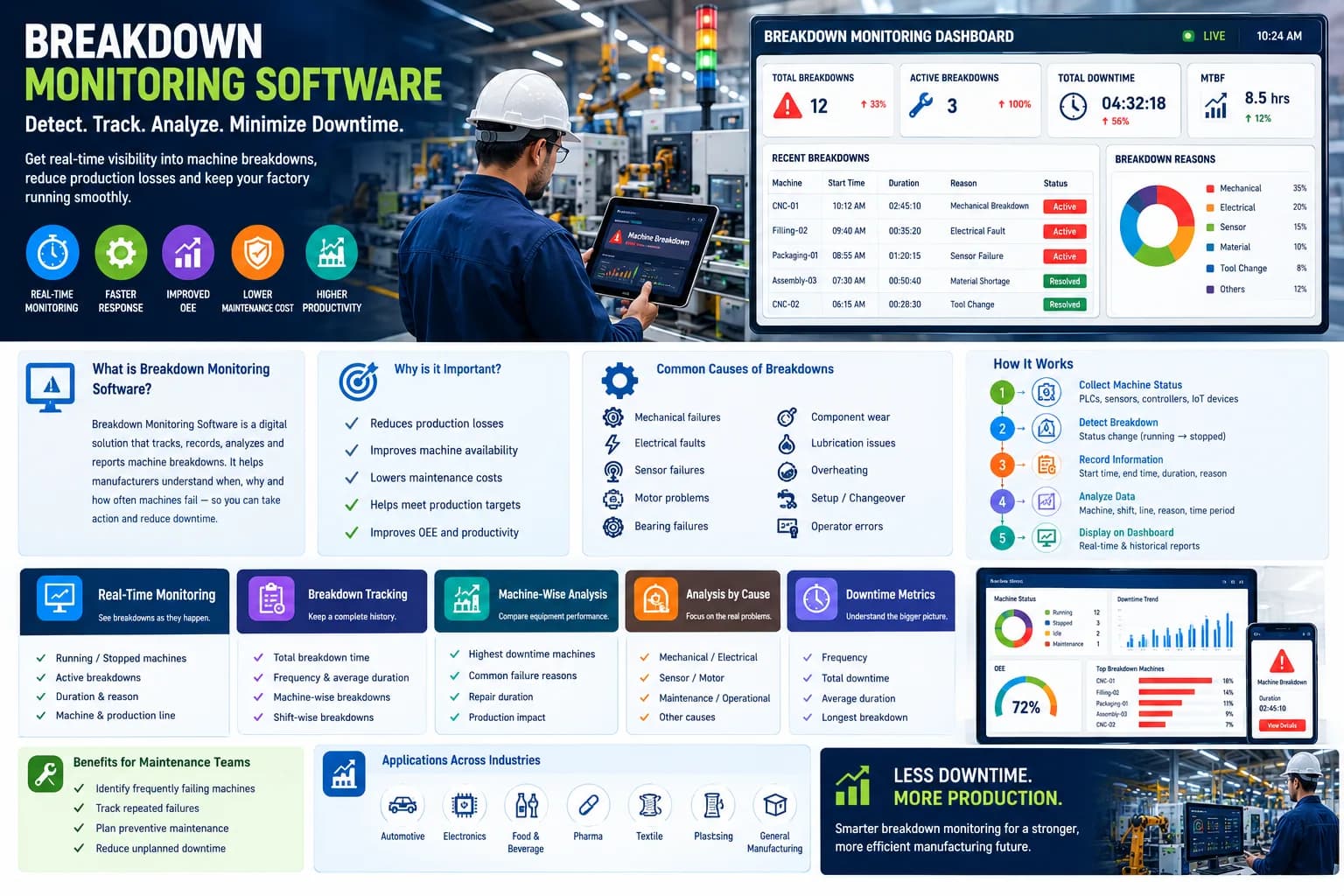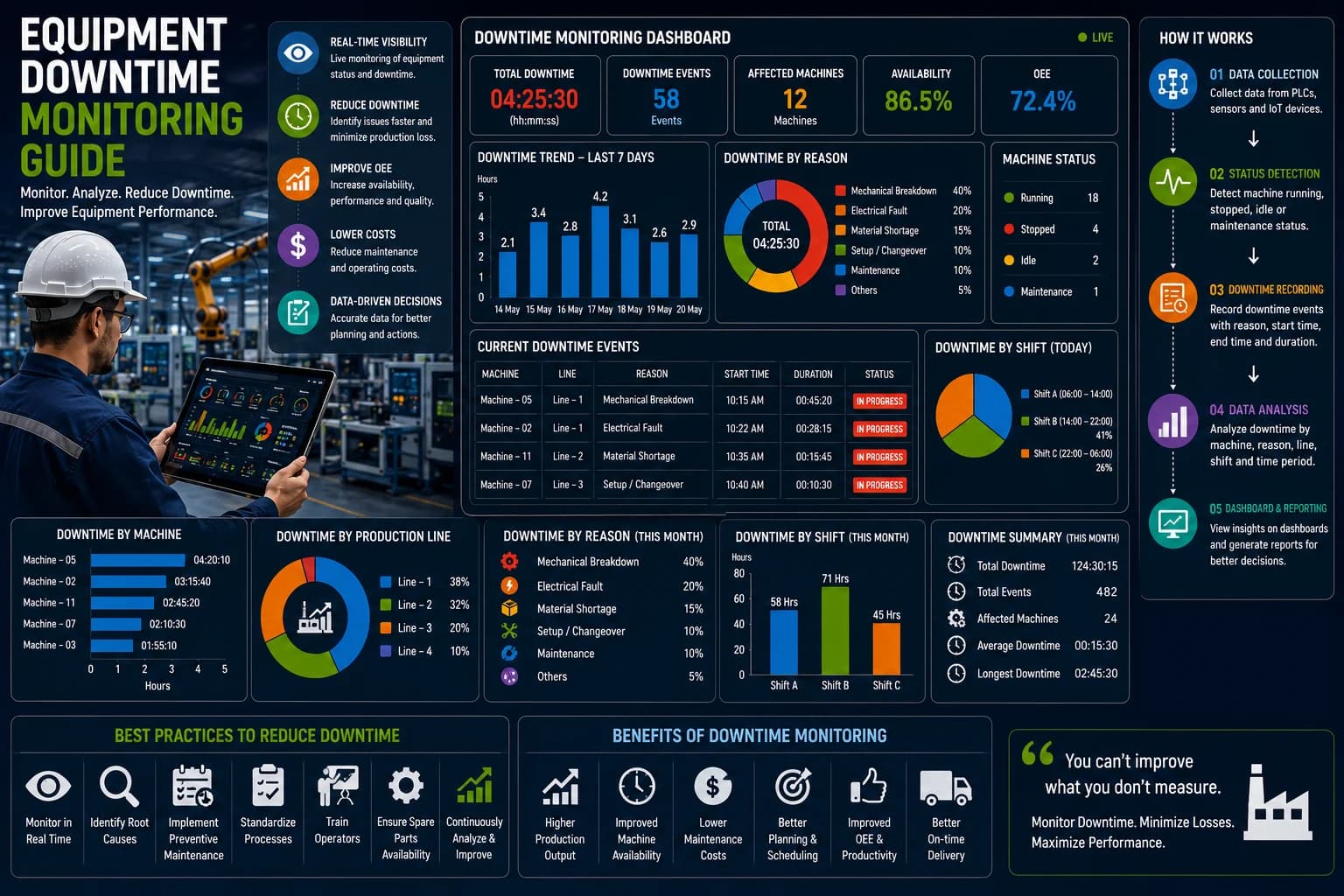
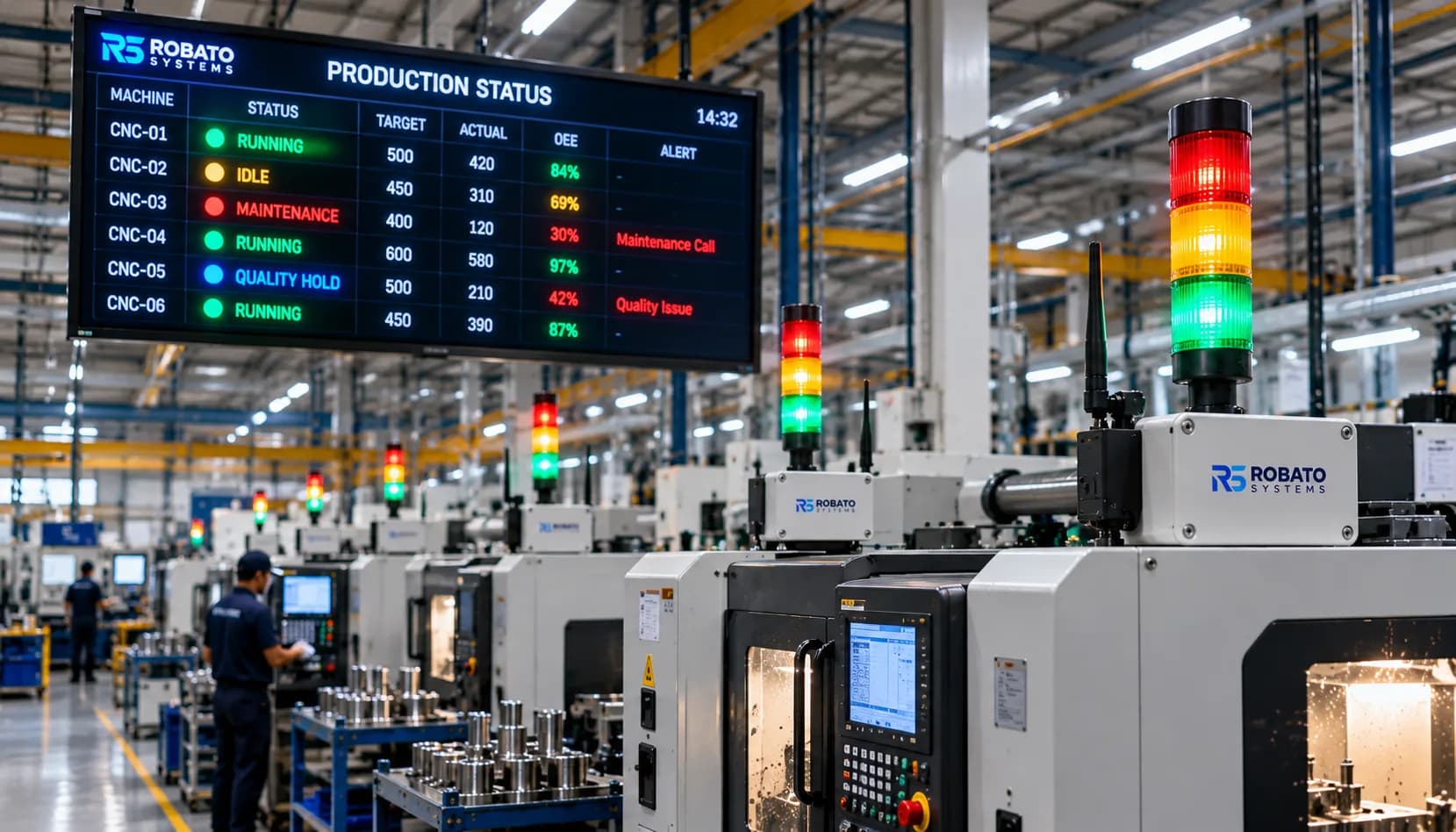
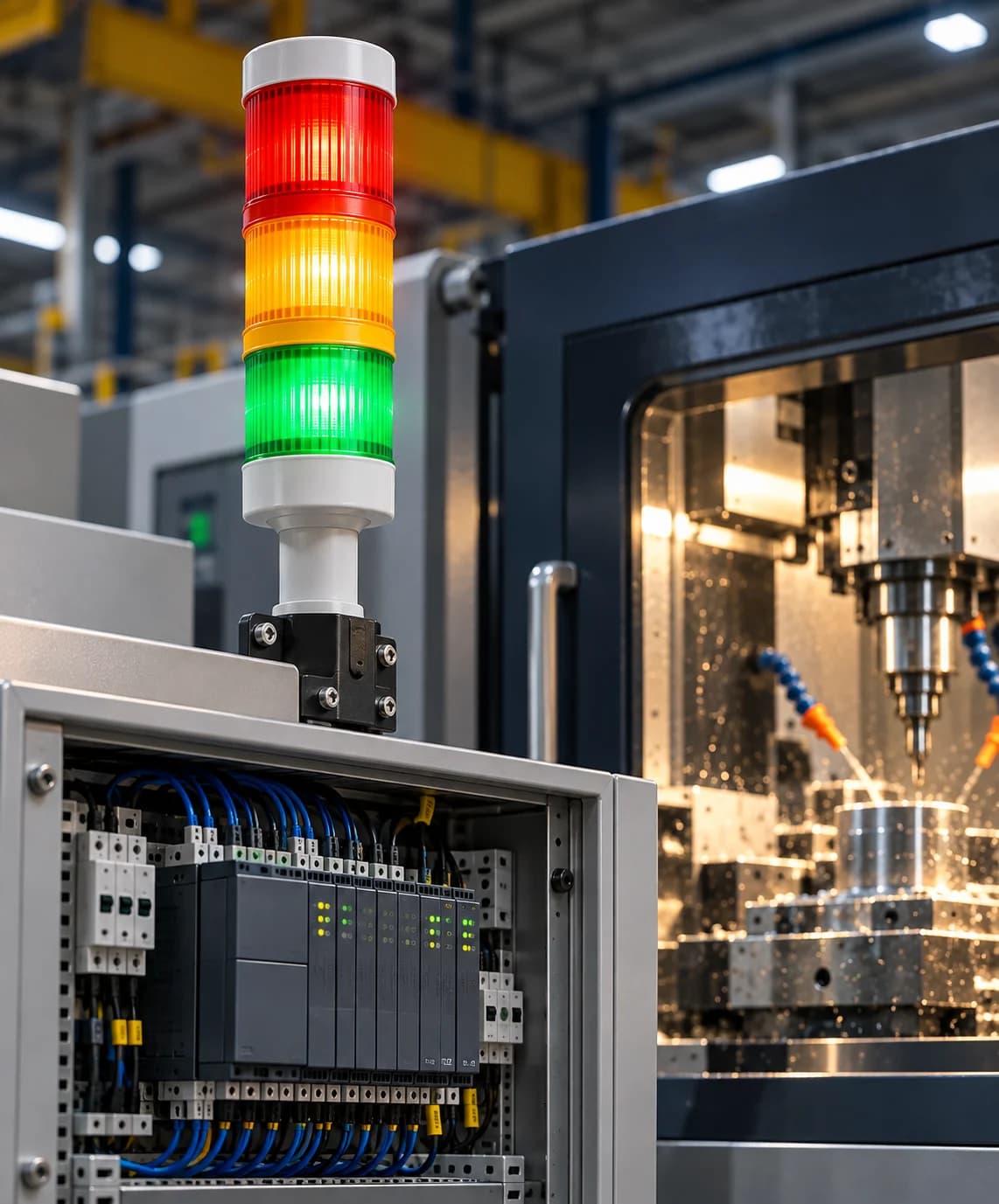
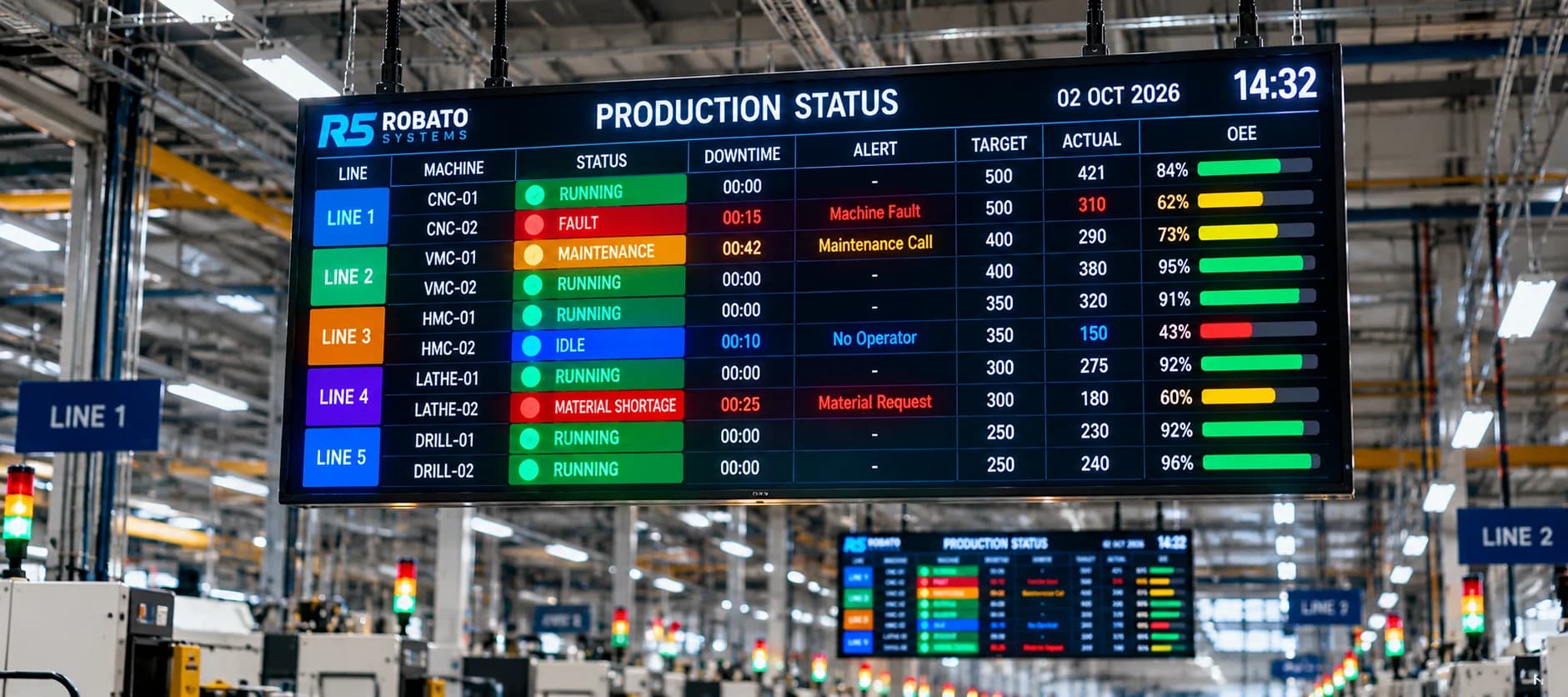
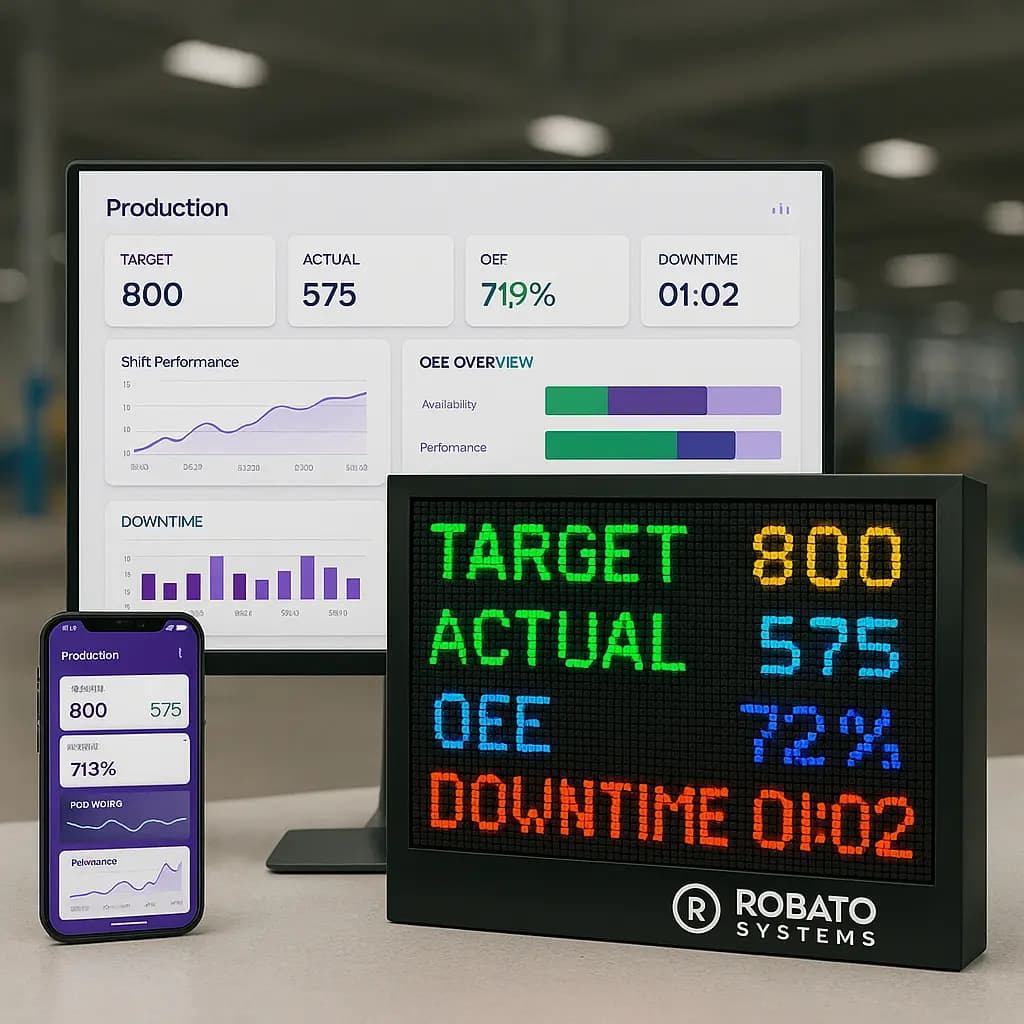
Machine downtime is one of the most important production losses that manufacturing companies need to monitor. When equipment stops, planned production time is lost and production targets can be affected.
However, simply recording that a machine stopped is not enough.
Manufacturers need to understand how often machines stop, how long they remain stopped, and what causes the downtime.
Downtime Analysis provides a structured way to study machine stoppages and identify the major causes of production losses.
By analyzing downtime data, production and maintenance teams can identify recurring problems, prioritize improvement activities, and work toward improving machine availability.
What is Downtime Analysis?
Downtime Analysis is the process of examining machine stoppage information to understand the causes, duration, frequency, and impact of production downtime.
A downtime analysis system can provide information such as:
- Machine name
- Downtime duration
- Number of downtime events
- Downtime reason
- Production line
- Shift
- Date
- Machine status
- Production impact
This information helps manufacturers move beyond simply recording downtime and start understanding why production interruptions occur.
Why is Downtime Analysis Important?
Manufacturing plants can experience downtime for many different reasons.
Some machines may experience frequent short stops, while others may have occasional but very long breakdowns.
Without proper analysis, it can be difficult to determine which problems have the greatest impact on production.
Downtime analysis helps manufacturers identify:
- Machines with high downtime
- Frequent breakdown causes
- Long downtime events
- Repeated machine stoppages
- Shift-wise downtime differences
- Production lines with high downtime
This allows teams to focus their improvement efforts where they can have the greatest impact.
Common Causes of Manufacturing Downtime
Downtime can result from several operational and equipment-related problems.
Common causes include:
- Mechanical breakdowns
- Electrical faults
- Equipment maintenance
- Material shortages
- Tool changes
- Machine setup
- Product changeovers
- Quality problems
- Operator issues
- Sensor failures
Categorizing downtime reasons makes it easier to determine which causes are responsible for the largest losses.
Machine-Wise Downtime Analysis
Different machines can have significantly different downtime patterns.
Machine-wise analysis allows manufacturers to compare equipment performance.
For each machine, teams can examine:
- Total downtime
- Number of downtime events
- Average downtime
- Longest downtime
- Most common downtime reason
If one machine consistently has higher downtime than other machines, maintenance teams can investigate its reliability and operating conditions.
Production Line Downtime Analysis
Downtime should also be analyzed at the production-line level.
A production line may contain several machines, and the failure of one machine can affect the entire line.
Production line analysis can help identify:
- High-downtime lines
- Bottleneck equipment
- Frequent line stoppages
- Production interruptions
- Recurring downtime patterns
This provides a broader view of production performance.
Shift-Wise Downtime Analysis
Downtime can vary between shifts.
Shift-wise analysis allows managers to compare machine performance during different operating periods.
Important metrics can include:
- Total downtime per shift
- Number of downtime events
- Average downtime
- Downtime by machine
- Downtime by reason
If one shift consistently has higher downtime, management can investigate possible operational or equipment-related causes.
Downtime Reason Analysis
Understanding the reason behind downtime is one of the most important parts of downtime analysis.
A monitoring system can categorize downtime into groups such as:
- Mechanical
- Electrical
- Maintenance
- Material
- Setup
- Changeover
- Quality
- Operator-related
Once the reasons are categorized, manufacturers can determine which categories contribute most to overall downtime.
Frequency and Duration Analysis
Downtime frequency and downtime duration provide two different perspectives.
A machine may stop many times for short periods, while another machine may stop only a few times but remain unavailable for several hours.
Manufacturers should therefore analyze both:
- Number of downtime events
- Total downtime duration
This provides a more complete understanding of machine performance.
Real-Time Downtime Analysis
Traditional downtime reports may only become available after a shift or production period.
Real-time downtime monitoring provides information while the production event is happening.
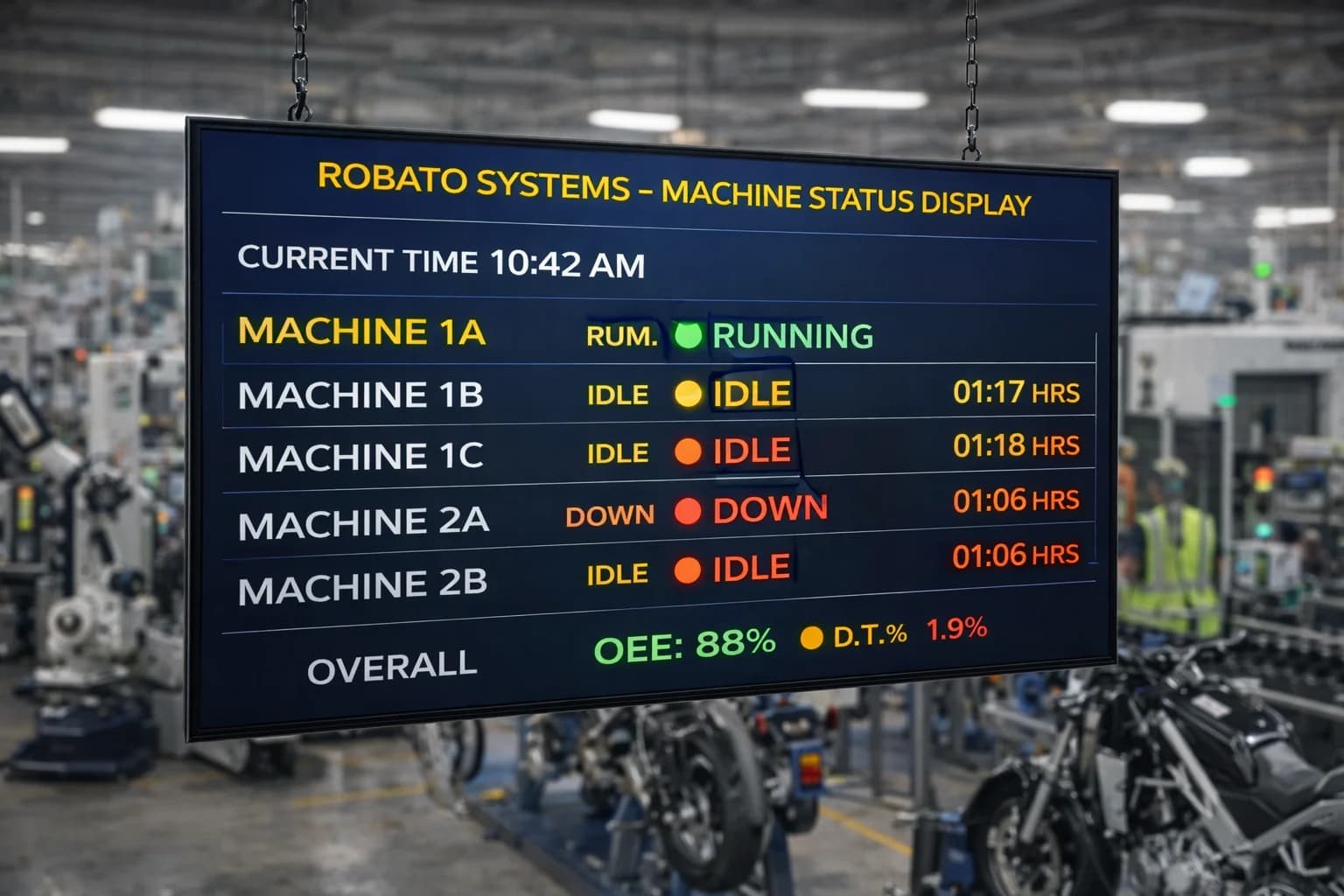
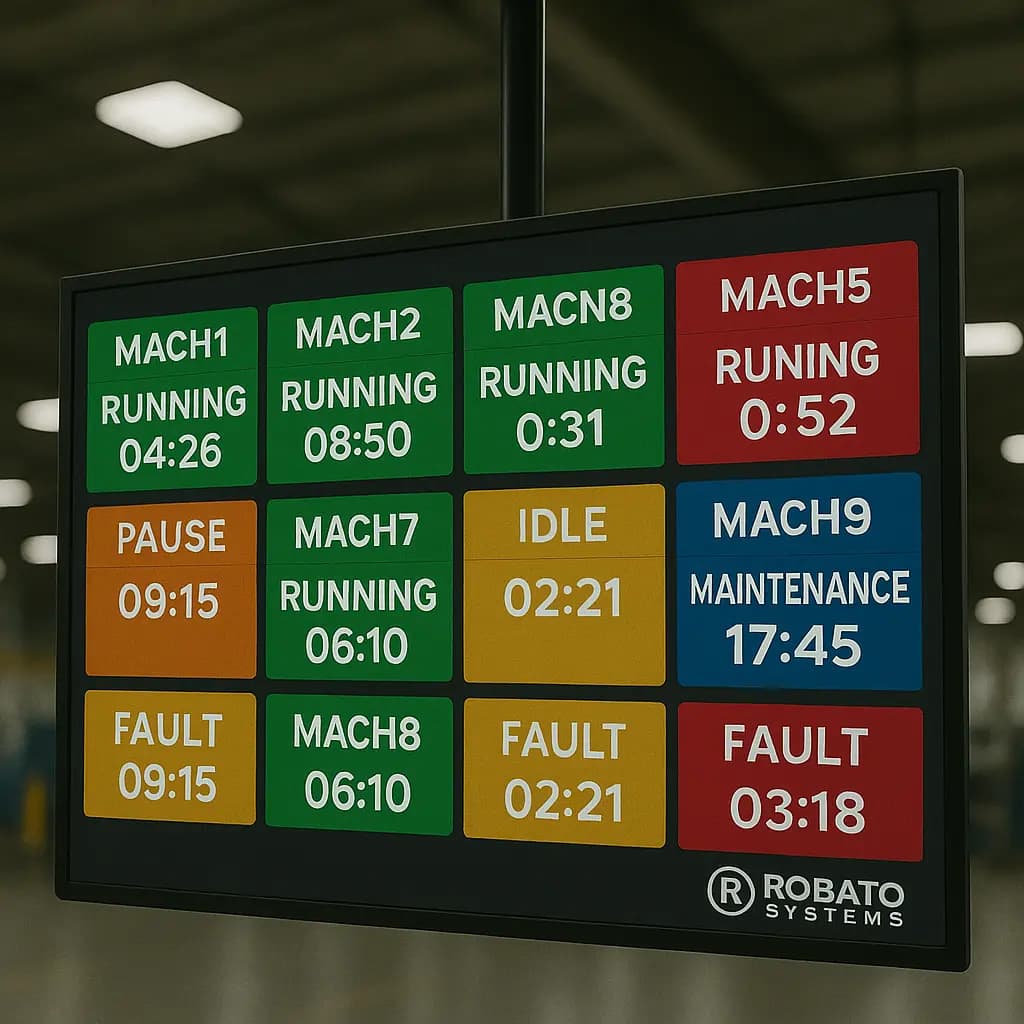
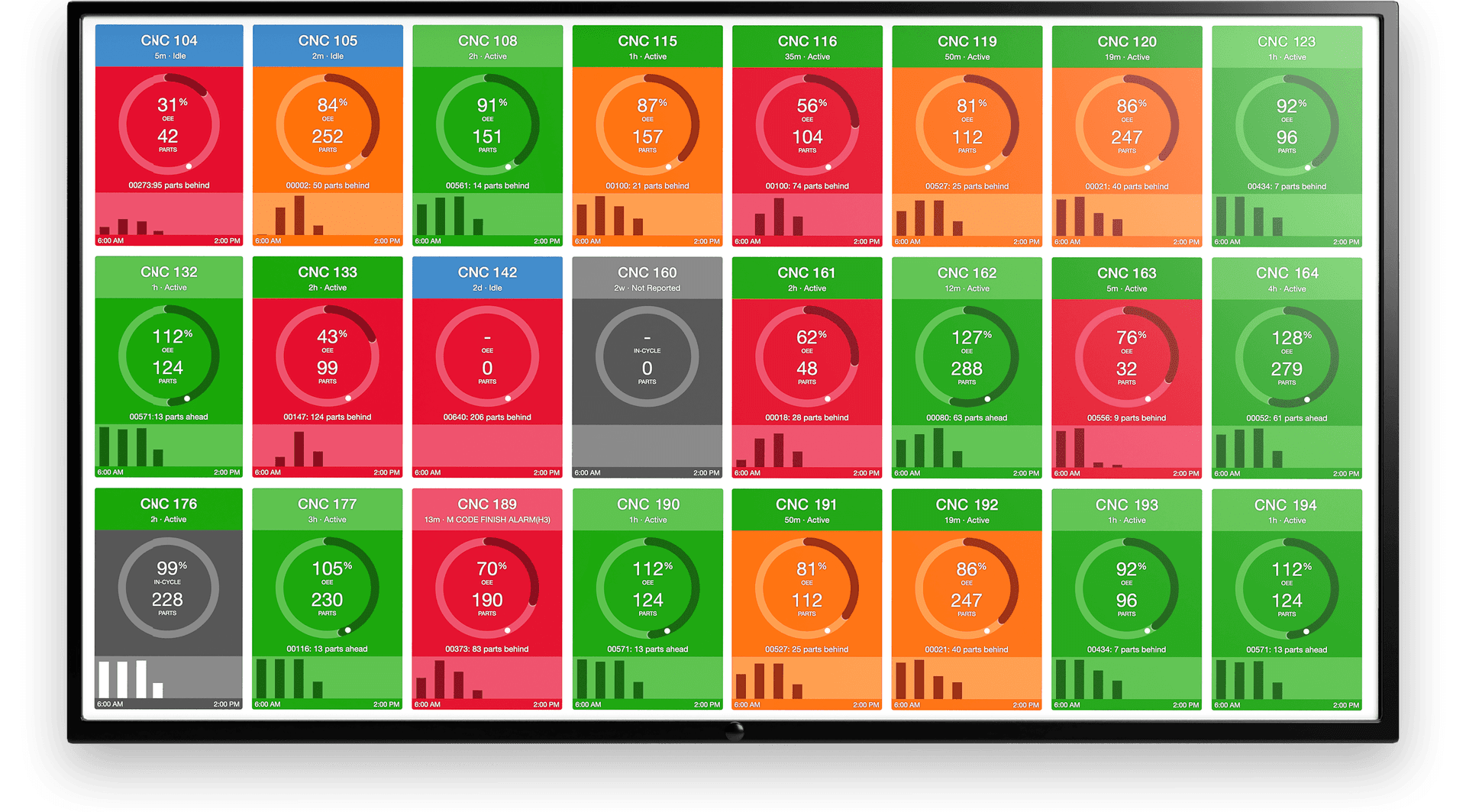
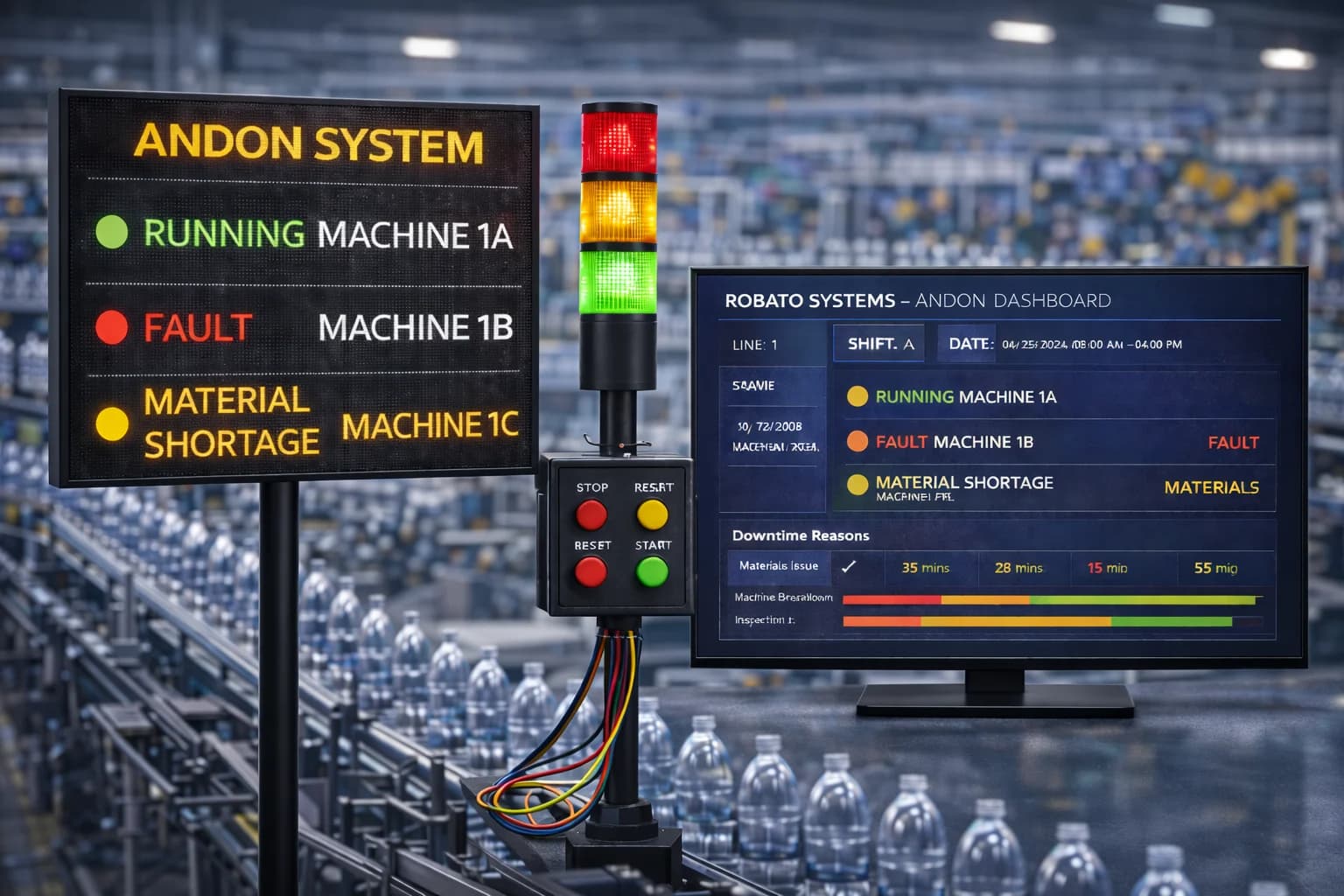
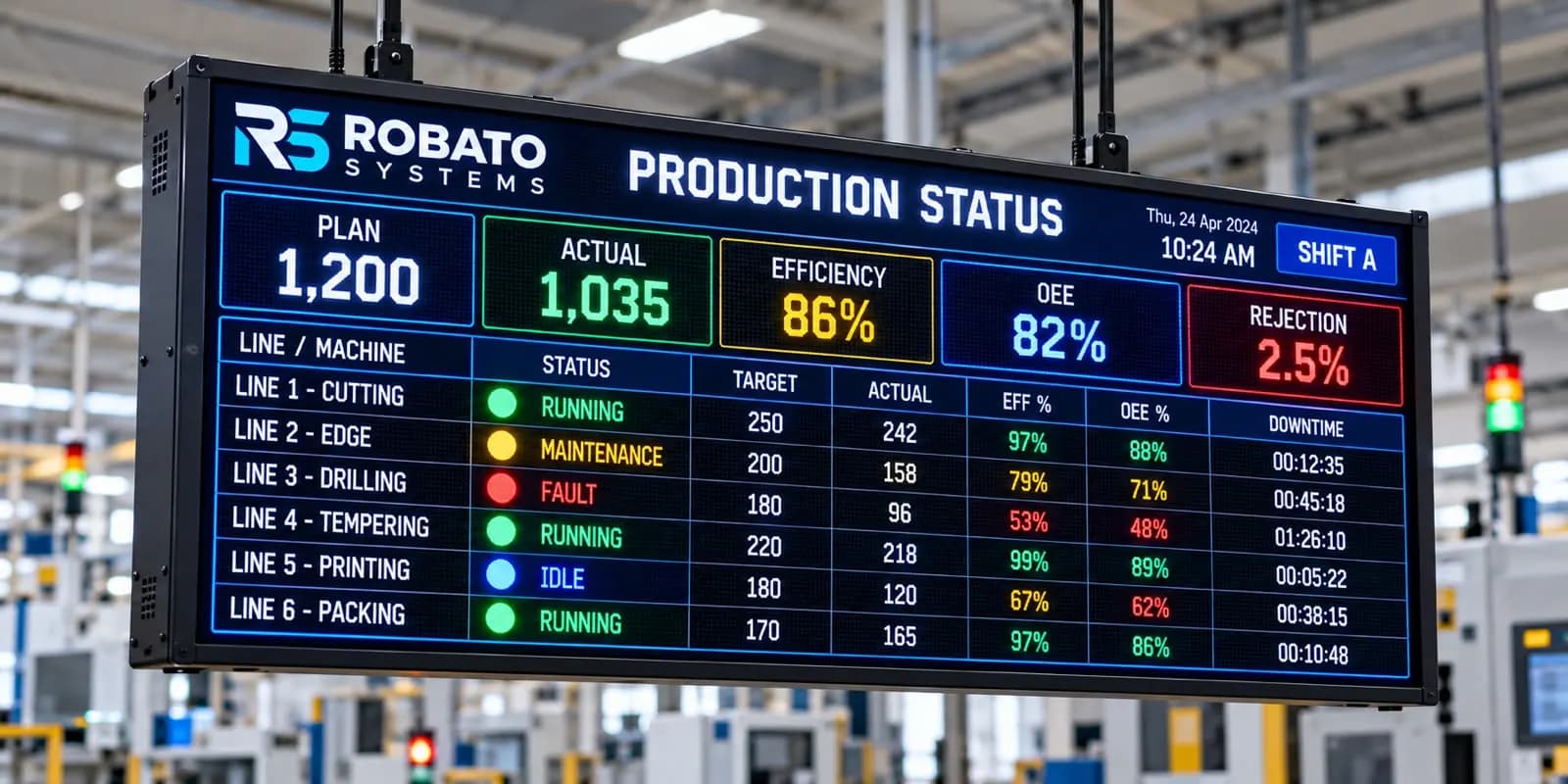
A dashboard can display:
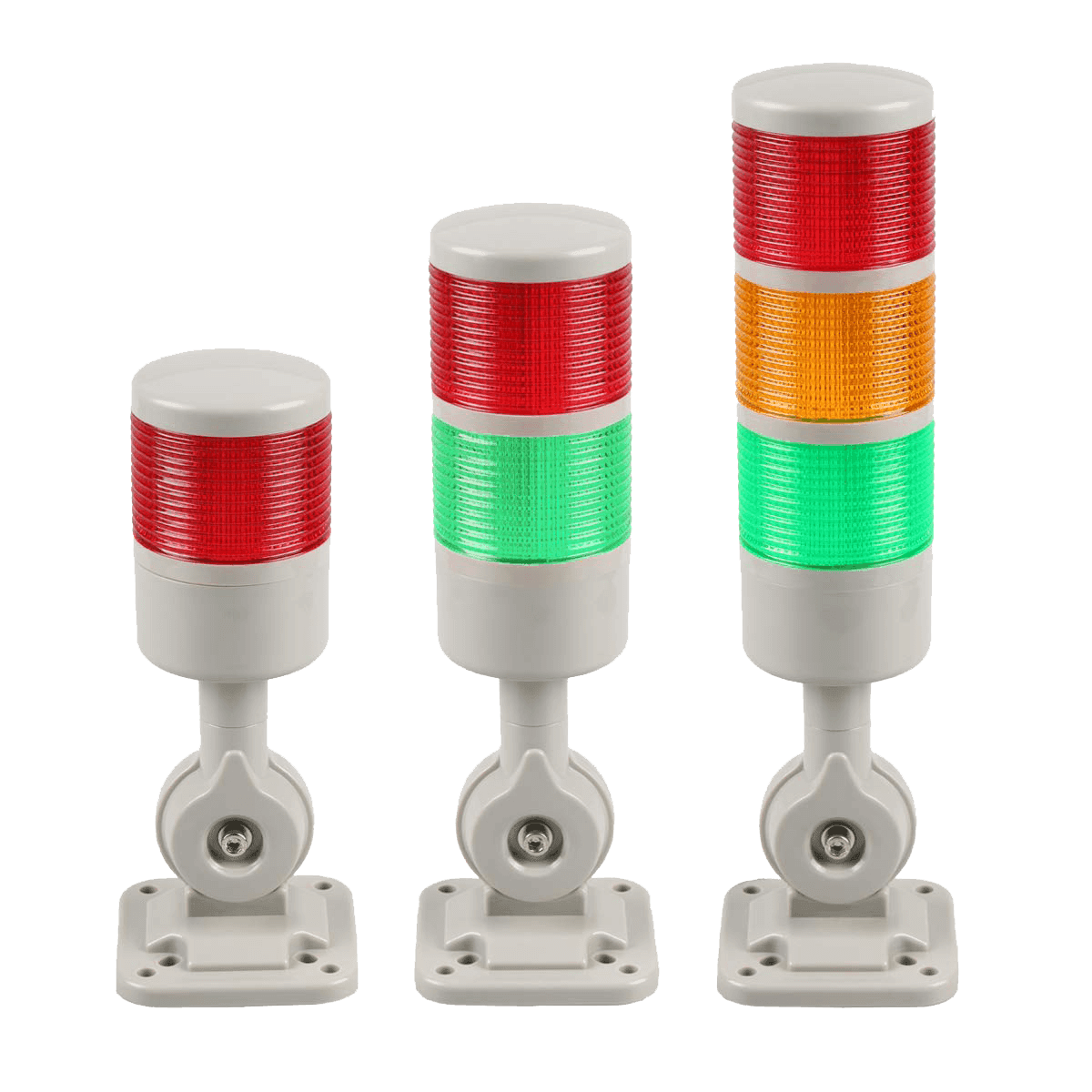
- Current machine status
- Active downtime
- Downtime duration
- Machine name
- Production line
- Downtime reason
This allows production and maintenance teams to respond more quickly to active machine stoppages.
Historical Downtime Analysis
Real-time information is useful for immediate response, but historical information is important for long-term improvement.
Manufacturers can analyze downtime across:
- Days
- Weeks
- Months
- Production shifts
- Machines
- Production lines
Historical trends can help identify recurring equipment problems.
For example, if a machine experiences similar breakdowns every week, the maintenance team can investigate the underlying cause.
Downtime Analysis and Production Losses
Machine downtime can directly reduce production output.
When equipment is unavailable, the planned production time decreases.
Downtime analysis can help manufacturers understand the relationship between:
- Machine downtime
- Production output
- Production targets
- Machine utilization
- OEE
This allows teams to understand the operational impact of equipment stoppages.
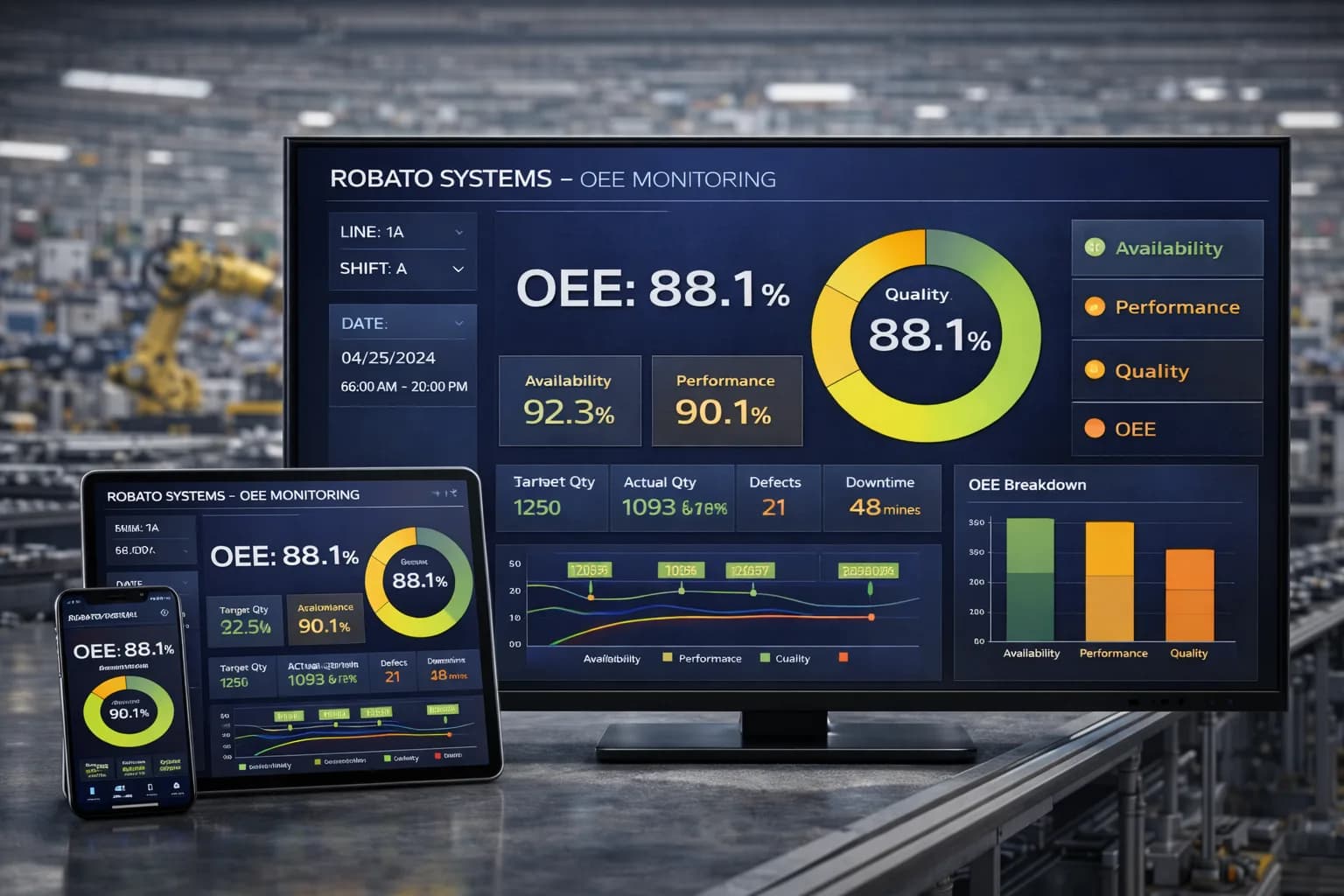
Downtime Analysis and OEE
Downtime is closely connected to Overall Equipment Effectiveness.
OEE is based on:
- Availability
- Performance
- Quality
Machine downtime directly affects availability.
Accurate downtime analysis can therefore help manufacturers understand why machine availability is decreasing.
Combining downtime information with OEE data provides a broader view of equipment performance.
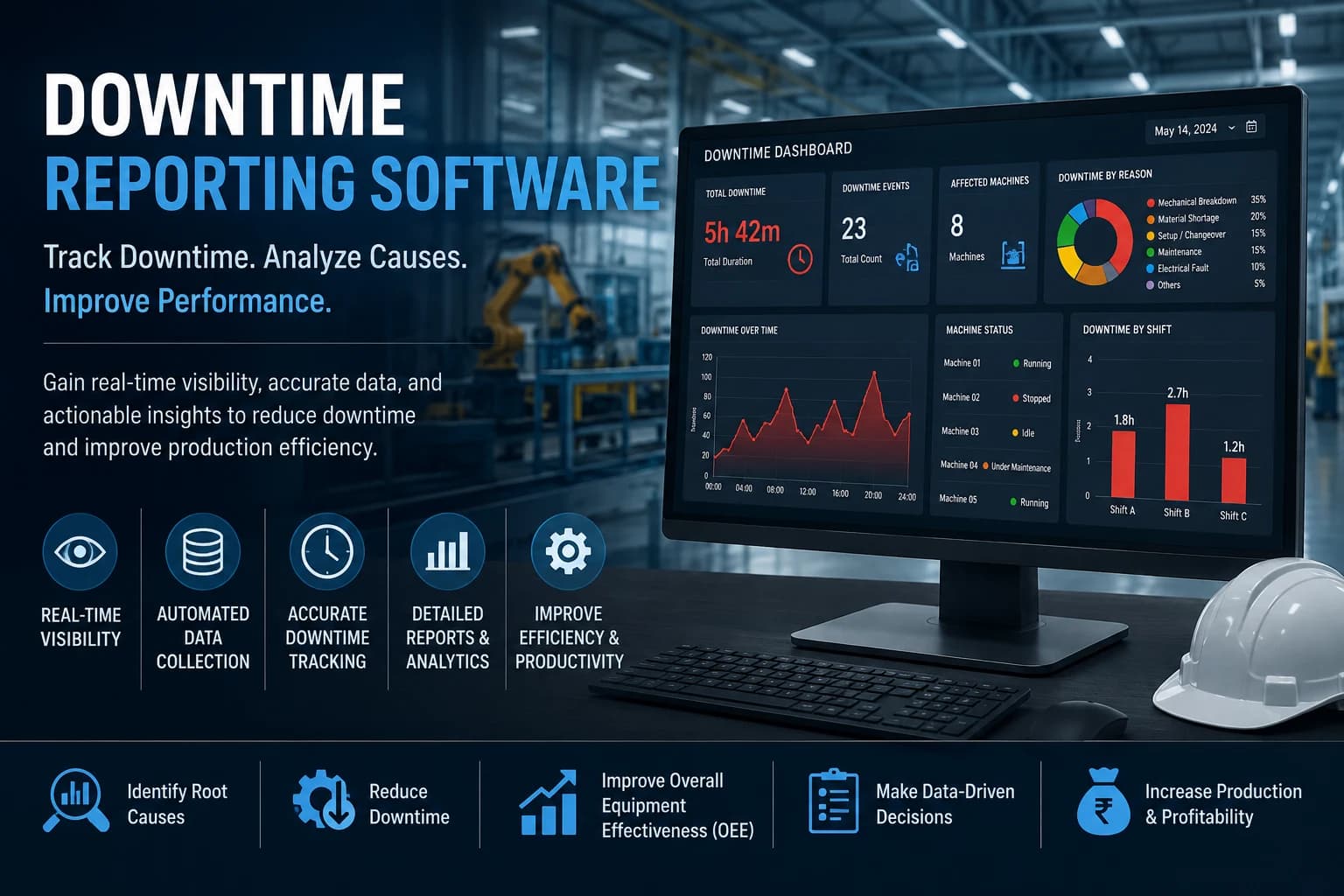
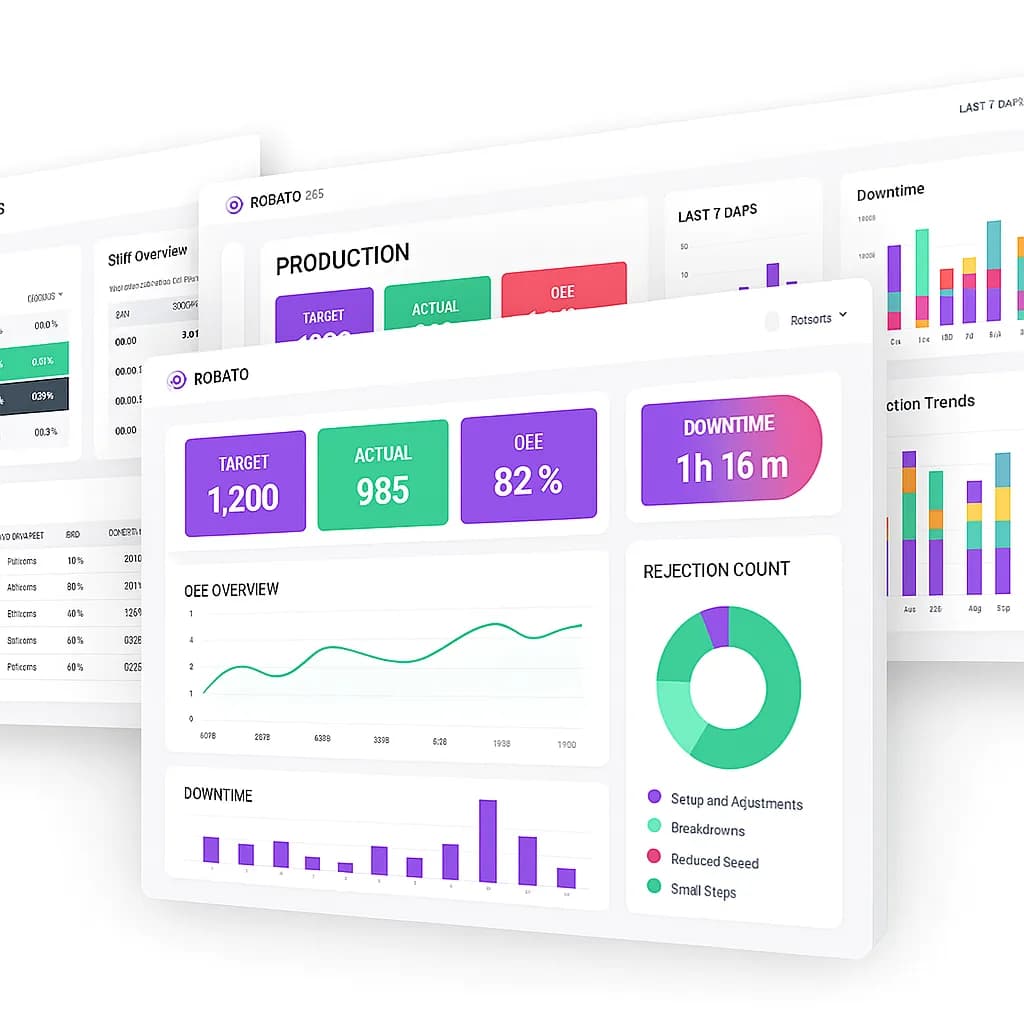
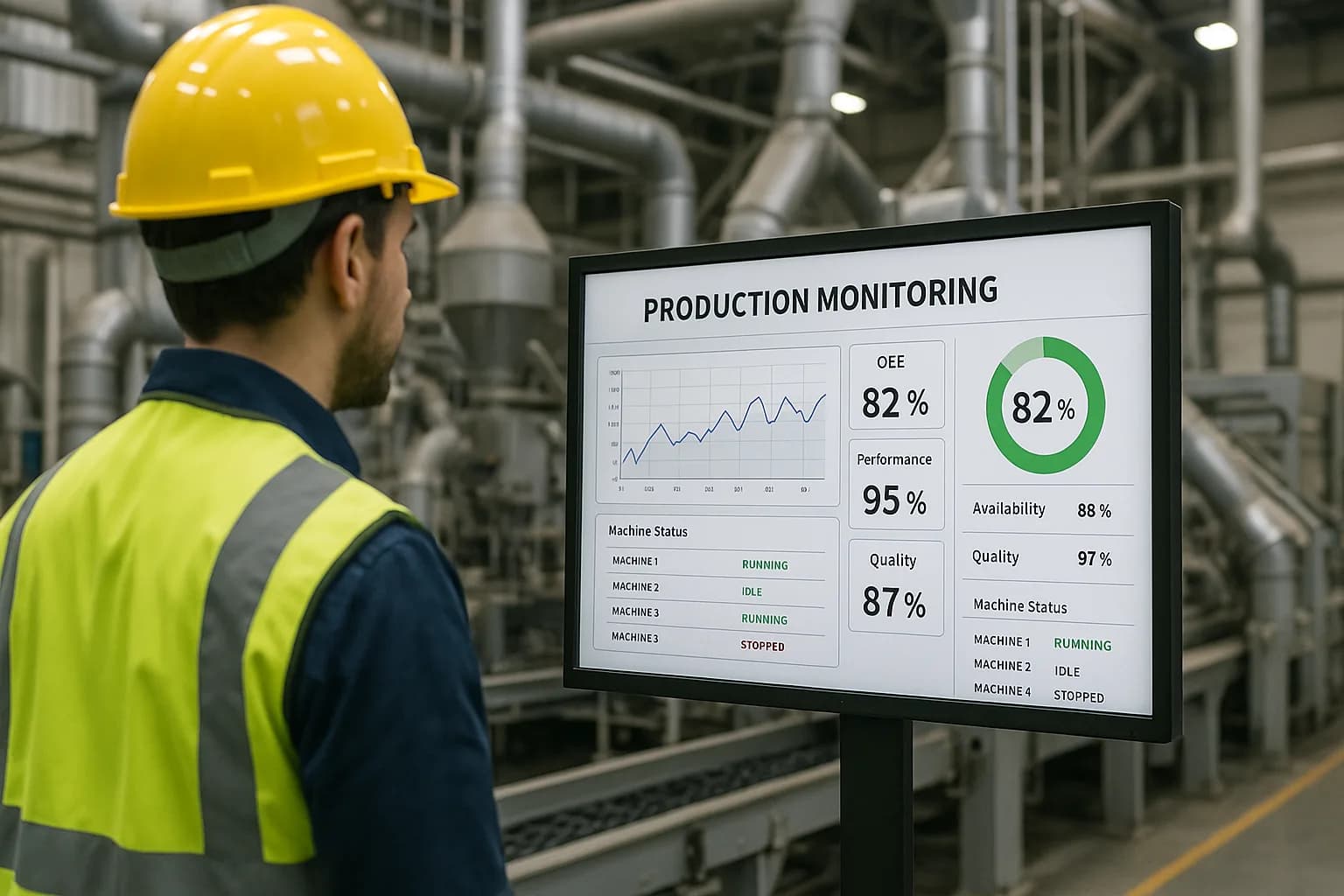
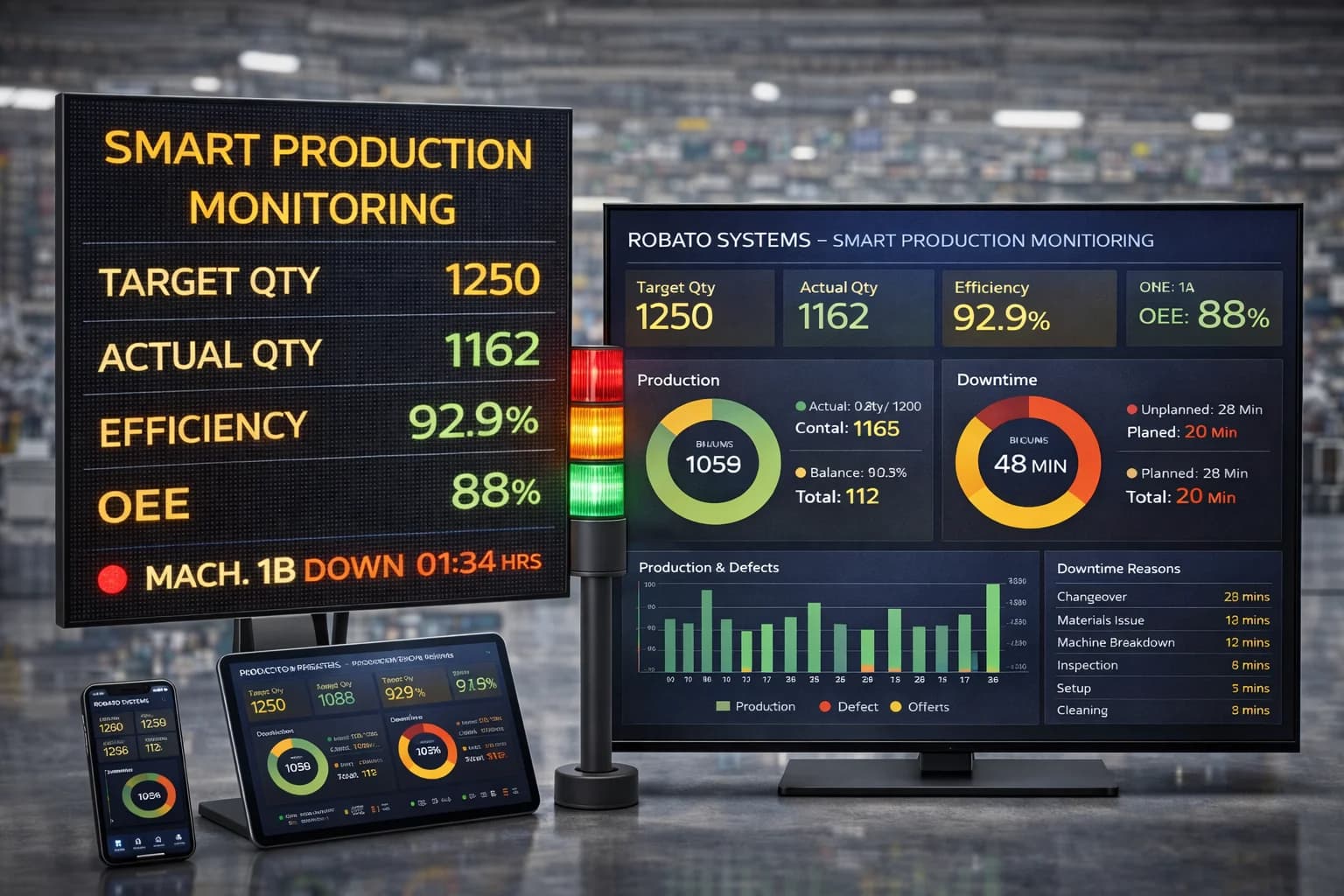
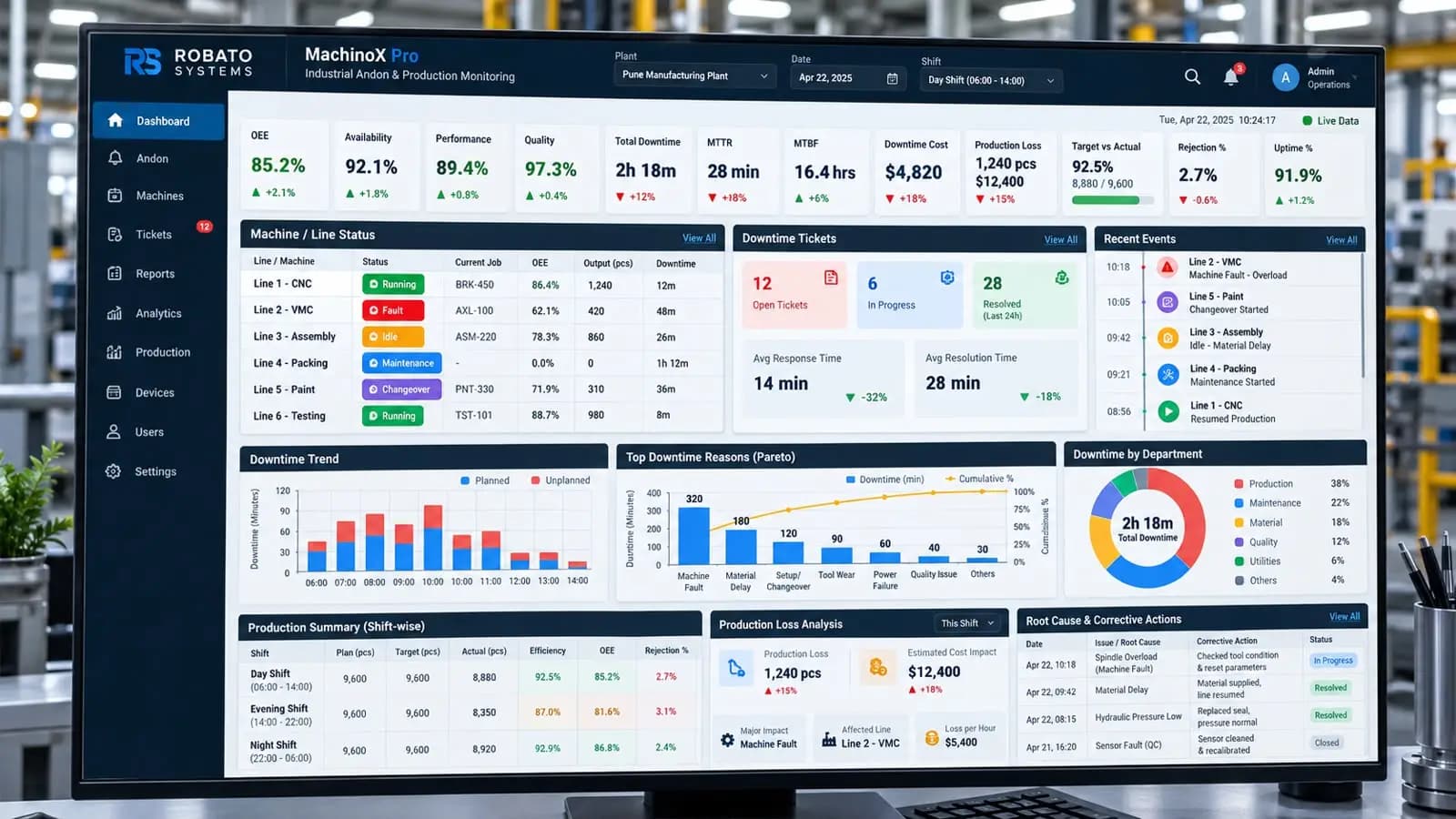
Downtime Analysis Dashboard
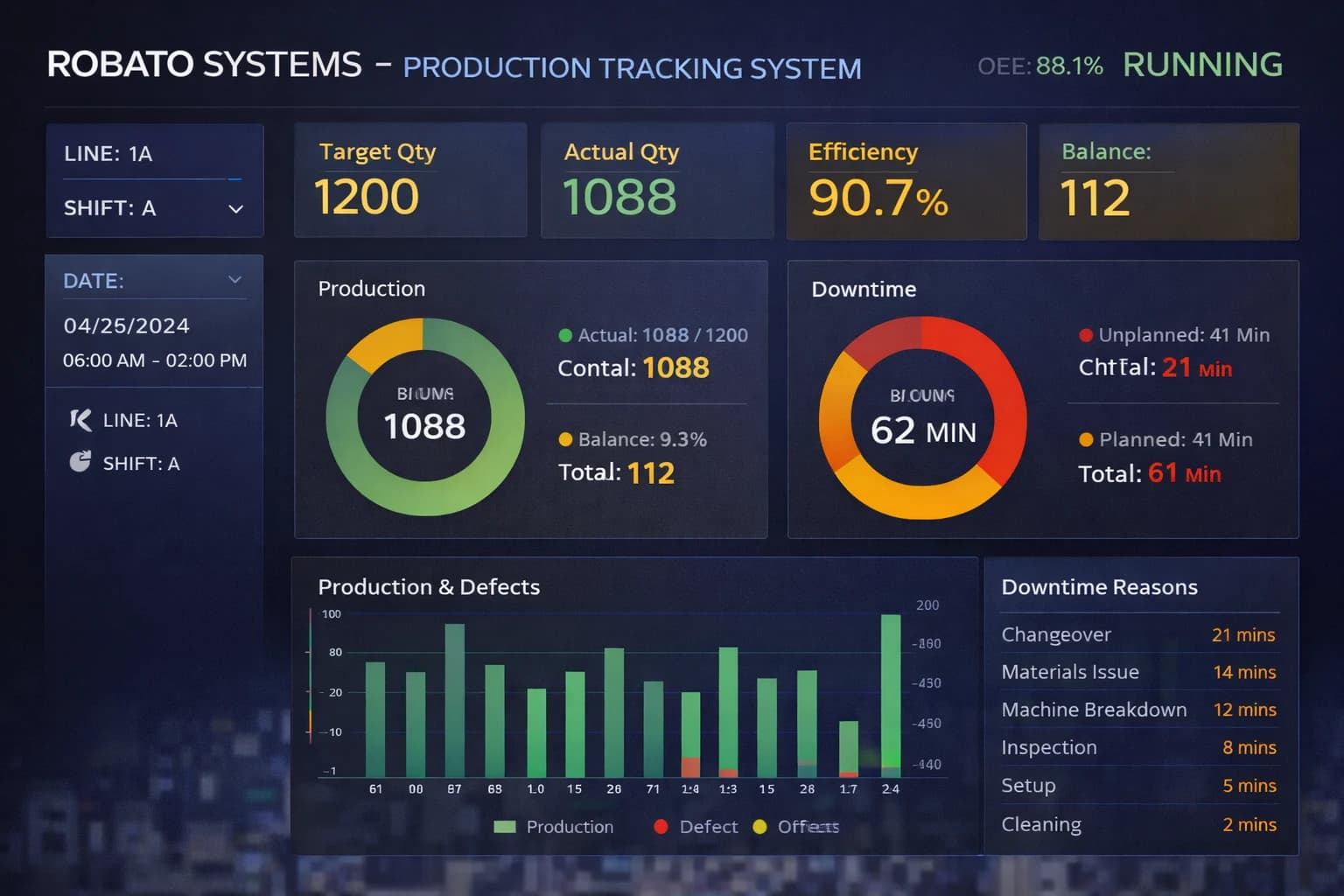
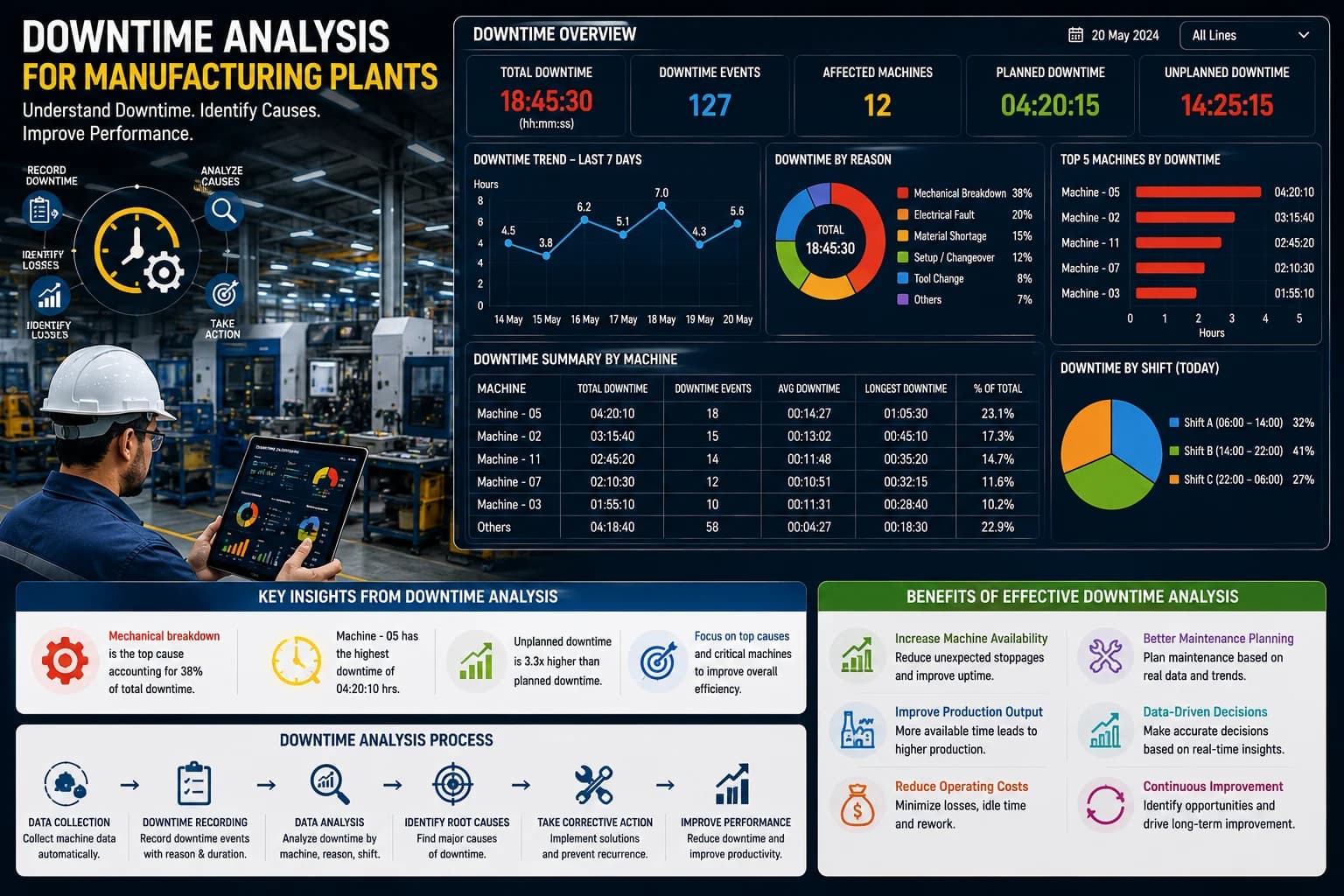
A downtime analysis dashboard can provide production and maintenance teams with a centralized view of equipment losses.
Important dashboard metrics can include:
- Total downtime
- Active downtime
- Downtime by machine
- Downtime by reason
- Downtime by shift
- Number of breakdowns
- Average downtime
- Longest downtime
- Production losses
Visual dashboards can make large amounts of production information easier to understand.
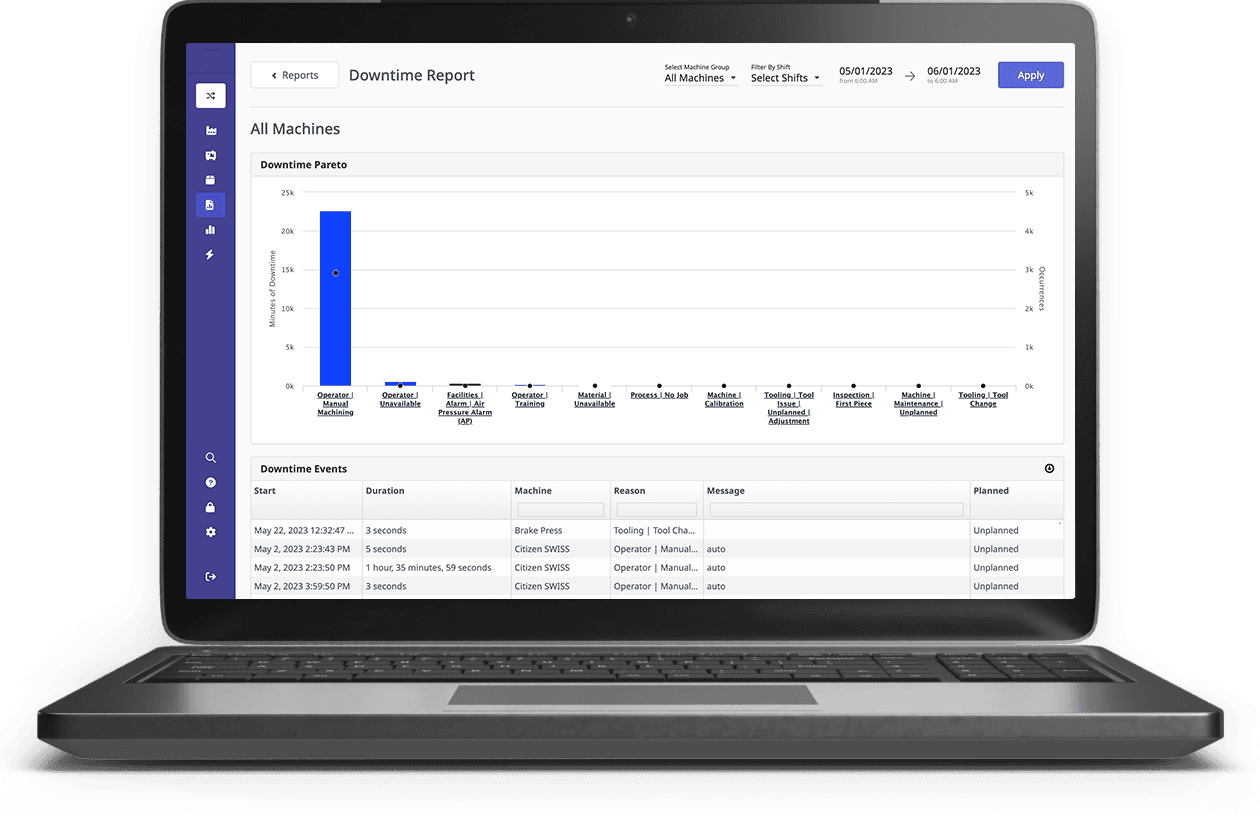
Downtime Pareto Analysis
A Pareto-style analysis can help manufacturers identify the downtime reasons responsible for the largest losses.
For example, a plant may discover that a small number of downtime causes account for a large percentage of total downtime.
Teams can then prioritize these causes instead of trying to solve every downtime problem at the same time.
This can make improvement programs more focused.
Downtime Analysis for Maintenance Teams
Maintenance teams can use downtime data to identify equipment reliability problems.
They can investigate:
- Frequent breakdowns
- Repeated failure types
- Long repair times
- Recurring maintenance problems
- High-downtime machines
This information can support preventive and predictive maintenance strategies.
Downtime Analysis for Production Managers
Production managers can use downtime information to understand production interruptions.
They can monitor:
- Current downtime
- Historical downtime
- Machine performance
- Production losses
- Production targets
- Shift performance
This helps production managers prioritize operational problems.
Downtime Analysis for Plant Managers
Plant managers can use downtime analysis to compare production areas and identify major sources of equipment loss.
The information can help with decisions related to:
- Maintenance priorities
- Equipment improvements
- Production planning
- Process improvements
- Machine replacement
- Resource allocation
Manual Downtime Analysis
Many factories still use spreadsheets or paper records for downtime analysis.
These methods can provide basic information, but they can also create several challenges.
Common limitations include:
- Delayed data
- Manual errors
- Missing downtime events
- Inconsistent downtime reasons
- Time-consuming report preparation
- Difficult historical comparisons
Digital downtime monitoring can help automate much of this process.
Automated Downtime Analysis
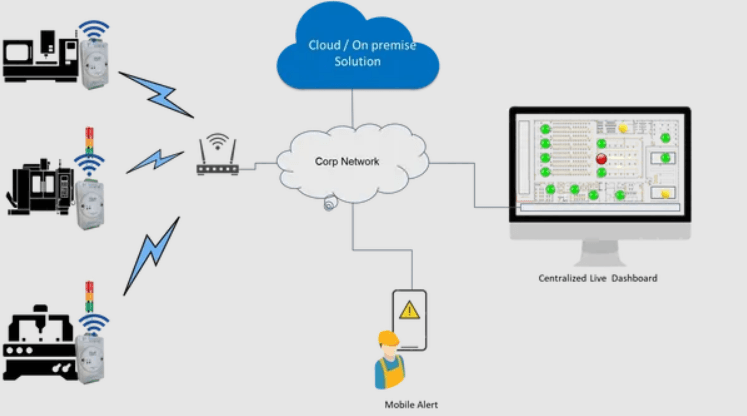
Automated downtime monitoring systems can collect machine status information directly from production equipment.
Data can be collected using:
- PLCs
- Sensors
- Machine controllers
- Industrial IoT devices
- Production counters
- Industrial gateways
The collected information can then be analyzed automatically.
This can provide faster and more consistent downtime information.
Benefits of Downtime Analysis
Identifies Major Production Losses
Downtime analysis helps identify where the largest amounts of production time are being lost.
Improves Maintenance Planning
Historical downtime information helps maintenance teams prioritize equipment that experiences repeated failures.
Reduces Response Time
Real-time monitoring can help teams identify active machine stoppages faster.
Improves Machine Availability
Understanding downtime causes can help manufacturers develop strategies to reduce unnecessary stoppages.
Supports Better Decision-Making
Accurate downtime information provides managers with data for production and maintenance decisions.
Supports Continuous Improvement
Downtime trends can be used to measure whether improvement activities are reducing equipment losses.
Best Practices for Downtime Analysis
Collect Accurate Data
Downtime analysis is only useful when the underlying data is reliable.
Standardize Downtime Reasons
Use consistent categories across machines and production lines.
Monitor in Real Time
Real-time monitoring provides faster visibility into active downtime.
Analyze Historical Trends
Review downtime over longer periods to identify recurring problems.
Focus on Major Losses
Prioritize downtime causes that have the greatest production impact.
Connect Downtime with OEE
Combining downtime and OEE provides better visibility into equipment performance.
Take Corrective Action
Downtime analysis should always lead to investigation and improvement activities.
How to Implement Downtime Analysis
Manufacturers can follow a structured implementation process.
Step 1: Identify Critical Equipment
Start with machines that have a major effect on production.
Step 2: Collect Machine Data
Connect machines through suitable sensors, PLCs, gateways, or Industrial IoT devices.
Step 3: Define Downtime Categories
Create clear and standardized downtime reasons.
Step 4: Monitor Downtime
Track machine stoppages and record their duration.
Step 5: Analyze the Data
Review downtime by machine, reason, shift, production line, and time period.
Step 6: Identify Major Causes
Determine which downtime causes contribute most to production losses.
Step 7: Implement Improvements
Take corrective action and continue monitoring the results.
Downtime Analysis and Industry 4.0
Industry 4.0 technologies allow manufacturing companies to connect machines and collect production information digitally.
Downtime analysis can become part of a connected manufacturing environment.
Machines can provide information through sensors, PLCs, and Industrial IoT devices.
The information can then be processed and displayed through digital production dashboards.
This provides manufacturers with better visibility into equipment performance.
Downtime Analysis for Legacy Machines
Older machines may not have modern communication interfaces.
However, manufacturers can often integrate legacy equipment using:
- Sensors
- PLC signals
- Industrial gateways
- IoT devices
This allows older equipment to participate in digital downtime monitoring and analysis.
Why Choose Robato Systems?
Robato Systems provides manufacturing monitoring solutions designed to improve machine and production visibility.
The solution can connect with machines, PLCs, sensors, production counters, and Industrial IoT devices.
Manufacturers can monitor:
- Machine status
- Downtime
- Production output
- OEE
- Availability
- Performance
- Quality
- Machine utilization
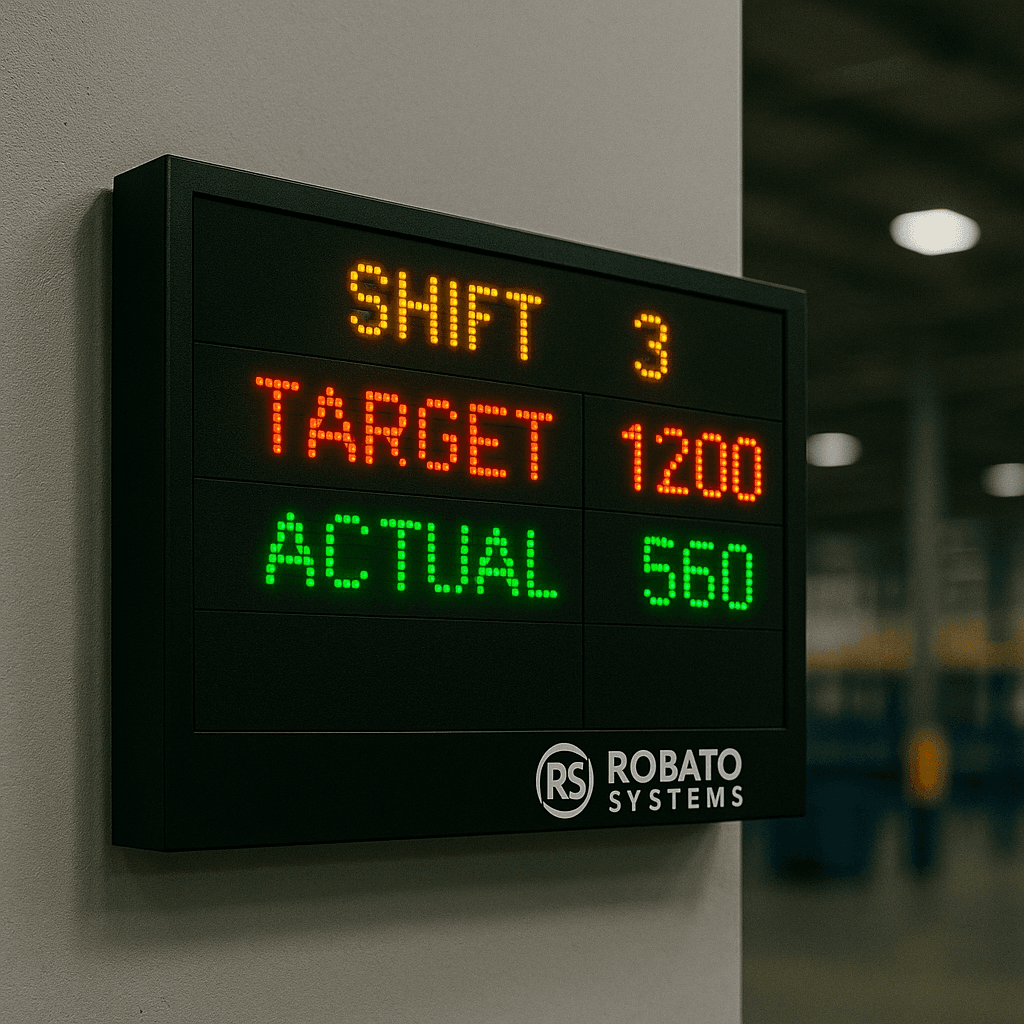
- Production targets
- Actual production
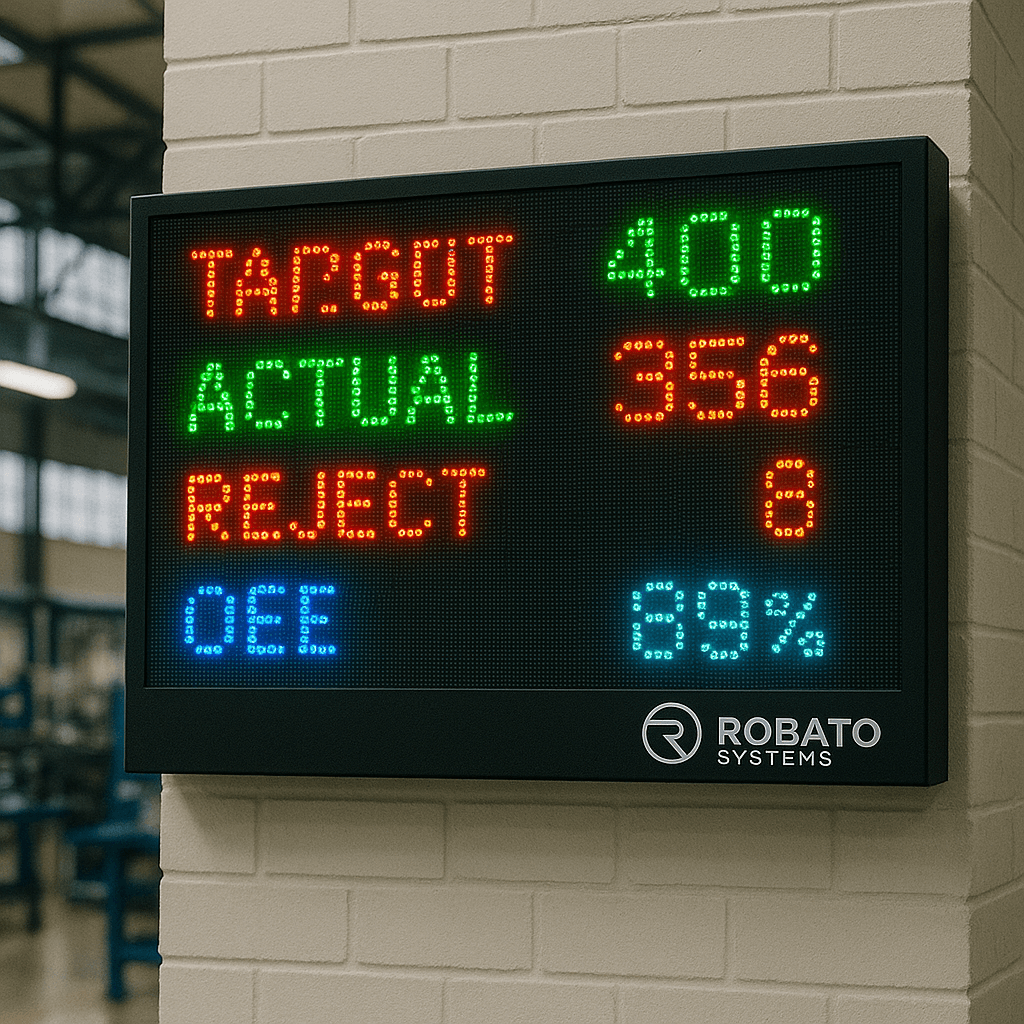
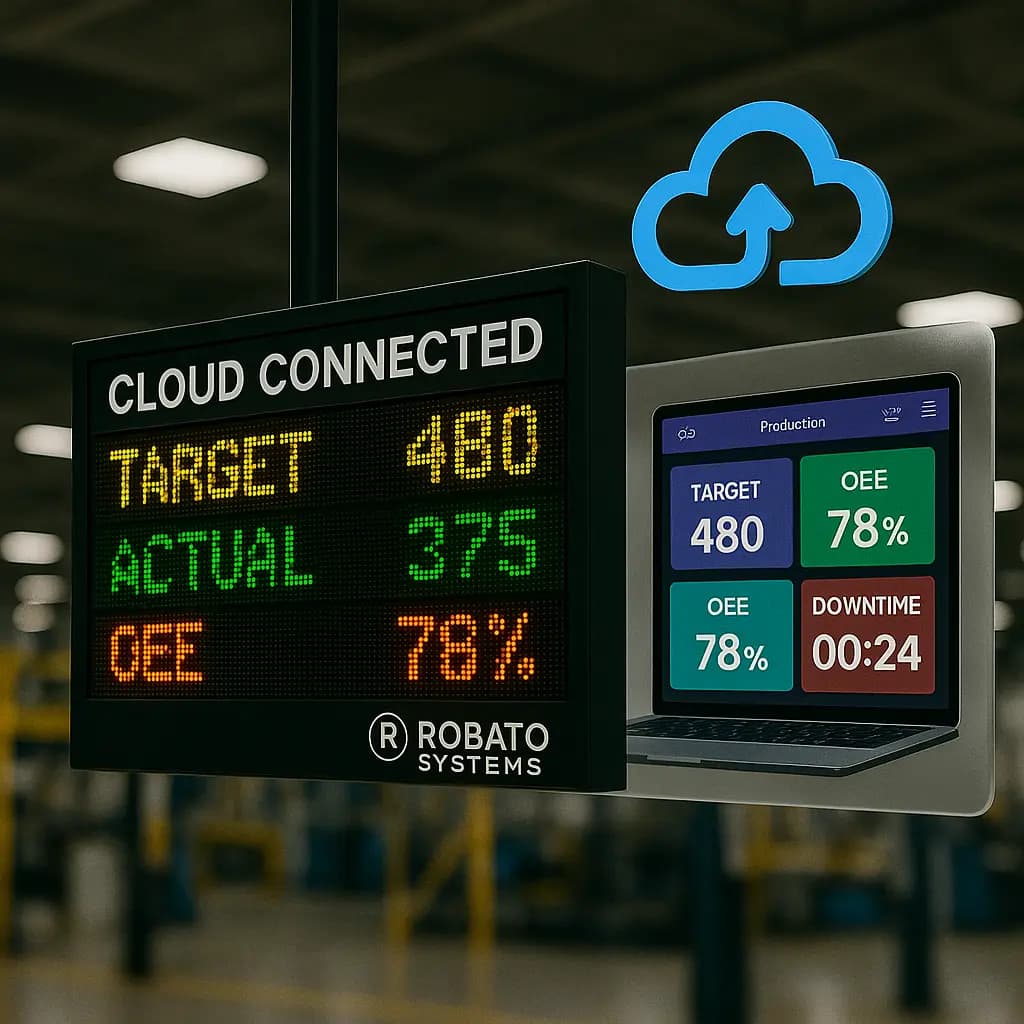
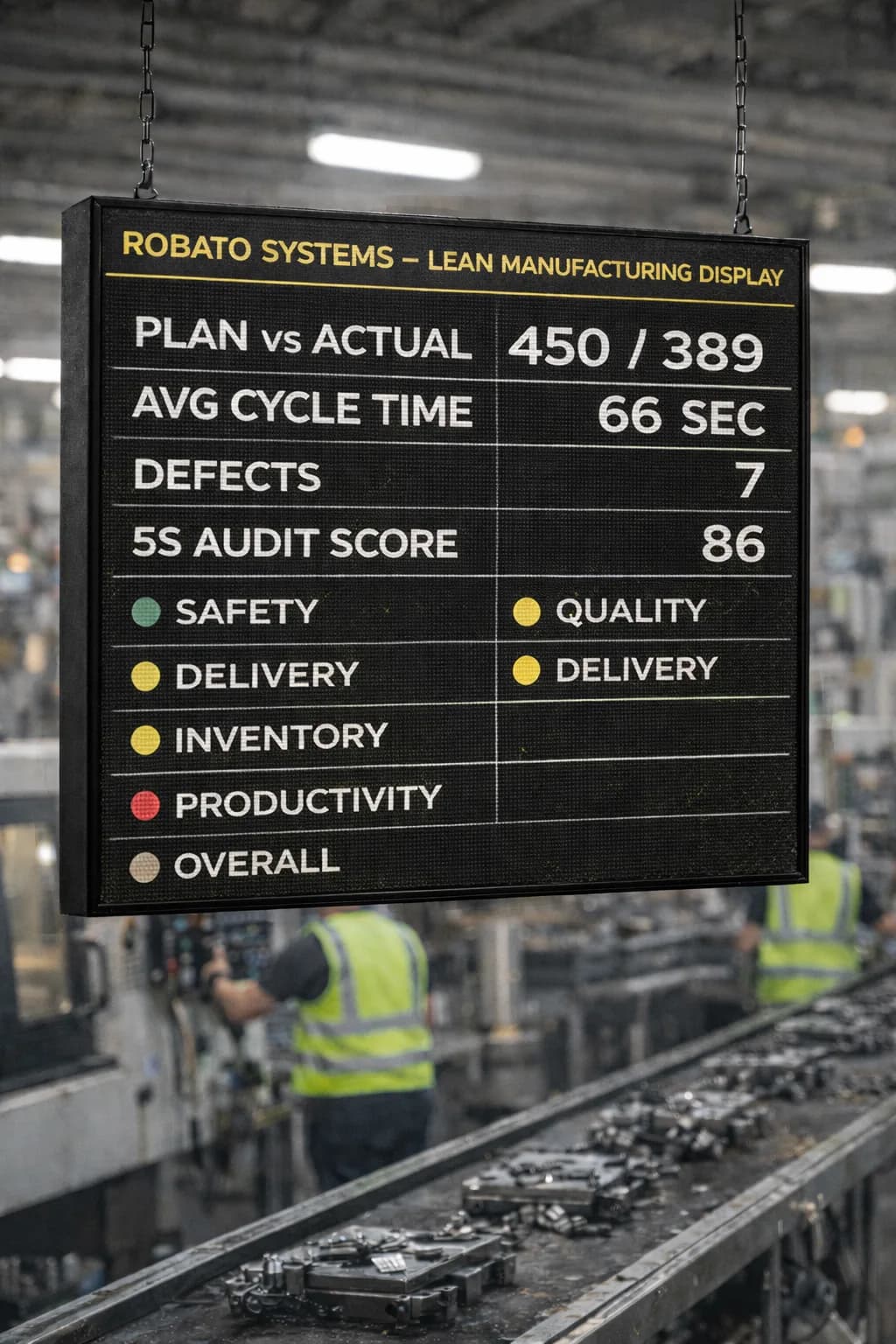
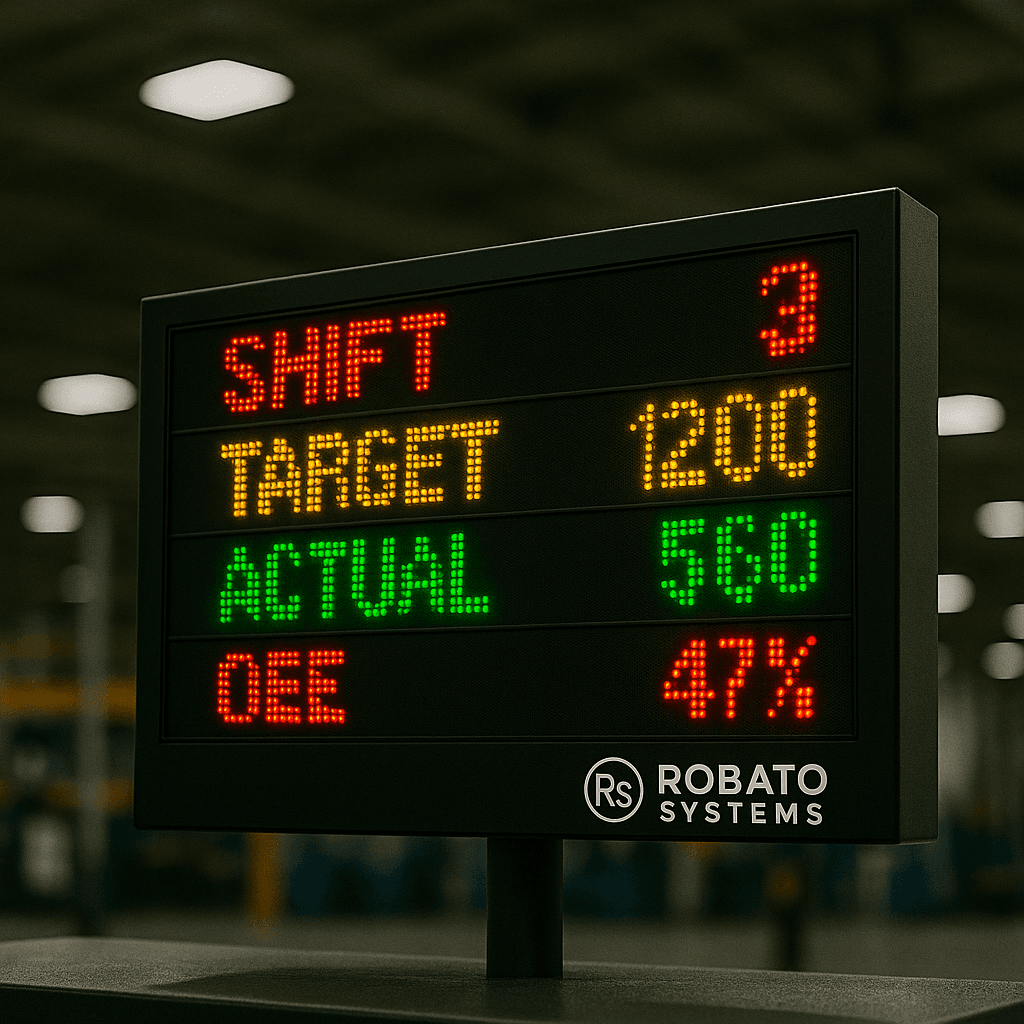
Real-time dashboards can help production and maintenance teams analyze downtime and identify opportunities for improvement.
Conclusion
Downtime Analysis provides manufacturers with a structured method for understanding machine stoppages and production losses.
By analyzing downtime by machine, reason, shift, production line, frequency, and duration, manufacturers can identify recurring problems and prioritize improvement activities.
Real-time monitoring provides immediate visibility into active downtime, while historical analysis helps identify long-term trends.
When combined with OEE monitoring, production data, maintenance planning, and continuous improvement, downtime analysis can help manufacturers improve equipment availability and production efficiency.
Frequently Asked Questions
What is Downtime Analysis?
Downtime Analysis is the process of studying machine stoppages to understand their frequency, duration, causes, and impact on production.
Why is downtime analysis important?
It helps manufacturers identify major production losses and recurring equipment problems.
What should be included in downtime analysis?
Important information includes machine, downtime duration, downtime reason, number of events, shift, production line, and date.
Can downtime analysis be automated?
Yes. Downtime monitoring software can collect machine status information automatically using PLCs, sensors, and Industrial IoT devices.
How does downtime analysis help maintenance teams?
It helps maintenance teams identify machines with frequent failures and recurring downtime causes.
How does downtime affect OEE?
Downtime reduces machine availability, which directly affects the availability component of OEE.
Can older machines be included in downtime analysis?
Yes. Legacy equipment can often be connected using sensors, PLC signals, industrial gateways, or IoT devices.