Machine downtime is one of the biggest challenges faced by manufacturing plants. A machine may stop because of a mechanical failure, electrical problem, material shortage, tooling issue, quality problem, or another operational reason.
Repairing the machine and restarting production solves the immediate problem, but it does not necessarily solve the underlying cause.
If the same machine fails again a few days later, the maintenance team may be spending time repeatedly fixing the symptom instead of eliminating the source of the problem.
This is why root cause analysis in manufacturing is so important.
Root cause analysis helps production and maintenance teams move beyond the question of "What happened?" and investigate why it happened.
When combined with accurate downtime tracking and machine monitoring, root cause analysis can help manufacturers reduce repeated downtime, improve equipment reliability, and increase production efficiency.
What Is Root Cause Analysis in Manufacturing?
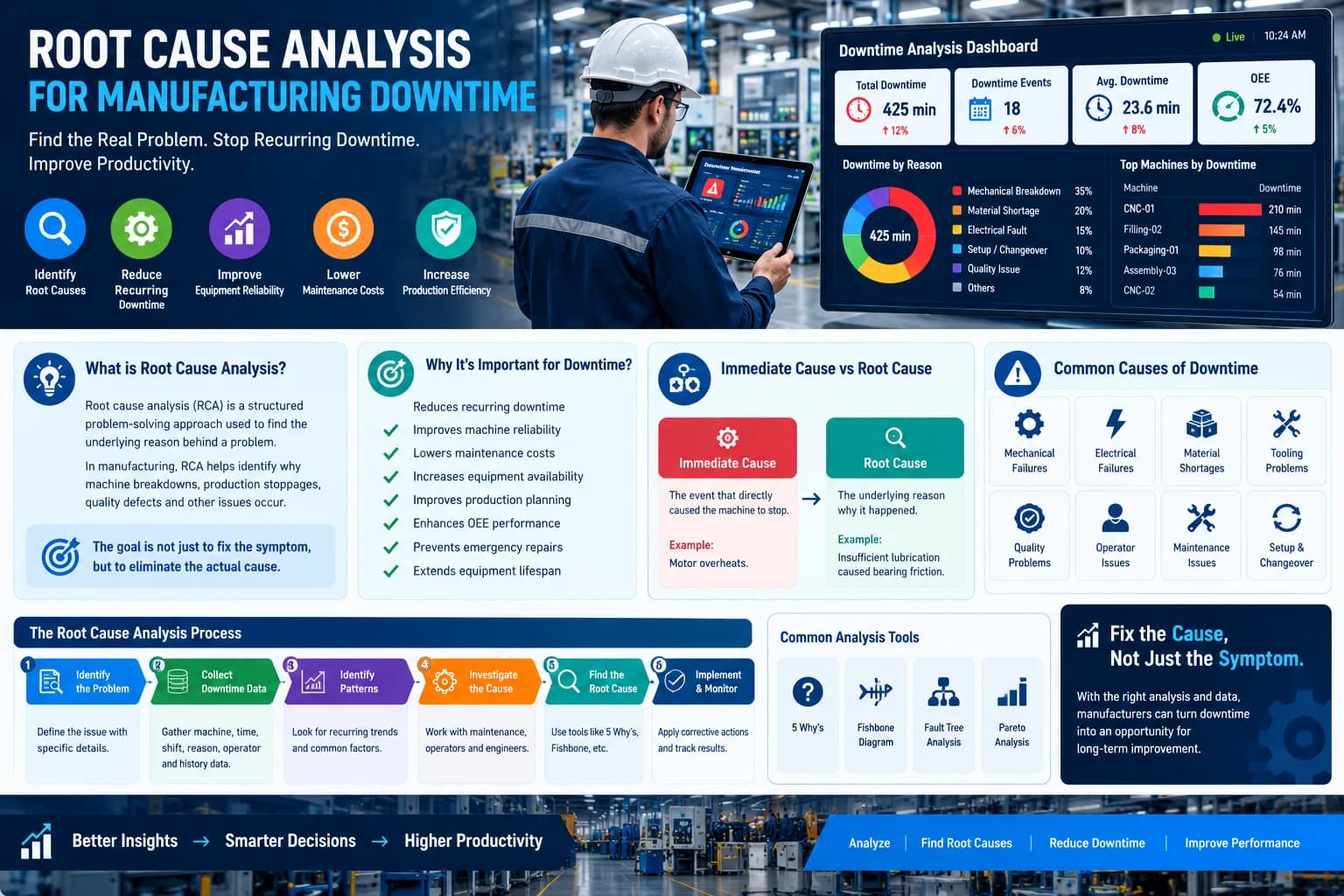
Root cause analysis, commonly called RCA, is a structured problem-solving approach used to identify the underlying reason behind a problem.
In manufacturing, RCA can be used for:
- Machine breakdowns
- Production stoppages
- Quality defects
- Equipment failures
- Material-related delays
- Repeated downtime
- Process problems
- Safety incidents
- Production losses
The objective is to identify the root cause rather than repeatedly addressing the immediate symptom.
For example:
Machine stops
→ Motor overheats
→ Bearing becomes damaged
→ Lubrication is inadequate
→ Lubrication inspection is not being performed according to schedule
The visible problem is the motor stopping.
The deeper problem may be an ineffective maintenance process.
Why Is Root Cause Analysis Important for Downtime?
Repeated downtime can become expensive for manufacturers.
Suppose a machine experiences the same failure every week.
Each time:
- Production stops.
- Maintenance is called.
- The machine is repaired.
- Production resumes.
- The same failure occurs again.
This creates a cycle of reactive maintenance.
Root cause analysis attempts to break that cycle.
Instead of repeatedly repairing the machine, the team investigates why the failure keeps occurring.
This can help:
- Reduce recurring downtime
- Improve machine reliability
- Reduce maintenance costs
- Improve production availability
- Reduce emergency repairs
- Improve preventive maintenance
- Increase equipment lifespan
- Improve production planning
Root Cause vs Immediate Cause
Understanding the difference between an immediate cause and a root cause is essential.
Immediate Cause
The immediate cause is the event that directly caused the machine to stop.
For example:
Machine stopped because the motor overheated.
Root Cause
The root cause explains why the motor repeatedly overheated.
For example:
Insufficient lubrication caused excessive bearing friction, which resulted in motor overheating.
The immediate cause tells you what happened.
The root cause helps explain why it happened.
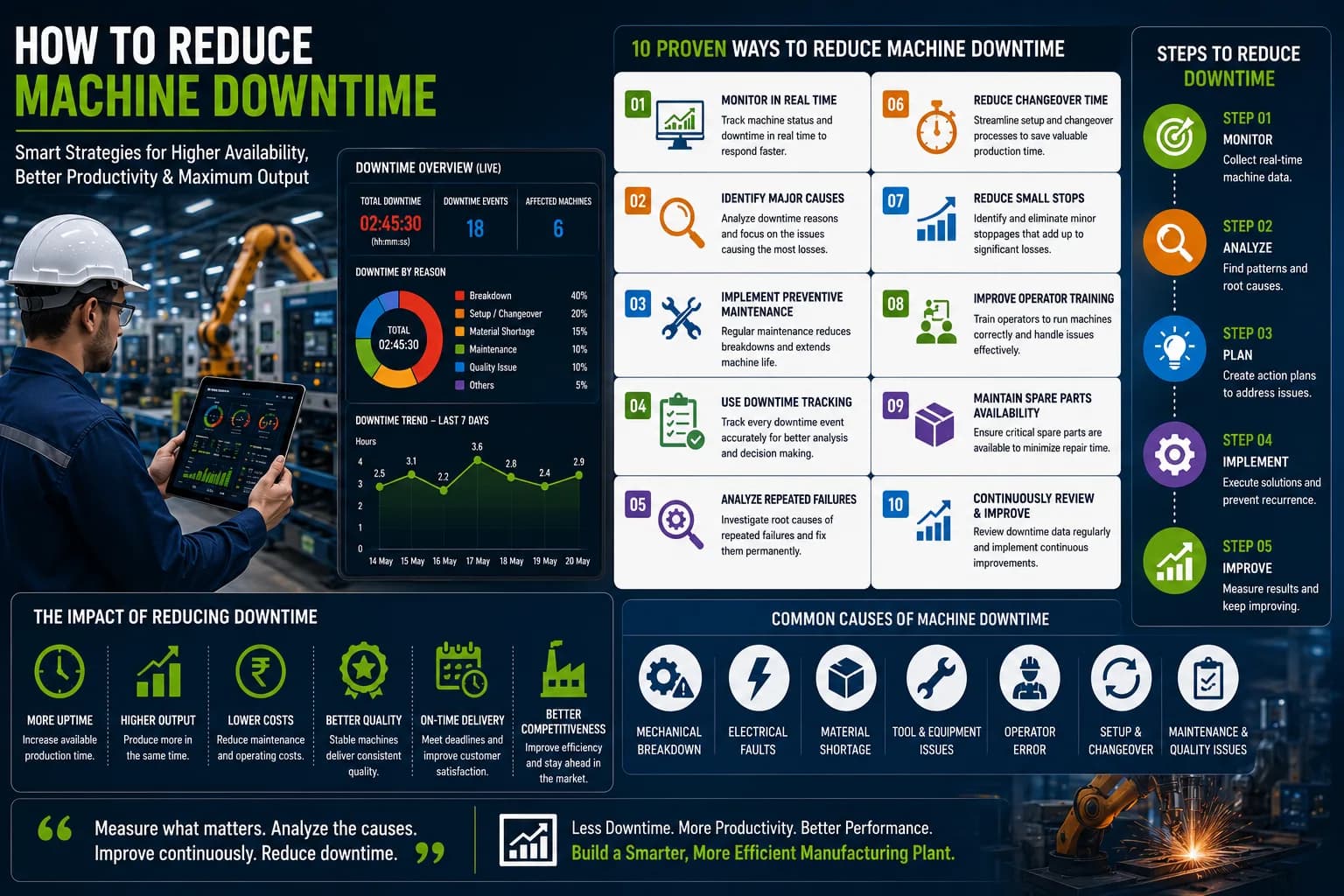
Common Causes of Manufacturing Downtime
Manufacturing downtime can originate from many different areas.
Mechanical Failures
Examples include:
- Bearing failure
- Belt failure
- Gear damage
- Motor problems
- Hydraulic issues
- Pneumatic failures
- Shaft damage
Electrical Failures
Examples include:
- Power supply problems
- Wiring issues
- Motor faults
- Electrical component failure
- Control panel problems
Material Shortages
Machines may remain idle because required materials are not available.
Examples include:
- Raw material shortage
- Incorrect material
- Delayed material delivery
- Material handling problems
Tooling Problems
Examples include:
- Broken tools
- Worn tools
- Incorrect tool setup
- Tool replacement delays
Quality Problems
Production may stop because:
- Defective components are detected
- Process parameters are incorrect
- Quality inspection fails
- Rework is required
Operator-Related Issues
Examples include:
- Insufficient training
- Incorrect machine operation
- Operator unavailability
- Incorrect setup procedures
Maintenance Issues
Examples include:
- Delayed preventive maintenance
- Incorrect repair
- Lack of spare parts
- Poor maintenance procedures
The Root Cause Analysis Process
A structured RCA process can be divided into several stages.
Step 1: Identify the Problem
Clearly define what happened.
Instead of:
Machine has problems
use:
Machine 04 stopped six times during the last production shift, resulting in 85 minutes of downtime.
A specific problem statement makes analysis easier.
Step 2: Collect Downtime Data
Gather information about the event.
Important data may include:
- Machine
- Date
- Time
- Shift
- Downtime duration
- Downtime reason
- Production order
- Operator
- Maintenance activity
- Previous failure history
Accurate historical data is particularly valuable when investigating repeated failures.
Step 3: Identify Patterns
Look for recurring patterns.
Ask:
- Does the same machine fail repeatedly?
- Does the problem occur during a particular shift?
- Does it happen after a certain number of operating hours?
- Does it occur with a specific product?
- Is the problem related to a particular component?
- Does the failure happen after changeover?
Patterns can provide important clues.
Step 4: Investigate the Cause
Once a pattern has been identified, investigate the possible causes.
Maintenance technicians, operators, engineers, and production supervisors can contribute information from their respective areas.
Step 5: Identify the Root Cause
The team should distinguish between symptoms, contributing factors, and the actual underlying cause.
This is where structured RCA techniques become useful.
Step 6: Implement Corrective Action
Once the root cause has been identified, define an action.
Examples include:
- Change maintenance frequency
- Replace a component
- Modify machine settings
- Improve operator training
- Change material handling
- Improve inspection procedures
- Maintain spare parts inventory
Step 7: Monitor the Result
After implementing the corrective action, continue tracking the machine.
The objective is to verify whether downtime actually decreases.
If the same problem continues, the root cause may not have been correctly identified.
The 5 Whys Method
The 5 Whys technique is one of the simplest root cause analysis methods used in manufacturing.
The approach is straightforward:
Ask "Why?" repeatedly until the underlying cause becomes clear.
Example
Problem: Production machine stopped.
Why 1: Why did the machine stop?
Because the motor overheated.
Why 2: Why did the motor overheat?
Because the bearing generated excessive friction.
Why 3: Why did the bearing generate excessive friction?
Because lubrication was insufficient.
Why 4: Why was lubrication insufficient?
Because the lubrication interval was not followed.
Why 5: Why was the lubrication interval not followed?
Because the maintenance schedule was not properly monitored.
The investigation has moved from a machine failure to a process-related maintenance problem.
Fishbone Diagram for Manufacturing RCA
Another popular RCA technique is the Fishbone Diagram, also known as an Ishikawa Diagram.
It organizes possible causes into categories.
Common manufacturing categories include:
- Man
- Machine
- Method
- Material
- Measurement
- Environment
For example, if a machine experiences frequent quality-related downtime, the team can investigate possible causes under each category.
Machine
- Worn component
- Incorrect machine setting
- Sensor problem
Method
- Incorrect operating procedure
- Inconsistent setup
Material
- Incorrect material
- Material variation
Man
- Operator training
- Incorrect operation
Measurement
- Incorrect calibration
- Sensor measurement problems
Environment
- Temperature
- Humidity
- Dust
- Vibration
This approach helps prevent teams from focusing on only one possible cause.
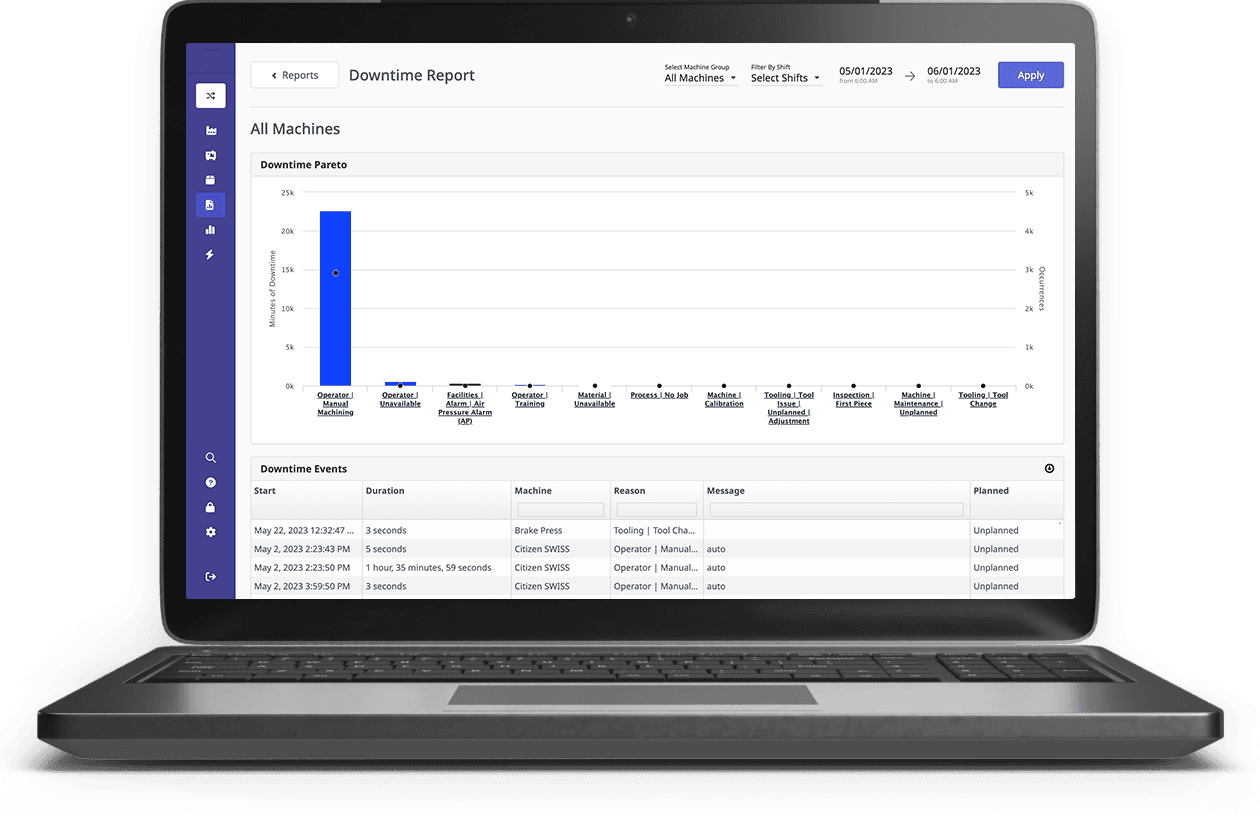
Pareto Analysis for Downtime Root Causes
Pareto analysis can help prioritize downtime causes.
Suppose a factory records the following downtime:
- Mechanical breakdown: 300 minutes
- Material shortage: 180 minutes
- Changeover: 100 minutes
- Quality issue: 70 minutes
- Operator issue: 40 minutes
The production team can prioritize the largest contributors first.
Instead of attempting to solve every issue simultaneously, improvement teams can focus on the causes creating the greatest production loss.
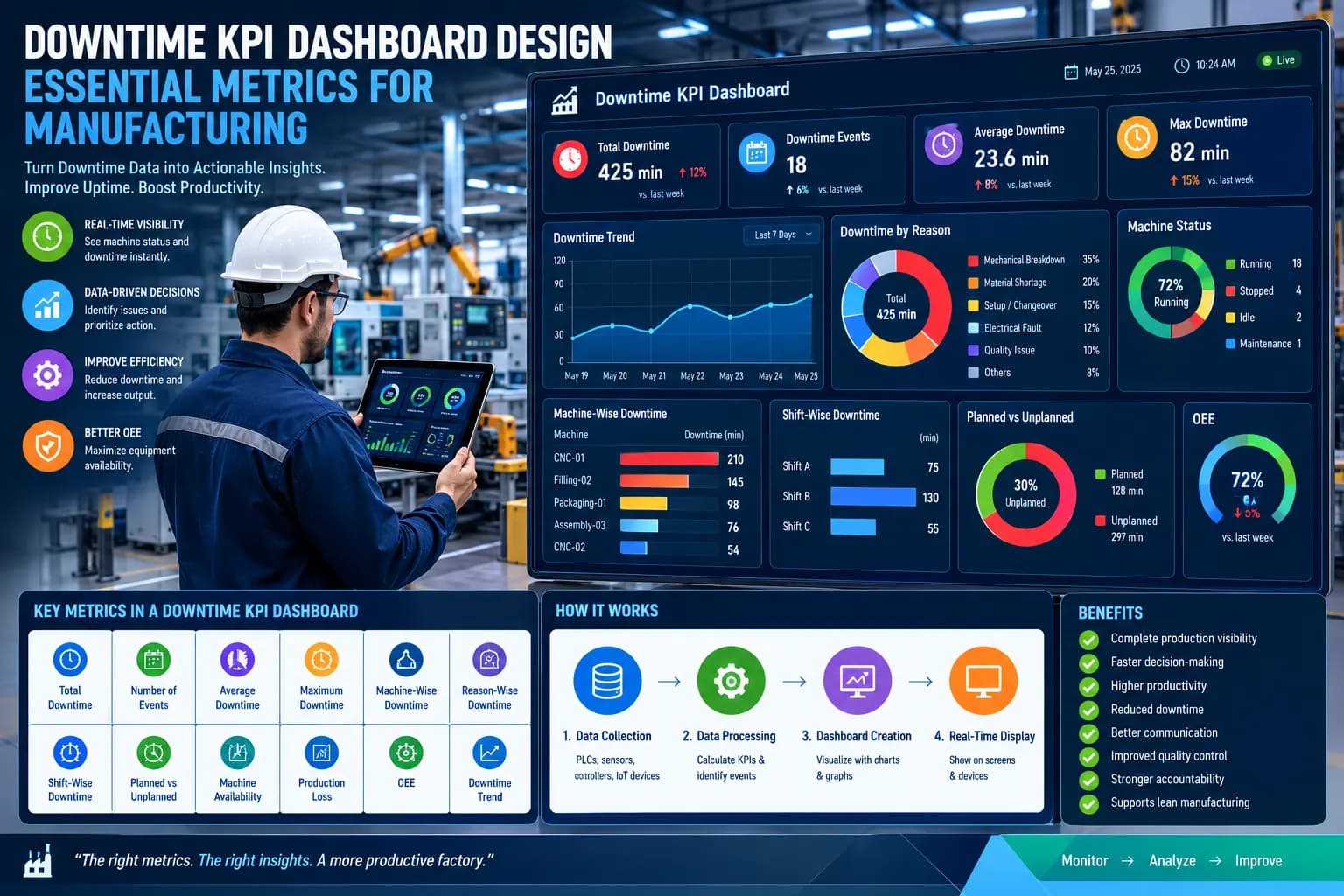
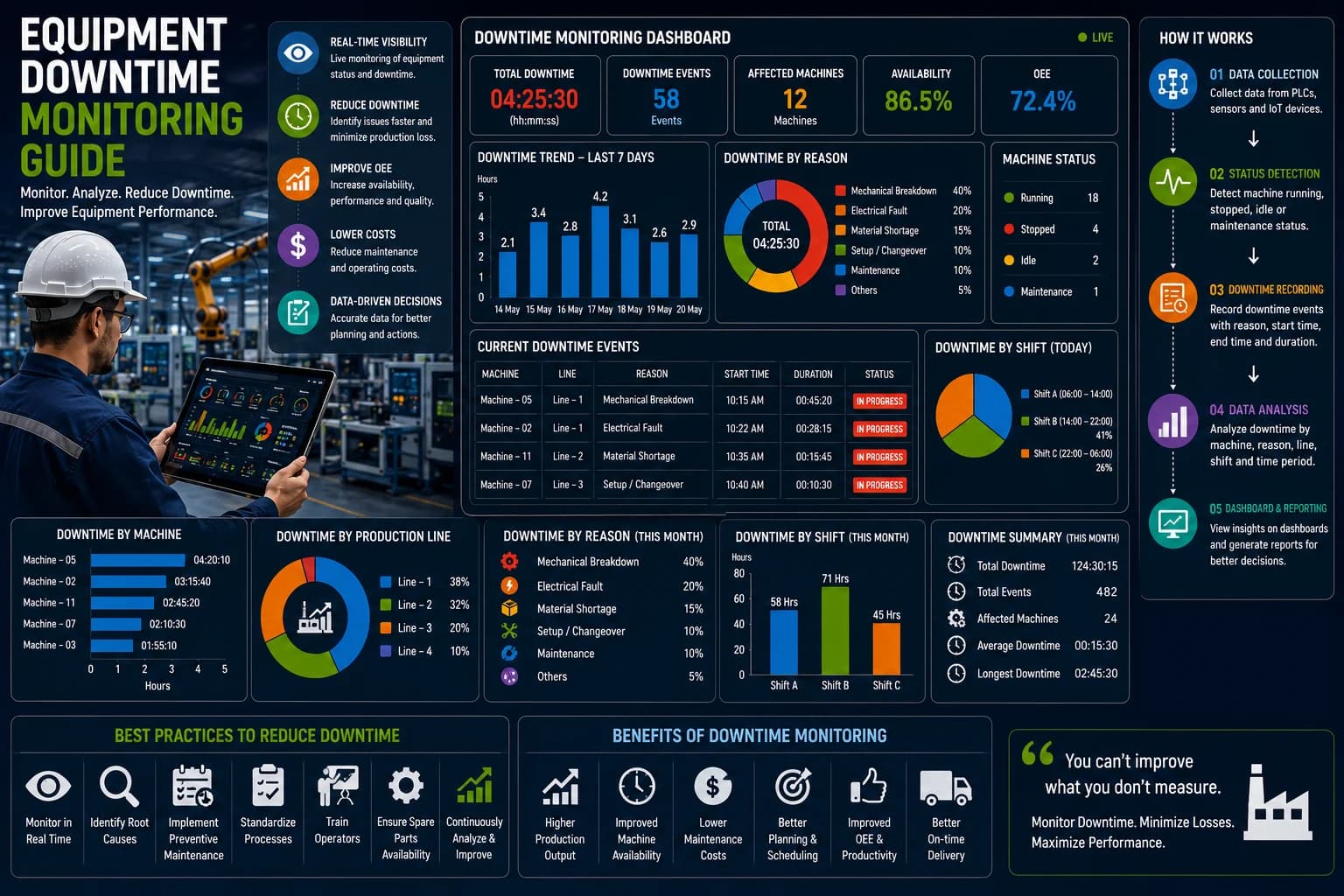
Using Downtime Data for Root Cause Analysis
Accurate downtime tracking makes RCA much more effective.
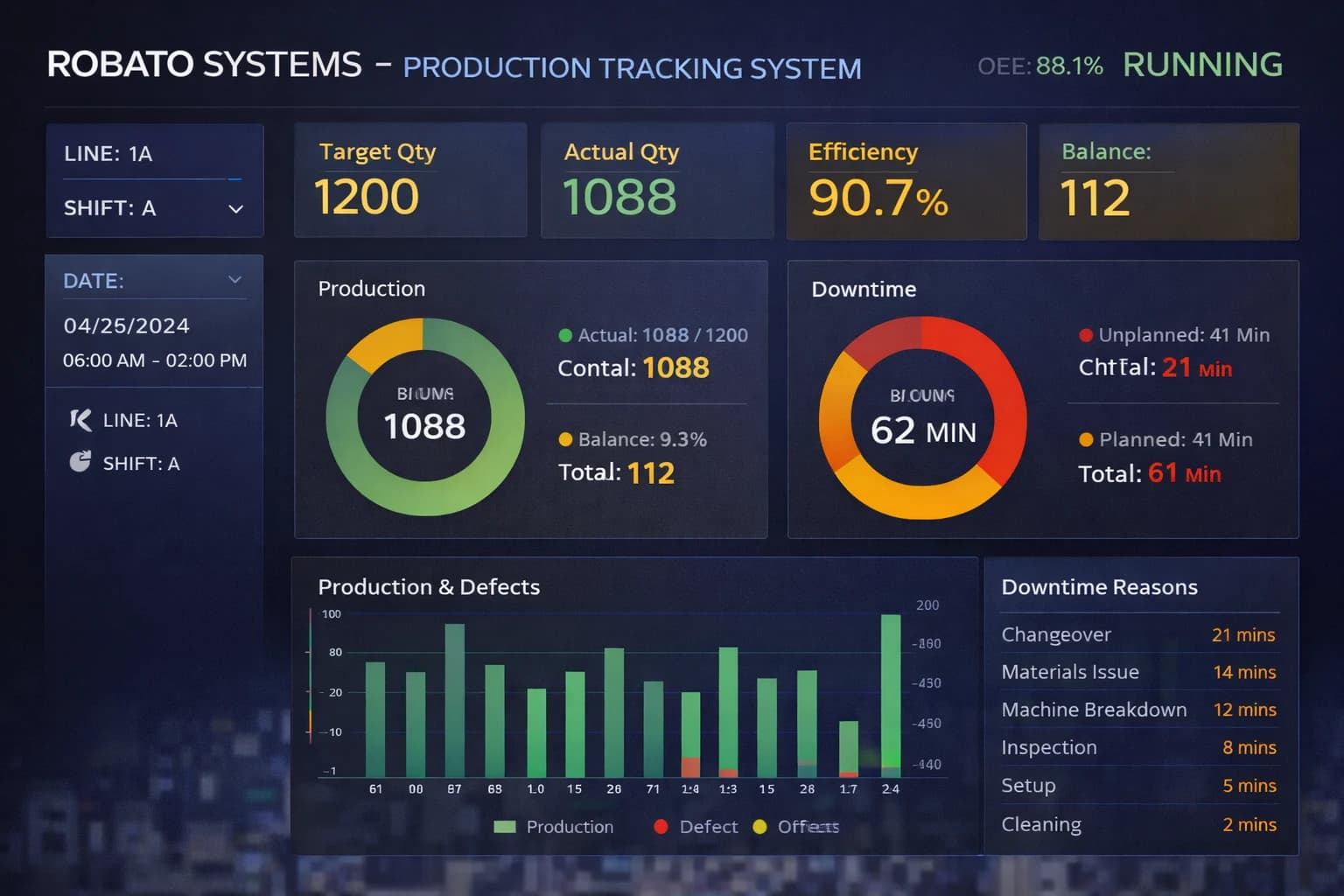
A downtime monitoring system can provide historical information such as:
- Machine-wise downtime
- Reason-wise downtime
- Frequency of failures
- Duration of failures
- Shift-wise downtime
- Downtime trends
- Repeated failure patterns
For example, a machine may appear to have only occasional breakdowns when viewed individually.
However, historical data may reveal that:
Machine B → 18 breakdowns → 420 minutes downtime → Same component involved in most events
This provides a strong reason for further investigation.
Machine-Wise Root Cause Analysis
Different machines may have completely different downtime patterns.
Consider:
Machine A
Primary problem: Electrical failure
Machine B
Primary problem: Material shortage
Machine C
Primary problem: Tool failure
Machine D
Primary problem: Mechanical breakdown
A plant-wide RCA approach should therefore be supported by machine-level information.
Machine-wise analysis helps maintenance and production teams prioritize the right equipment.
Repeated Downtime Analysis
Repeated downtime should receive special attention.
A single unexpected failure may be unavoidable.
Repeated failures, however, may indicate an unresolved underlying problem.
For example:
Monday: Bearing failure
Wednesday: Bearing failure
Friday: Bearing failure
This pattern suggests that simply replacing the bearing is not solving the underlying issue.
Possible root causes could include:
- Incorrect installation
- Misalignment
- Poor lubrication
- Excessive load
- Vibration
- Incorrect bearing specification
Downtime Duration vs Downtime Frequency
Both duration and frequency should be considered during RCA.
High Frequency, Low Duration
A machine may stop 20 times for three minutes each.
This creates frequent interruptions.
Low Frequency, High Duration
Another machine may stop twice for 90 minutes each.
This creates fewer but much longer interruptions.
Both situations can affect production, but they require different improvement strategies.
A downtime KPI dashboard should ideally provide both metrics.
Root Cause Analysis and Preventive Maintenance
RCA can improve preventive maintenance strategies.
If historical data shows that a particular component repeatedly fails before its scheduled maintenance interval, the maintenance strategy may need adjustment.
Possible actions include:
- Increasing inspection frequency
- Changing replacement intervals
- Adding condition checks
- Monitoring temperature
- Monitoring vibration
- Improving lubrication
- Maintaining critical spare parts
This changes maintenance from a purely reactive approach to a more proactive one.
Root Cause Analysis and Predictive Maintenance
RCA can also support predictive maintenance initiatives.
If sensor or machine data shows that a failure is preceded by certain conditions, manufacturers can investigate those conditions.
For example:
Increasing vibration
→ Bearing degradation
→ Machine failure
The organization can use this information to identify potential failure conditions before the machine reaches a critical state.
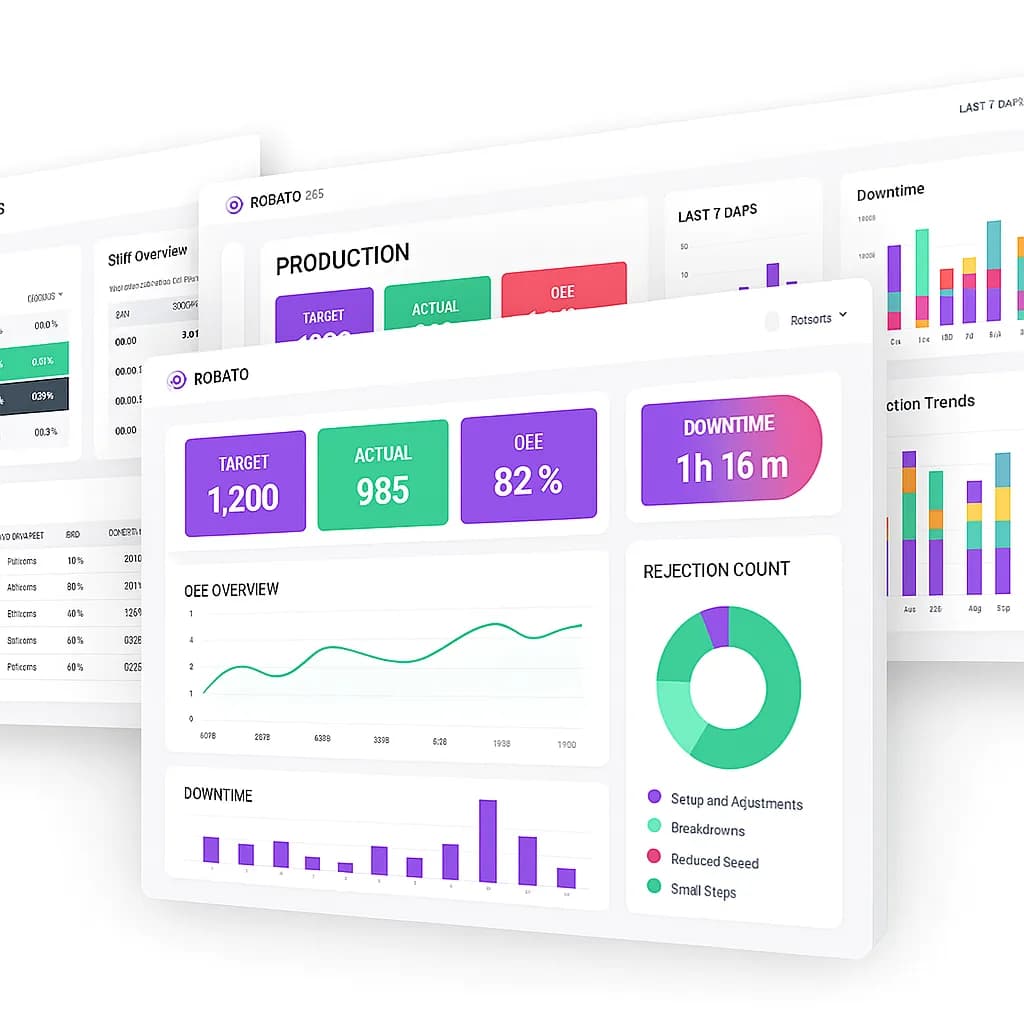
Root Cause Analysis Dashboard
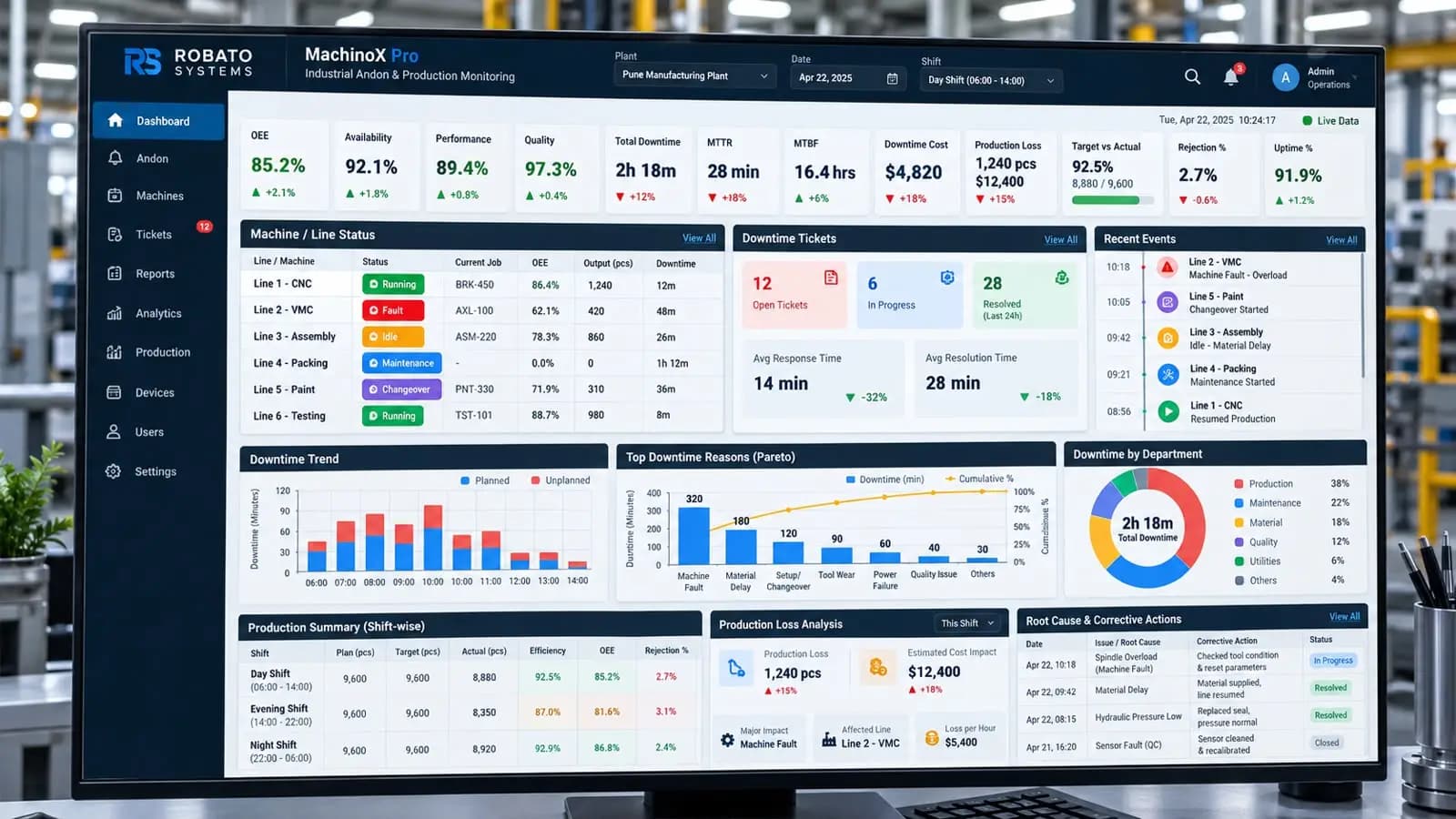
A digital RCA dashboard can help teams organize downtime investigations.
Useful information can include:
- Problem machine
- Downtime duration
- Failure frequency
- Downtime reason
- Root cause
- Corrective action
- Responsible team
- Action status
- Verification date
- Before-and-after downtime
This creates accountability and makes improvement activities easier to track.
Corrective Action vs Preventive Action
RCA should distinguish between corrective and preventive actions.
Corrective Action
Fixes the current problem.
Example:
Replace the failed bearing.
Preventive Action
Reduces the possibility of the problem happening again.
Example:
Introduce regular bearing inspection and lubrication monitoring.
Both are important, but preventive action is what helps prevent recurrence.
Measuring the Success of Root Cause Analysis
RCA should always be followed by measurement.
Useful metrics include:
Downtime Before RCA
320 minutes/month
Downtime After Corrective Action
95 minutes/month
This provides measurable evidence that the improvement worked.
Other useful metrics include:
- Failure frequency
- Mean time between failures
- Mean downtime
- Machine availability
- Production loss
- Maintenance response time
Common Mistakes in Manufacturing Root Cause Analysis
Stopping at the First Cause
Finding the immediate cause does not always mean the root cause has been identified.
Blaming the Operator
Operator error may sometimes be involved, but the team should investigate whether training, procedures, machine design, or workload contributed to the issue.
Using Poor Downtime Data
Incorrect or incomplete downtime information makes RCA unreliable.
Focusing Only on Major Breakdowns
Small recurring stoppages can create significant production losses over time.
Not Verifying Corrective Actions
An RCA is incomplete if the team never checks whether the implemented solution actually worked.
Failing to Document Findings
Root cause findings should be documented so future teams can learn from previous failures.
Best Practices for Root Cause Analysis in Manufacturing
Use Accurate Downtime Data
Automated machine monitoring can improve the quality of information available for analysis.
Standardize Downtime Reasons
Consistent categories make historical comparisons easier.
Involve Multiple Teams
Production, maintenance, quality, engineering, and operators may each have important information.
Prioritize High-Impact Problems
Focus on downtime events that create significant production losses.
Document Root Causes
Maintain a history of failures and corrective actions.
Measure Results
Always compare machine performance before and after corrective actions.
Focus on Prevention
The ultimate objective is to prevent repeated failures rather than repeatedly repairing the same problem.
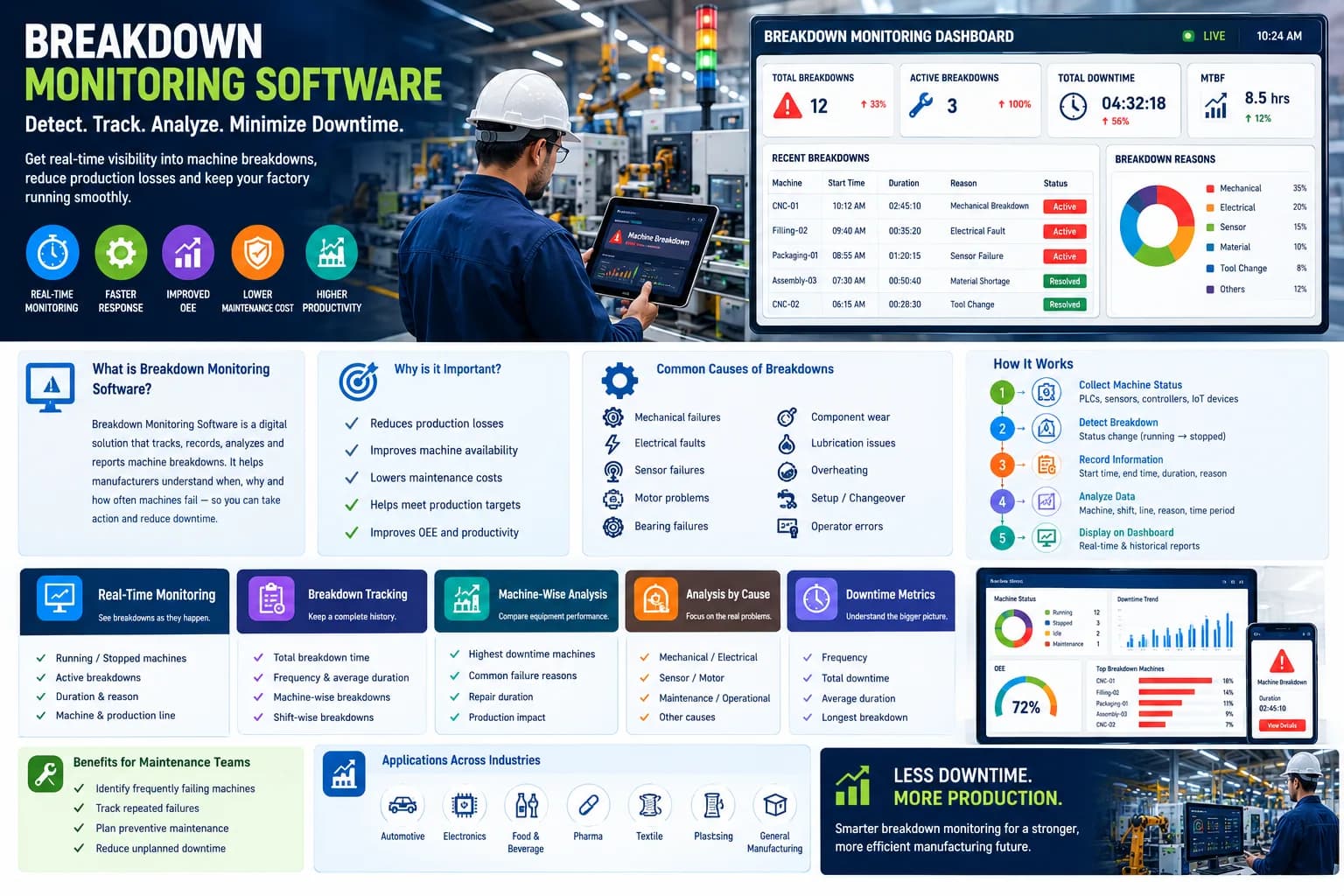
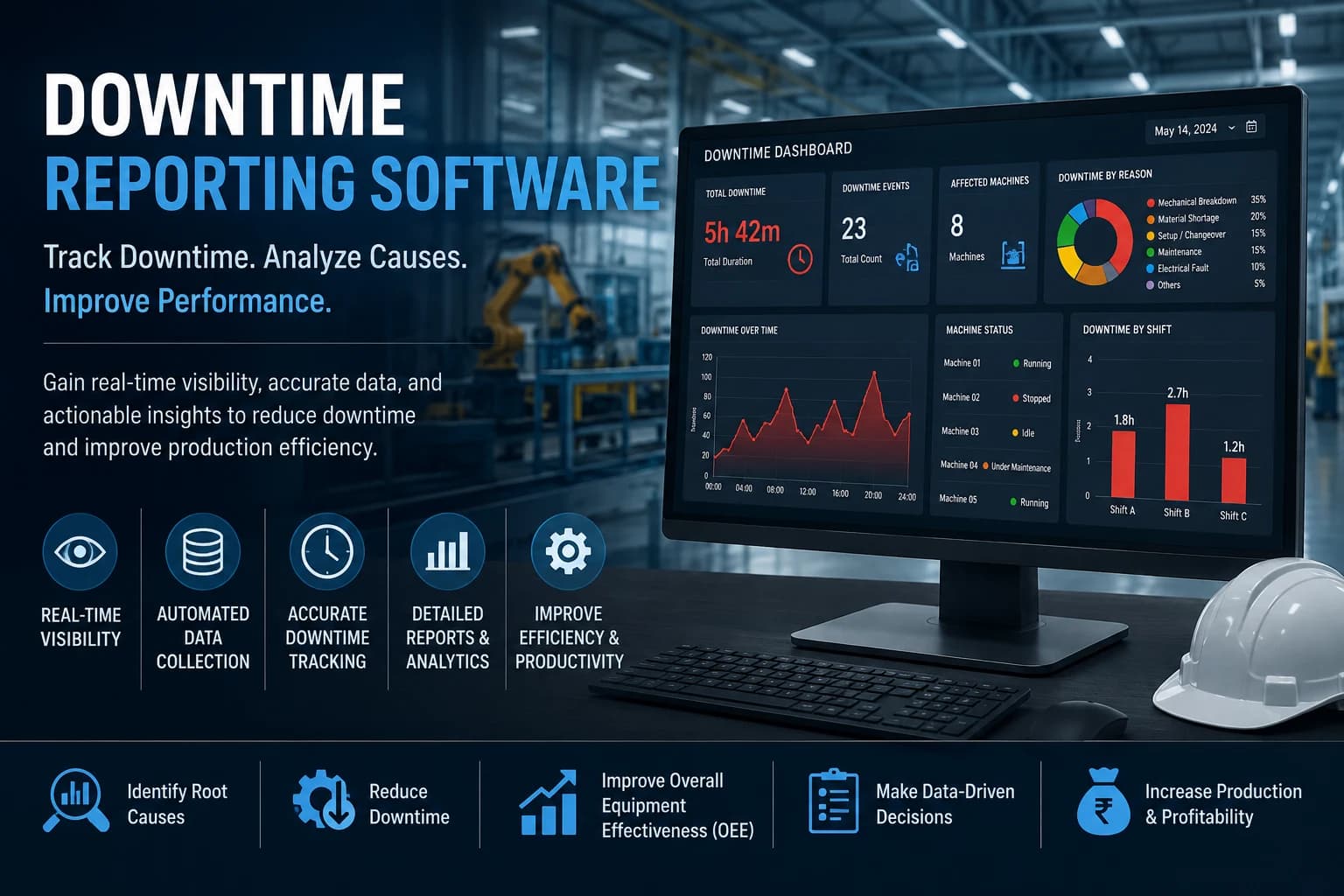
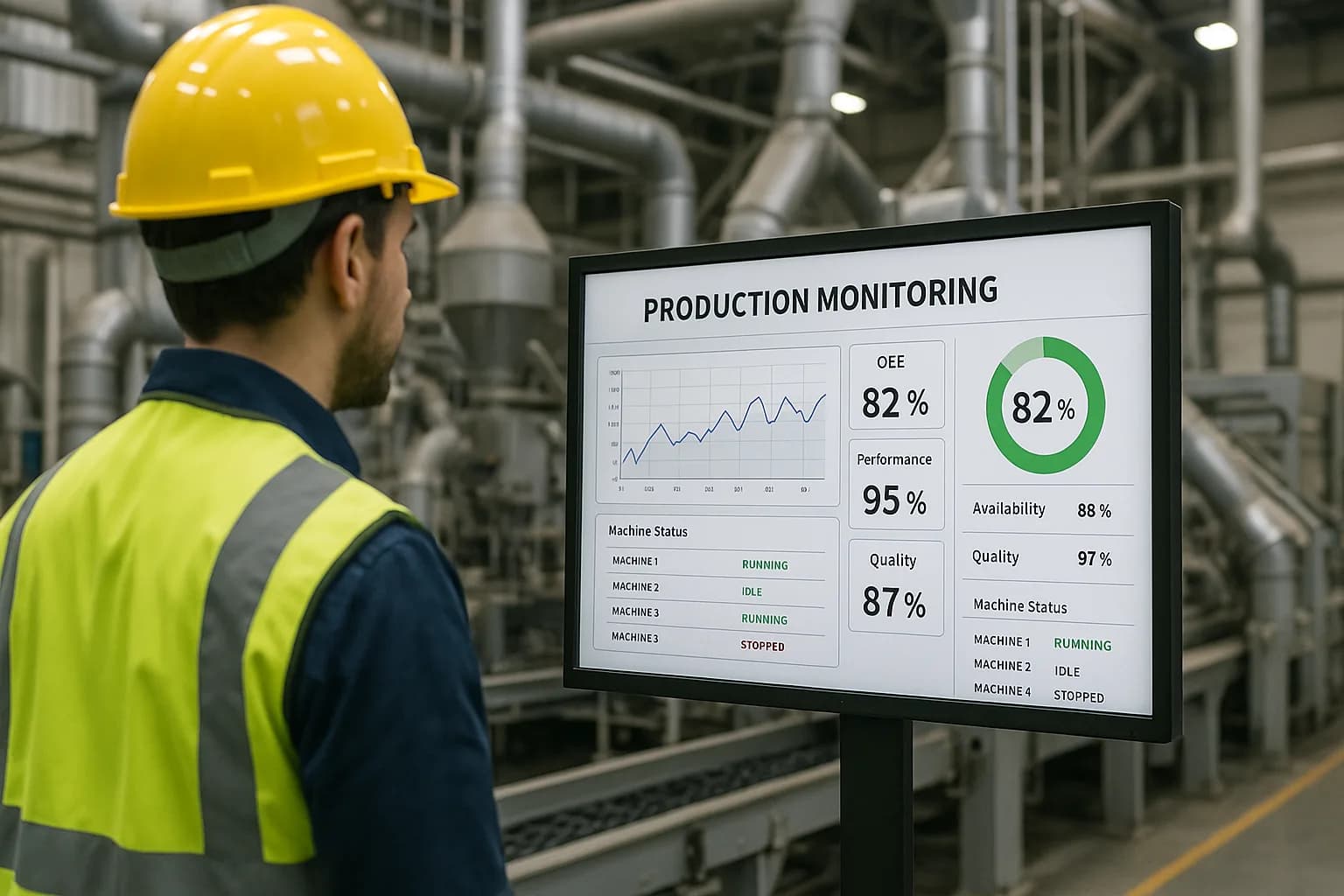
How Downtime Monitoring Software Supports RCA
Downtime monitoring software can provide the historical information required for effective root cause analysis.
For example, production teams can identify:
Which machine has the most downtime?
Which downtime reason occurs most frequently?
Which failure creates the longest stoppage?
Which shift has the highest downtime?
Which machines have recurring failures?
This information helps improvement teams determine where RCA efforts should be concentrated.
Root Cause Analysis and Industry 4.0
Industry 4.0 manufacturing increasingly depends on connected equipment and real-time operational data.
Connected machines can provide information about:
- Machine status
- Production cycles
- Downtime
- Fault conditions
- Process parameters
- Equipment performance
When this information is stored historically, manufacturers can analyze machine behavior and identify recurring patterns.
This creates a foundation for data-driven root cause analysis and continuous improvement.
Root Cause Analysis With Robato Systems
Robato Systems provides manufacturing monitoring solutions designed to improve visibility into machine and production performance.
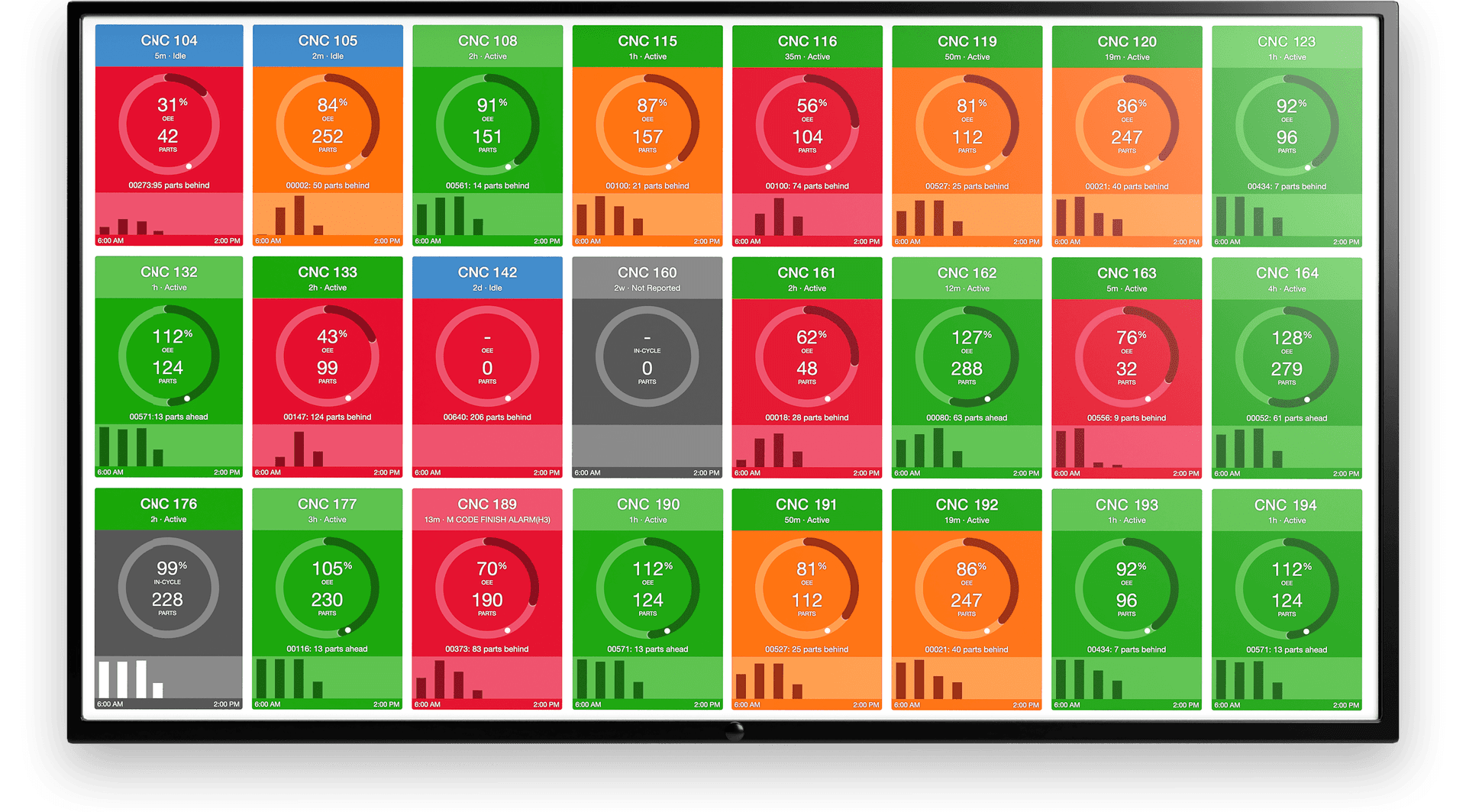
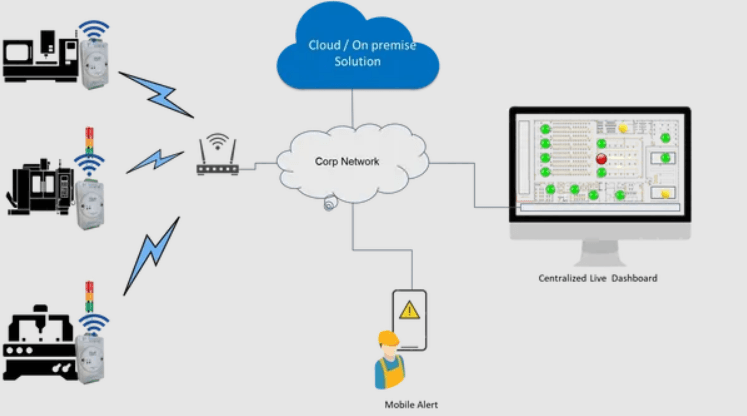
By monitoring machine downtime and organizing downtime information into centralized dashboards, production and maintenance teams can gain better visibility into recurring machine problems.
Downtime information can then support investigations into:
- Frequent machine stoppages
- Major downtime reasons
- Repeated breakdowns
- Long-duration failures
- Machine-specific performance issues
This provides a practical foundation for moving from basic downtime tracking toward structured production improvement.
Conclusion
Root cause analysis is an important part of effective manufacturing downtime management.
Repairing a machine and restarting production may solve an immediate problem, but it does not necessarily prevent the same failure from occurring again.
A structured RCA process helps manufacturers investigate the underlying causes of downtime and implement corrective and preventive actions.
When root cause analysis is combined with accurate production downtime tracking, machine monitoring, KPI dashboards, and historical data, manufacturers can identify recurring problems more effectively.
The improvement cycle becomes:
Track → Identify → Investigate → Find Root Cause → Correct → Verify → Prevent
The ultimate goal is not simply to repair machines faster.
It is to stop the same downtime problem from happening repeatedly.
FAQs
What is root cause analysis in manufacturing?
Root cause analysis is a structured method for identifying the underlying cause of a manufacturing problem rather than only fixing its immediate symptoms.
How does root cause analysis reduce machine downtime?
RCA identifies why failures repeatedly occur, allowing manufacturers to implement corrective and preventive actions that reduce recurring downtime.
What is the 5 Whys method?
The 5 Whys method involves repeatedly asking why a problem occurred until the team reaches an underlying cause that can be addressed.
What is a Fishbone Diagram?
A Fishbone Diagram is a visual RCA technique that organizes possible causes into categories such as machine, method, material, manpower, measurement, and environment.
Why is downtime data important for RCA?
Historical downtime data helps teams identify recurring failures, high-impact machines, frequent downtime reasons, and patterns that may reveal underlying problems.
What is the difference between corrective and preventive action?
Corrective action addresses an existing problem, while preventive action aims to prevent the same problem from happening again.
Can downtime monitoring software support root cause analysis?
Yes. Downtime monitoring software can provide machine-wise, reason-wise, shift-wise, and historical downtime information that supports RCA investigations.
How often should manufacturers perform root cause analysis?
RCA should be performed for significant, recurring, or high-impact problems. The exact criteria should depend on the plant's production requirements and downtime thresholds.