Accurate production data is the foundation of effective manufacturing management. Before a factory can calculate Overall Equipment Effectiveness (OEE), identify downtime losses, compare machine performance, or improve production efficiency, it needs reliable data from the shop floor.
This is where OEE Data Collection becomes important.
OEE data collection is the process of gathering information from machines, operators, production systems, sensors, and other manufacturing equipment to calculate Availability, Performance, and Quality. Traditionally, this information was recorded manually on paper or spreadsheets. Modern factories, however, are increasingly using PLCs, Industrial IoT devices, sensors, machine interfaces, and automated production monitoring systems to collect data in real time.
The quality of collected data directly affects the quality of OEE calculations. If production counts are incorrect, downtime is missed, or machine status is recorded inaccurately, the resulting OEE percentage may not represent actual factory performance.
A well-designed OEE data collection strategy therefore focuses on accuracy, automation, consistency, and real-time visibility.
What is OEE Data Collection?
OEE Data Collection is the process of capturing the production information required to calculate and analyze Overall Equipment Effectiveness.
The three primary OEE components are:
- Availability
- Performance
- Quality
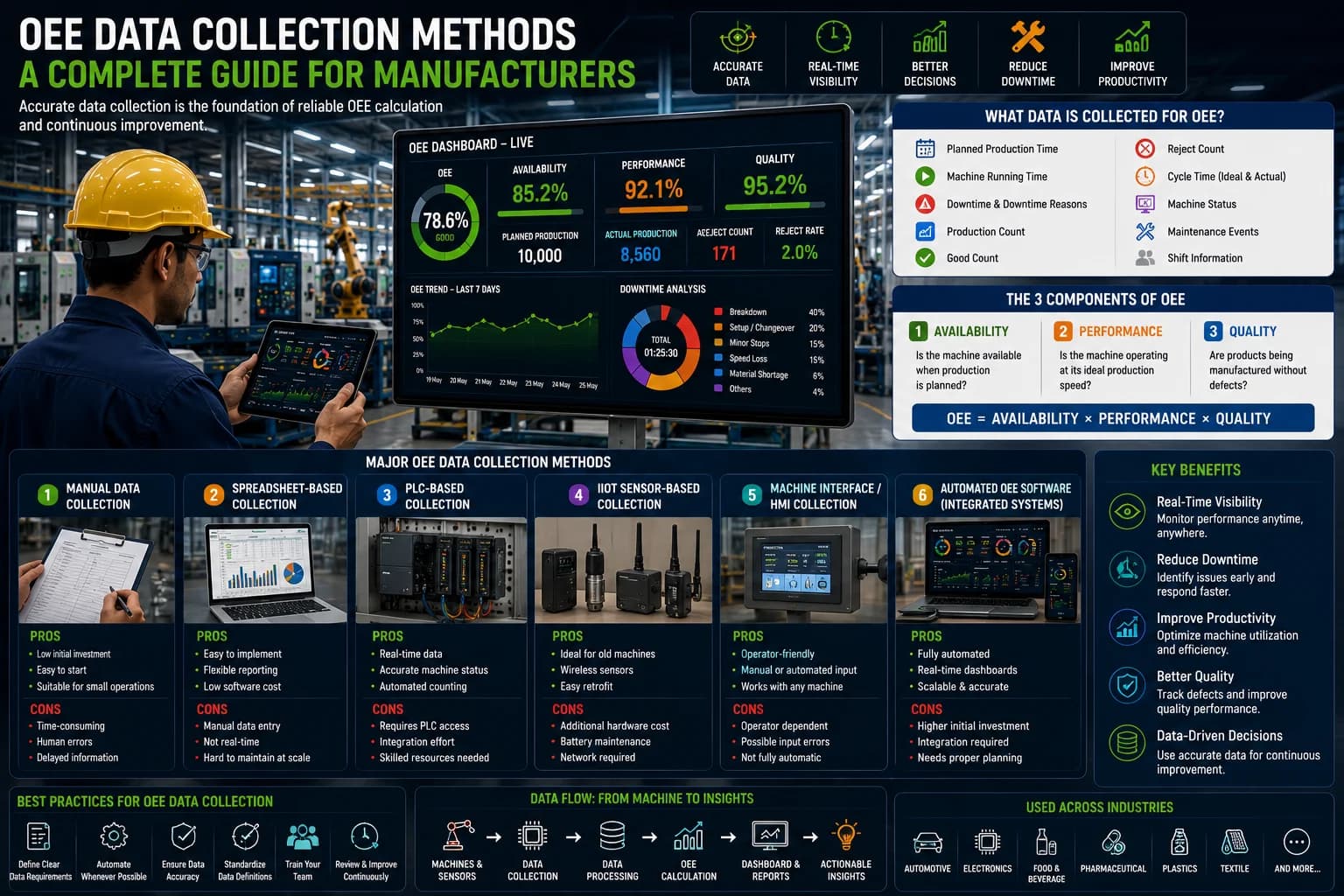
To calculate these metrics, a manufacturing system may need to collect information such as:
- Planned production time
- Machine running time
- Machine downtime
- Production quantity
- Good production quantity
- Rejected quantity
- Ideal cycle time
- Actual cycle time
- Machine status
- Downtime reasons
- Production shift
- Maintenance events
This information can be collected automatically, manually, or through a combination of both approaches.
Why Accurate OEE Data Collection Matters
OEE is only as reliable as the data used to calculate it.
Imagine a machine actually produces 950 parts during a shift, but the production report records only 900. The calculated performance may appear lower than the actual machine performance.
Similarly, if a 30-minute machine breakdown is recorded as only 10 minutes, the availability figure will be misleading.
Poor data collection can result in:
- Incorrect OEE calculations
- Misleading performance reports
- Incorrect downtime analysis
- Poor maintenance decisions
- Difficult root-cause analysis
- Inaccurate production planning
Accurate data collection creates a reliable foundation for continuous improvement.
What Data is Required for OEE?
Before selecting a collection method, manufacturers should understand what information needs to be captured.
Machine Runtime
Records how long equipment is actually operating.
Planned Production Time
Defines the period during which the machine is expected to produce.
Downtime
Tracks when and why production stops.
Production Count
Measures the total number of products manufactured.
Good Count
Records products that meet quality requirements.
Reject Count
Tracks defective or rejected products.
Cycle Time
Measures how long it takes to produce one unit.
Machine Status
Common states include:
- Running
- Idle
- Breakdown
- Maintenance
- Setup
- Waiting
Major OEE Data Collection Methods
Manufacturers can use different methods depending on machine age, production environment, connectivity, budget, and automation level.
1. Manual Data Collection
Manual data collection is one of the simplest methods.
Operators record production information using:
- Paper forms
- Logbooks
- Checklists
- Shift reports
They may record:
- Production quantity
- Downtime
- Rejection
- Machine status
- Production start and stop times
Advantages
- Low initial investment
- Easy to start
- Suitable for basic production environments
Limitations
- Time-consuming
- Higher possibility of human error
- Delayed information
- Difficult to analyze
- Inconsistent data
- Poor real-time visibility
Manual collection can be useful for small operations, but it becomes difficult to manage as production volume increases.
2. Spreadsheet-Based Data Collection
Many factories move from paper records to spreadsheets.
Operators or supervisors enter production data into applications such as Excel or other spreadsheet tools.
Typical information includes:
- Machine ID
- Production quantity
- Downtime
- Reject quantity
- Shift
- Operator
Advantages
- Easy to implement
- Familiar to employees
- Flexible reporting
- Low software cost
Limitations
- Still dependent on manual entry
- Data may be delayed
- Difficult to maintain at scale
- Limited real-time monitoring
- Greater risk of inconsistent data
Spreadsheets are useful for basic reporting but are not ideal for real-time OEE monitoring.
3. PLC-Based Data Collection
A Programmable Logic Controller (PLC) can provide machine-level production information directly.
PLCs commonly provide signals related to:
- Machine running status
- Machine stops
- Production cycles
- Part counts
- Alarms
- Machine states
An OEE platform can connect to the PLC through industrial communication protocols.
This allows production information to be collected automatically.
Benefits
- Real-time data
- Reduced manual entry
- Accurate machine status
- Automated production counting
- Faster downtime detection
PLC integration is one of the most common approaches for automated OEE data collection.
4. Industrial IoT Sensor-Based Collection
Older machines may not have accessible PLC data or modern communication interfaces.
In such situations, Industrial IoT sensors can be installed to capture machine activity.
Sensors can detect:
- Machine vibration
- Motor operation
- Machine movement
- Production cycles
- Temperature
- Energy consumption
- Machine state
The sensor data can then be transmitted to an OEE platform for analysis.
This approach is especially useful for retrofitting legacy equipment.
5. Machine Controller Integration
Many modern machines have built-in controllers that generate valuable production information.
An OEE system can connect with machine controllers to retrieve:
- Cycle count
- Cycle time
- Machine status
- Production quantity
- Alarms
- Operating parameters
Direct machine integration provides detailed and timely information without requiring operators to manually enter production data.
6. Operator-Based Data Collection
Automation cannot always identify the reason behind every production stop.
For example, a machine may stop, but the system may not know whether the cause was:
- Material shortage
- Tool change
- Quality inspection
- Operator assistance
- Setup
- Maintenance
An operator interface can allow employees to select the appropriate downtime reason.
This creates a hybrid data collection model:
Machine automatically detects the event → Operator identifies the reason.
This approach provides both automation and contextual information.
7. Production Counter Integration
Production counters can provide real-time information about the number of units produced.
A production counter can be connected to:
- PLCs
- Sensors
- Machines
- Edge devices
- OEE software
The system can continuously compare:
Target Production vs Actual Production
This makes it easier to identify production gaps during a shift.
8. Barcode and RFID-Based Data Collection
Barcode and RFID technologies can provide additional production information.
They can be used for:
- Product identification
- Batch tracking
- Work-order tracking
- Production movement
- Material identification
- Production traceability
When integrated with OEE Software, these technologies provide additional context around production performance.
9. Edge Computing
Edge devices can collect and process machine information close to the production equipment.
Instead of sending every raw machine signal directly to a remote server, an edge device can:
- Collect machine data
- Process the information
- Identify machine events
- Send relevant data to the OEE platform
Benefits
- Low latency
- Faster event detection
- Reduced network dependency
- Local processing
- Better scalability
Edge computing is becoming increasingly important in Industry 4.0 manufacturing environments.
10. Cloud-Based OEE Data Collection
Cloud-based OEE systems can collect and centralize information from multiple production facilities.
Manufacturers can monitor:
- Multiple machines
- Production lines
- Departments
- Plants
- Locations
from a centralized platform.
Cloud connectivity also enables remote access to dashboards and reports.
Automated vs Manual OEE Data Collection
The right approach depends on the manufacturing environment.
| Factor | Manual Collection | Automated Collection |
|---|---|---|
| Data Entry | Human | Machine/System |
| Real-Time Visibility | Limited | High |
| Accuracy | Variable | Generally higher |
| Downtime Detection | Delayed | Immediate |
| Scalability | Low | High |
| Reporting | Manual | Automated |
| Historical Analysis | Difficult | Easy |
| Initial Cost | Low | Higher |
For modern manufacturing facilities, automated or hybrid collection generally provides better long-term value.
Hybrid OEE Data Collection
Not every manufacturing event can be detected automatically.
This is why many factories use a hybrid approach.
For example:
PLC → detects machine stop
OEE software → records downtime
Operator → selects downtime reason
Dashboard → displays downtime analysis
This approach combines automated machine-level data with human operational knowledge.
How OEE Data Collection Works in a Smart Factory
A modern OEE data architecture may look like this:
Machine → PLC/Sensor → Edge Gateway → Manufacturing Network → OEE Platform → Dashboard → Reports
The process typically works as follows:
Step 1: Machine Generates Data
Machines continuously produce operational signals.
Step 2: Data is Captured
PLCs, sensors, or controllers capture those signals.
Step 3: Data is Processed
An edge gateway or software platform interprets the raw data.
Step 4: OEE Metrics are Calculated
The system calculates Availability, Performance, Quality, and OEE.
Step 5: Information is Displayed
Managers and operators view the information through dashboards.
Step 6: Reports are Generated
Historical information is used for performance analysis and continuous improvement.
Challenges in OEE Data Collection
Legacy Machines
Older equipment may not support modern communication protocols.
Solution
Use retrofit sensors, gateways, or edge devices.
Inconsistent Data
Different machines may provide data in different formats.
Solution
Use standardized data structures and machine mapping.
Incorrect Downtime Reasons
Automated systems may detect a stop without understanding the reason.
Solution
Use operator interfaces for downtime classification.
Network Problems
Connectivity issues can interrupt data transmission.
Solution
Use edge-based buffering and reliable industrial networks.
Poor Data Quality
Incorrect cycle times, production counts, or machine states can affect OEE.
Solution
Regularly validate data against actual production conditions.
Best Practices for OEE Data Collection
Start with Critical Machines
Begin with machines where downtime and inefficiency have the greatest impact.
Automate Wherever Possible
Reduce manual data entry to improve consistency and speed.
Standardize Downtime Categories
Create a common downtime classification system.
Validate Production Counts
Regularly compare system counts with actual production quantities.
Monitor Data Quality
Check for missing, duplicated, or abnormal data.
Involve Operators
Operators understand production processes and can provide important context.
Create a Scalable Architecture
Design the system so additional machines and production lines can be added easily.
Integrate with Existing Systems
Connect OEE data with MES, ERP, SCADA, Andon, and production monitoring platforms where required.
Benefits of Automated OEE Data Collection
Real-Time Production Visibility
Manufacturers can see machine performance as production happens.
Faster Downtime Detection
Machine stoppages can be detected immediately.
More Accurate OEE
Automated collection reduces errors caused by manual calculations and data entry.
Reduced Administrative Work
Operators and supervisors spend less time preparing reports.
Better Root-Cause Analysis
Detailed historical data makes it easier to identify recurring losses.
Improved Maintenance
Maintenance teams receive better information about equipment behavior.
Better Production Planning
Reliable historical data supports more accurate production planning.
Improved Continuous Improvement
Manufacturers can measure whether improvement initiatives actually produce results.
OEE Data Collection and Industry 4.0
OEE data collection is an important part of the Industry 4.0 ecosystem.
Connected factories use technologies such as:
- Industrial IoT
- Edge computing
- Cloud platforms
- AI
- Machine learning
- Digital twins
- Advanced analytics
- Smart sensors
These technologies enable manufacturers to move from reactive production management toward predictive and data-driven operations.
Why Choose Robato Systems for OEE Data Collection?
Robato Systems provides intelligent manufacturing solutions designed to automate OEE Data Collection across production environments. The platform can connect with PLCs, Industrial IoT devices, machine controllers, sensors, production counters, and other factory systems to collect real-time production information.
The collected data can be transformed into actionable OEE metrics, including Availability, Performance, Quality, downtime, production output, machine utilization, and target-versus-actual performance.
Robato Systems also supports real-time dashboards, automated reporting, alerts, historical analytics, and centralized production visibility, helping manufacturers reduce manual reporting and make faster operational decisions.
For factories with both modern and legacy equipment, a combination of direct machine connectivity, IoT sensors, edge devices, and operator inputs can create a scalable OEE data collection architecture.
Conclusion
OEE Data Collection is the foundation of accurate Overall Equipment Effectiveness measurement. Without reliable production data, even the most advanced OEE software cannot provide meaningful insights.
Manufacturers can collect OEE data using multiple approaches, including manual entry, spreadsheets, PLC integration, machine controllers, Industrial IoT sensors, production counters, barcode systems, RFID, edge computing, and cloud platforms.
For modern manufacturing environments, automated or hybrid data collection provides the strongest combination of accuracy, speed, scalability, and visibility. By connecting machines and production systems to an OEE platform, manufacturers can understand where production losses occur, respond faster to downtime, improve machine utilization, and build a stronger foundation for Industry 4.0 transformation.
Frequently Asked Questions
What is OEE Data Collection?
OEE Data Collection is the process of gathering machine, production, downtime, and quality information required to calculate Overall Equipment Effectiveness.
What data is needed to calculate OEE?
The main data requirements include planned production time, machine runtime, downtime, production quantity, good quantity, rejected quantity, and ideal cycle time.
Can OEE data be collected automatically?
Yes. PLCs, sensors, machine controllers, IIoT devices, production counters, and edge gateways can automatically collect production data.
How can legacy machines be connected to an OEE system?
Legacy machines can be connected using retrofit sensors, IoT gateways, edge devices, or other industrial communication interfaces.
Is manual OEE data collection reliable?
Manual collection can work for small operations, but it is more vulnerable to delays, missing information, and human errors compared with automated collection.
What is the best OEE data collection method?
For modern factories, automated or hybrid data collection is generally the most effective because it combines real-time machine data with operator input where human context is required.