Labor productivity is an important factor in manufacturing performance. Machines, automation, raw materials, and technology all contribute to production, but people remain central to many manufacturing processes.
When operators spend too much time waiting, production processes are poorly balanced, work is not allocated effectively, or employees lack the right training, a factory can lose productive capacity even when its machines are available.
Improving labor productivity in manufacturing is therefore not simply about asking employees to work faster. It involves improving the entire production environment so operators can perform their work efficiently.
Modern manufacturers can combine workforce management, operator performance monitoring, production analytics, machine data, and real-time dashboards to identify productivity losses and improve operational efficiency.
What is Labor Productivity in Manufacturing?
Labor productivity in manufacturing refers to the amount of production generated relative to the labor resources used to produce it.
A simple way to understand it is:
Labor Productivity = Production Output / Labor Input
Labor input can be measured using:
- Labor hours
- Number of operators
- Shift hours
- Workforce hours
- Productive working time
For example, if four operators produce 800 units during an 8-hour shift, management can analyze the output relative to the total labor hours used.
The purpose of this measurement is to understand how effectively workforce capacity is being converted into production output.
Why Labor Productivity Matters in Manufacturing
Labor costs can represent a significant part of manufacturing operating expenses.
If available workforce capacity is not being used effectively, manufacturers may experience:
- Lower production output
- Higher cost per unit
- Increased overtime
- Longer production lead times
- Higher idle time
- Poor workforce utilization
- Missed production targets
- Increased operational costs
Improving labor productivity can help manufacturers produce more effectively without simply increasing workforce size.
However, productivity improvement should focus on removing process inefficiencies rather than putting unnecessary pressure on employees.
Major Causes of Low Labor Productivity
Before improving labor productivity, manufacturers should identify the reasons behind productivity losses.
Common causes include:
1. Excessive Operator Idle Time
Operators may be available but unable to work because they are waiting for:
- Raw materials
- Machine availability
- Instructions
- Quality approval
- Maintenance
- Previous processes
Repeated waiting can reduce productive labor hours.
2. Machine Downtime
When a machine stops unexpectedly, the operator may also become unproductive.
This is why labor productivity should be analyzed together with machine availability.
3. Poor Workforce Allocation
An uneven workforce distribution can create bottlenecks.
One production area may have more operators than required while another area lacks sufficient workforce.
4. Inefficient Workstations
Poor workstation layouts can increase:
- Walking
- Material handling
- Tool movement
- Repetitive unnecessary actions
These small inefficiencies can accumulate over an entire shift.
5. Lack of Standard Work
When operators perform the same task in different ways, production cycle times can vary.
Standardized work instructions can help reduce unnecessary variation.
6. Inadequate Training
Operators may require additional training when processes, machines, products, or tools change.
7. Poor Production Planning
Frequent production changes, unplanned work, and inefficient scheduling can reduce workforce utilization.
How to Improve Labor Productivity in Manufacturing
Improving labor productivity requires a combination of workforce, process, technology, and management improvements.
1. Set Clear Production Targets
Operators and supervisors should have clear and realistic production targets.
Targets can be defined based on:
- Product type
- Standard cycle time
- Available production time
- Machine capacity
- Planned quantity
- Shift duration
Clear targets make it easier to measure actual production performance.
2. Monitor Target vs Actual Production
One of the simplest ways to identify productivity gaps is to compare planned production with actual production.
For example:
Target: 1,000 units
Actual: 920 units
The 80-unit gap requires further investigation.
Managers can analyze whether the gap was caused by:
- Downtime
- Slow cycles
- Material shortages
- Quality problems
- Operator waiting
- Changeovers
This creates a more structured approach to productivity improvement.
3. Track Operator Productivity
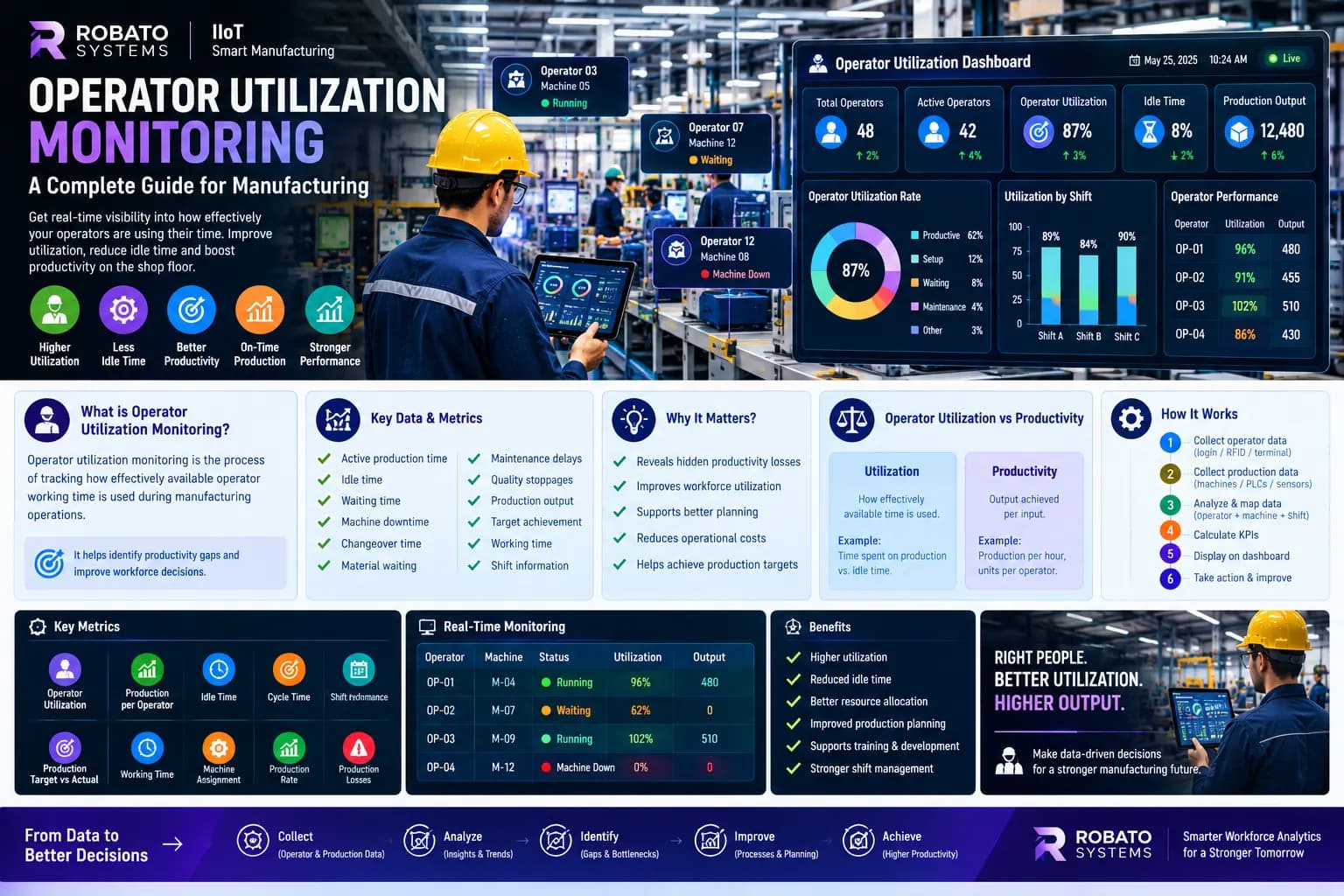
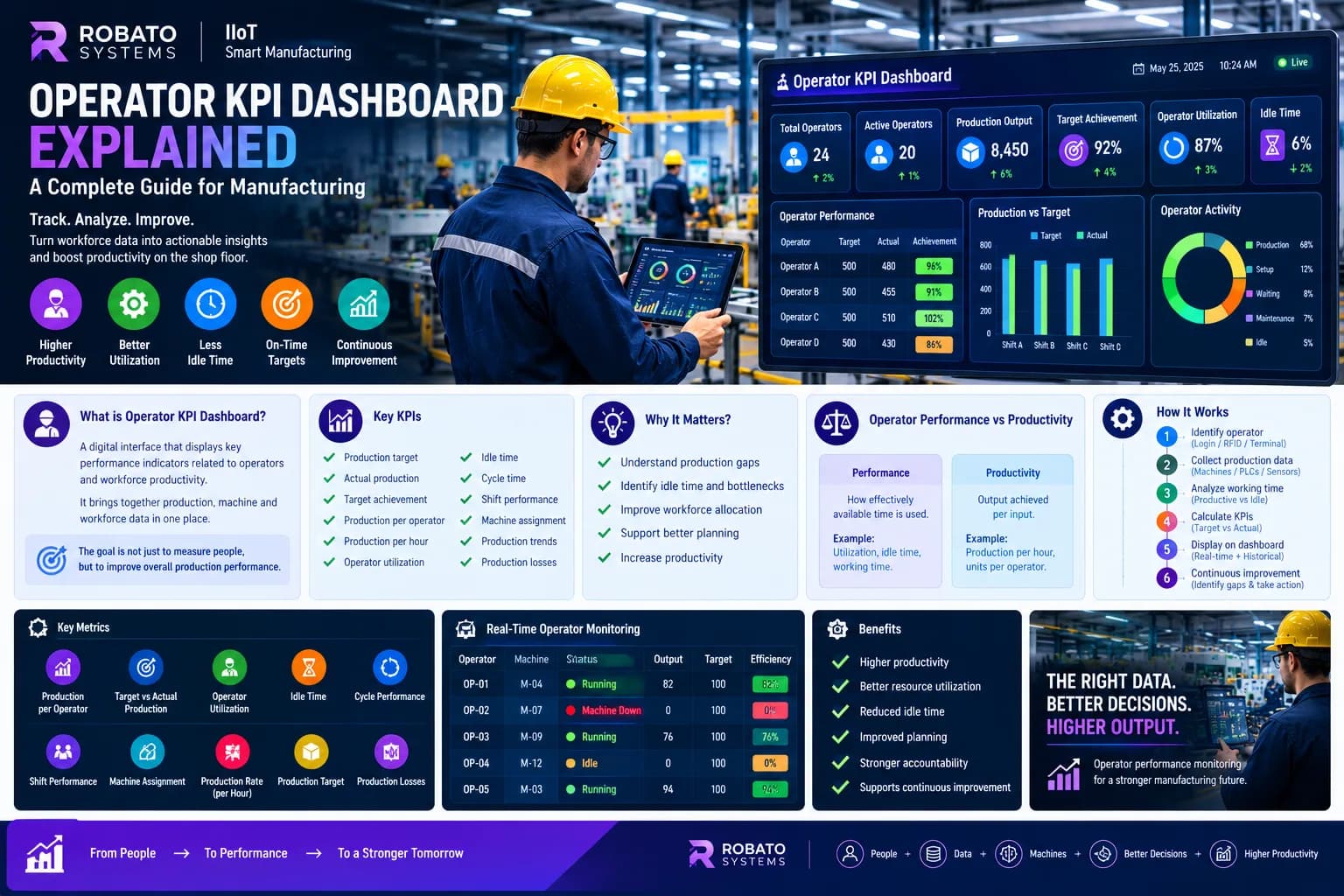
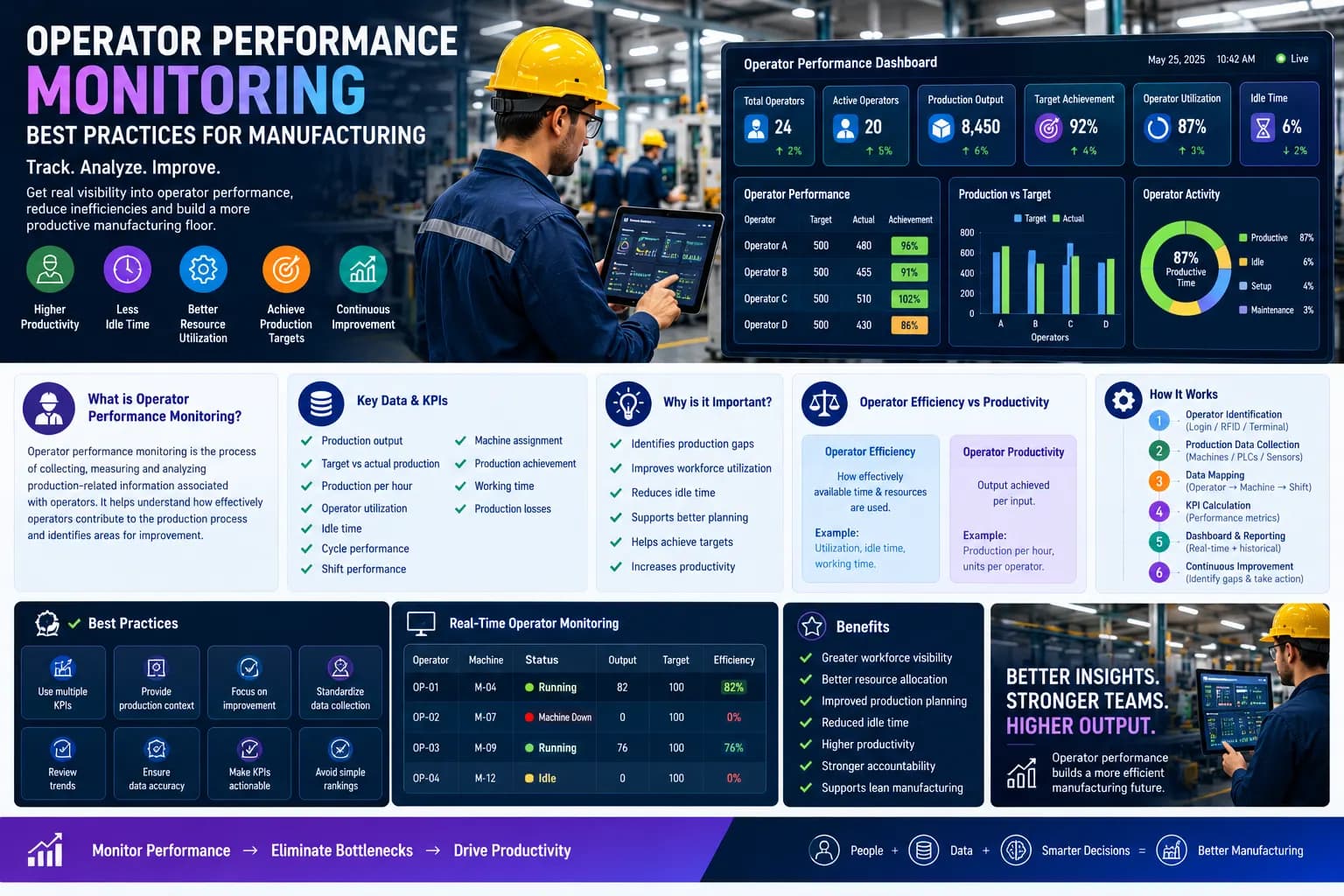
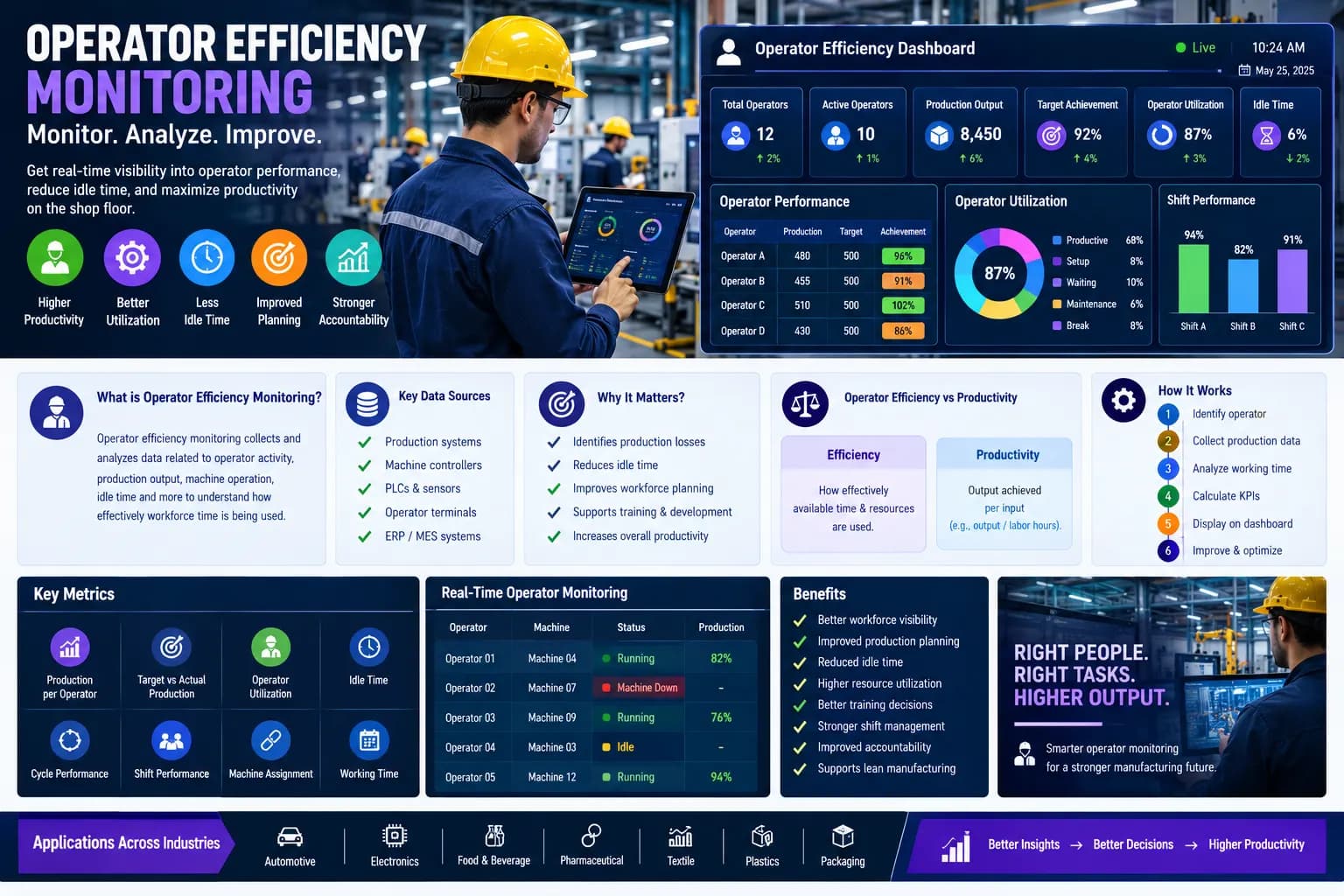
Operator productivity tracking helps managers understand production output in relation to workforce utilization.
Useful metrics include:
- Production per operator
- Production per hour
- Target achievement
- Operator utilization
- Idle time
- Shift performance
- Cycle performance
These metrics can reveal recurring productivity patterns that may not be visible through manual reports.
4. Reduce Operator Idle Time
Idle time represents an opportunity for improvement.
Manufacturers should identify why operators are waiting instead of simply measuring how long they are waiting.
For example:
High material waiting time
Possible improvement:
Improve material replenishment and line-side inventory planning.
High machine waiting time
Possible improvement:
Improve maintenance response and machine availability.
High process waiting time
Possible improvement:
Balance production processes and improve workflow coordination.
The important principle is to fix the cause of idle time.
5. Improve Workforce Allocation
Workforce allocation should match production requirements.
Managers can analyze workload across:
- Production lines
- Machines
- Departments
- Workstations
- Shifts
Historical production data can help determine where additional workforce is required and where capacity is available.
Better allocation can improve workforce utilization without necessarily increasing headcount.
6. Standardize Work Processes
Standard work helps operators perform tasks using a consistent process.
A standardized process can define:
- Work sequence
- Cycle expectations
- Tool usage
- Material handling
- Quality checks
- Safety requirements
Standardization can reduce unnecessary variation and make productivity measurement more consistent.
7. Improve Operator Training
Training should focus on actual production requirements.
Training opportunities can be identified through:
- Repeated cycle-time deviations
- Quality problems
- Machine operation issues
- Process errors
- Low productivity in specific operations
Training should also be updated when new machines, products, or processes are introduced.
8. Optimize Workstation Layout
The physical arrangement of a workstation can significantly affect operator productivity.
Manufacturers can review:
- Tool placement
- Material location
- Walking distance
- Work height
- Component accessibility
- Material replenishment
Small layout improvements can reduce unnecessary movement and improve workflow.
9. Reduce Unnecessary Manual Work
Automation does not necessarily mean replacing workers.
Manufacturers can automate repetitive activities such as:
- Data entry
- Production counting
- Report generation
- Manual calculations
- Status reporting
This allows production teams to spend more time on productive and value-adding activities.
10. Improve Machine Availability
Labor productivity is closely connected with machine productivity.
If operators regularly wait for machines to become available, workforce utilization will suffer.
Manufacturers can improve machine availability through:
- Preventive maintenance
- Planned maintenance
- Faster breakdown response
- Spare-parts planning
- Machine condition monitoring
- Downtime analysis
Improving machine availability can therefore improve both equipment and labor productivity.
Use Real-Time Production Data
Traditional production reports are often created at the end of a shift.
While these reports can provide historical information, they may not help supervisors correct problems while production is happening.
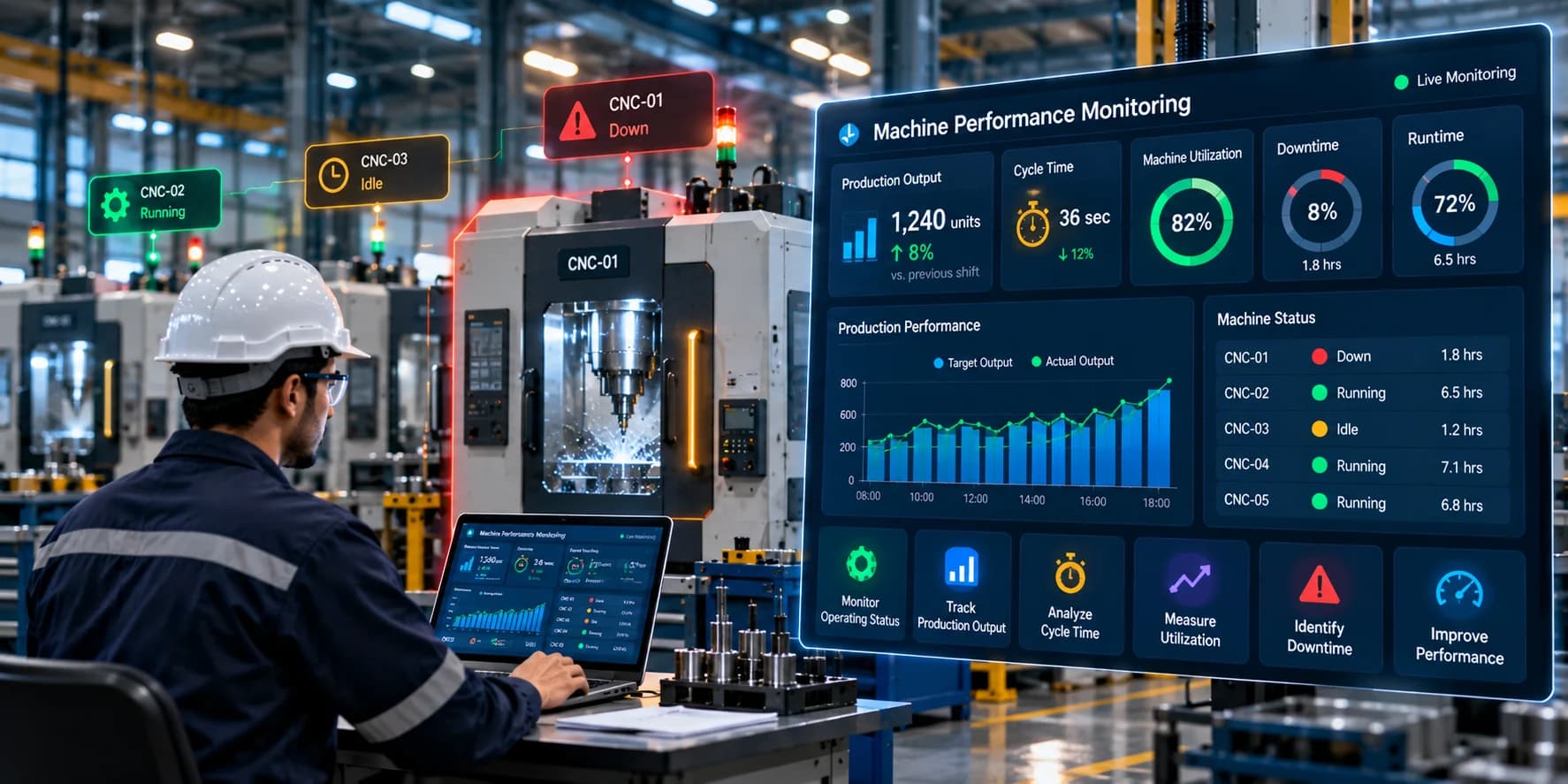
Real-time production monitoring can show:
- Current production
- Target
- Actual output
- Machine status
- Downtime
- Operator assignment
- Shift progress
For example, if production is significantly behind target halfway through a shift, the supervisor can investigate immediately.
This provides an opportunity to correct the situation before the shift ends.
Labor Productivity and OEE
Labor productivity and OEE measure different aspects of manufacturing performance, but they can complement each other.
OEE generally focuses on equipment performance through:
- Availability
- Performance
- Quality
Labor productivity focuses more specifically on workforce output and utilization.
Consider a situation where OEE is low because a machine experienced significant downtime.
Operator productivity may also be affected because the assigned operator could not produce during the downtime.
Analyzing both sets of information can provide a more complete view of production losses.
Labor Productivity and Downtime Monitoring
Downtime monitoring is another important component of labor productivity improvement.
When machines stop, operators may experience lost productive time.
A connected system can associate:
Machine → Operator → Downtime → Production Loss
This allows managers to understand whether lost labor capacity is caused by equipment problems, process problems, or workforce-related factors.
Labor Productivity Dashboard
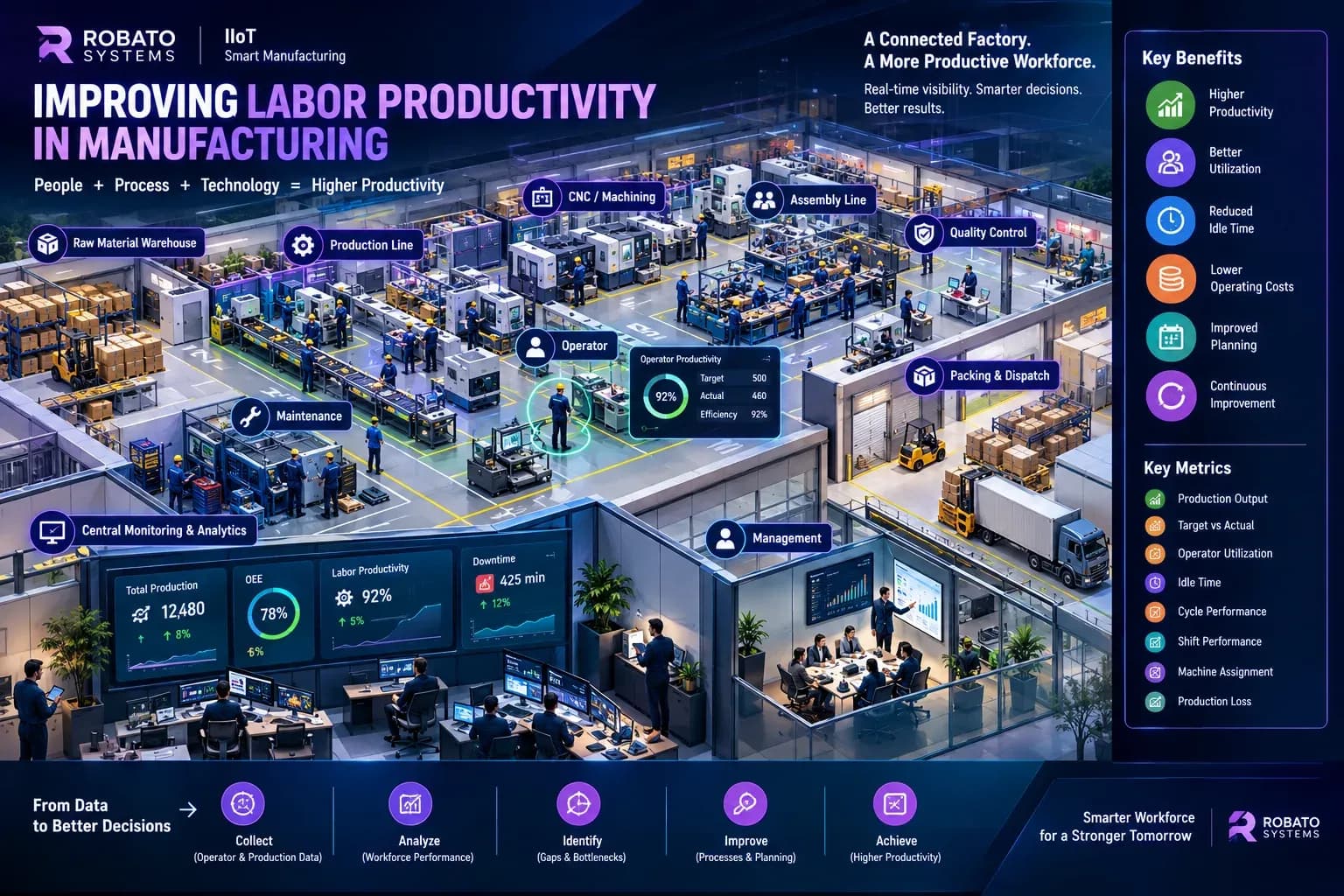
A digital labor productivity dashboard can provide managers with a centralized view of workforce performance.
Important dashboard metrics may include:
- Total operators
- Active operators
- Production target
- Actual production
- Target achievement
- Production per operator
- Production per hour
- Operator utilization
- Idle time
- Shift performance
- Machine downtime
- Production trends
A good dashboard should make important deviations easy to identify.
Managers should be able to move from an overall production view to a specific department, machine, shift, or operator.
Shift-Wise Labor Productivity Analysis
Manufacturing plants often operate multiple shifts.
Shift-wise analysis can identify differences in:
- Production output
- Target achievement
- Operator utilization
- Idle time
- Machine availability
- Production rate
For example:
Shift A: 96% target achievement
Shift B: 91% target achievement
Shift C: 87% target achievement
The numbers alone do not explain the reason for the difference.
Management should investigate machine availability, staffing, product mix, changeovers, material availability, and other operating conditions.
Use Data to Identify Productivity Trends
One production shift does not necessarily represent a long-term productivity problem.
Historical data provides better insight.
Managers can analyze:
- Daily productivity
- Weekly productivity
- Monthly trends
- Shift trends
- Product-level performance
- Machine-level performance
- Operator-level performance
If the same production line repeatedly shows low productivity, it may indicate a process-level issue that requires investigation.
Create a Culture of Continuous Improvement
Technology alone cannot improve labor productivity.
Manufacturers also need a culture where teams regularly identify and solve production problems.
Continuous improvement can involve:
- Daily production reviews
- Root-cause analysis
- Standard work updates
- Operator feedback
- Process improvement projects
- Training programs
- Workplace organization
Operators often have direct knowledge of problems that may not be visible in production reports.
Their feedback can therefore complement production data.
Do Not Use Productivity Data Without Context
This is one of the most important principles of labor productivity monitoring.
A lower production number does not automatically mean lower operator performance.
Production can be affected by:
- Machine breakdowns
- Material shortages
- Quality inspections
- Product complexity
- Changeovers
- Production scheduling
- Tool problems
- Process bottlenecks
Performance data should therefore be used to investigate problems rather than make assumptions.
Manual vs Digital Labor Productivity Monitoring
Traditional labor productivity monitoring may rely on:
- Paper sheets
- Excel
- Manual calculations
- Supervisor observations
- End-of-shift reports
Digital systems can automate data collection and provide centralized visibility.
| Manual Monitoring | Digital Monitoring |
|---|---|
| Manual data entry | Automated data collection |
| Delayed information | Real-time or near real-time data |
| Difficult historical analysis | Historical trend analysis |
| High reporting effort | Automated reporting |
| Limited visibility | Centralized dashboards |
| Higher risk of calculation errors | Consistent calculations |
Digital monitoring can reduce administrative work and provide managers with faster access to production information.
How to Implement a Labor Productivity Improvement Program
Step 1: Identify Current Productivity
Establish a baseline using current production and workforce data.
Step 2: Identify Major Losses
Find the largest contributors to lost productive time.
These may include:
- Idle time
- Machine downtime
- Material waiting
- Long changeovers
- Slow cycles
Step 3: Define Improvement Targets
Set measurable objectives based on realistic production conditions.
Step 4: Monitor Performance
Use production and workforce monitoring tools to track progress.
Step 5: Identify Root Causes
Investigate why productivity is below the expected level.
Step 6: Implement Improvements
Improve processes, training, machine availability, workforce allocation, or workstation design.
Step 7: Measure the Results
Compare performance before and after the improvement.
This creates a continuous improvement cycle:
Measure → Analyze → Improve → Measure Again
Industry 4.0 and Labor Productivity
Industry 4.0 technologies are making it easier for manufacturers to connect workforce information with machine and production data.
A connected manufacturing environment can combine:
- Machine data
- Operator data
- Production data
- Downtime data
- Quality data
- OEE data
- Shift information
This creates a broader view of factory performance.
Instead of analyzing workforce performance separately, manufacturers can understand how operators, machines, and processes interact.
Labor Productivity Improvement with Robato Systems
Robato Systems helps manufacturers build digital production monitoring environments that connect machine and production information.
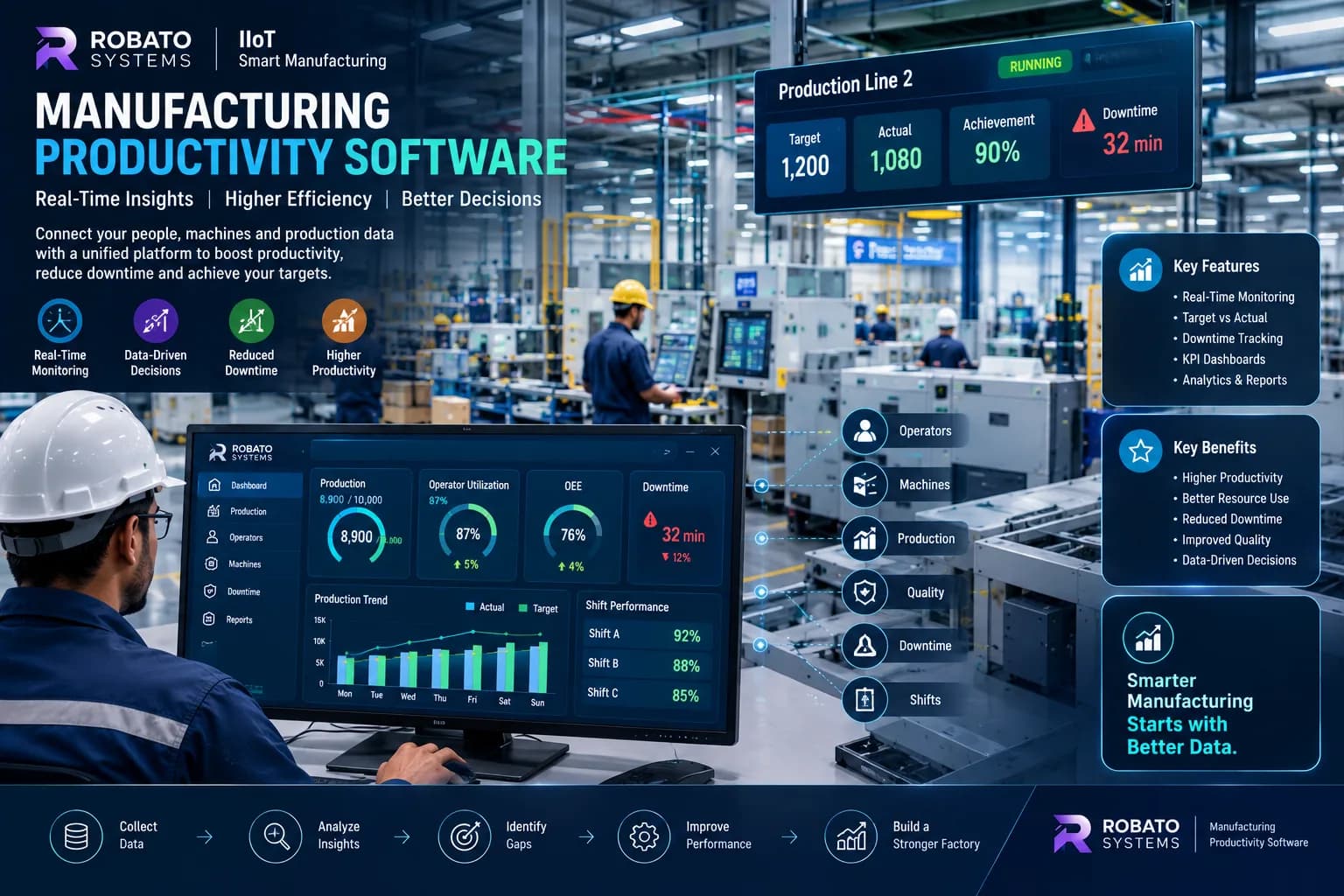
For labor productivity improvement, manufacturers can use connected production data to monitor production targets, actual output, operator assignments, utilization, shift performance, machine status, and other manufacturing KPIs.
When operator performance is analyzed alongside machine downtime, production counts, OEE, and production trends, managers can better understand where productive capacity is being lost.
The objective is to provide production teams with actionable information that can support better workforce utilization, production planning, and continuous improvement.
Conclusion
Improving labor productivity in manufacturing is not simply about increasing the amount of work performed by employees.
It is about creating a production environment where operators have the machines, materials, information, training, and processes required to work effectively.
Manufacturers can improve labor productivity by reducing idle time, improving workforce allocation, standardizing work, optimizing workstation layouts, increasing machine availability, and using real-time production data.
Digital operator productivity and performance monitoring can provide the visibility needed to identify productivity gaps and understand their underlying causes.
When workforce information is combined with machine, production, downtime, and OEE data, manufacturers can build a more complete picture of factory performance.
For companies moving toward Industry 4.0, labor productivity monitoring can become an important part of a connected manufacturing strategy.
FAQs
What is labor productivity in manufacturing?
Labor productivity in manufacturing measures the amount of production output generated relative to the labor resources used to produce it.
How can manufacturers improve labor productivity?
Manufacturers can improve labor productivity by reducing idle time, improving workforce allocation, standardizing work, improving training, optimizing workstations, reducing machine downtime, and using production data for decision-making.
What are the main causes of low labor productivity?
Common causes include operator idle time, machine downtime, material shortages, poor workforce allocation, inefficient workstations, inadequate training, process delays, and poor production planning.
How is labor productivity measured?
A basic measurement is production output divided by labor input, such as total labor hours or workforce hours.
What is the role of operator productivity monitoring?
Operator productivity monitoring provides visibility into production output, target achievement, utilization, idle time, and other performance indicators associated with production activities.
Can machine downtime affect labor productivity?
Yes. When a machine is unavailable, operators assigned to that machine may be unable to continue production, reducing productive labor time.
How does real-time monitoring improve labor productivity?
Real-time monitoring allows supervisors to identify production gaps, idle time, machine downtime, and other issues while the shift is still running.
Is labor productivity the same as employee performance?
No. Labor productivity is a production-related measurement. Employee performance should be evaluated using relevant operational context rather than production output alone.