A machine does not need to break down to cause a production loss. It can remain operational, available, and ready to work while waiting for materials, an operator, a production order, or the completion of another process.
These periods of inactivity are often overlooked because the equipment may not generate a fault or trigger a maintenance alert. However, repeated idle periods can reduce productive operating time, delay orders, and prevent manufacturers from using their existing production capacity effectively.
Machine Idle Time Monitoring helps factories identify when equipment is available but not actively producing, measure the duration of idle periods, and investigate the operational conditions responsible for them.
By combining machine signals, production information, and historical reports, manufacturers can distinguish avoidable waiting time from legitimate pauses and take targeted action to improve production flow.
This guide explains what machine idle time means, why it occurs, how to monitor it, and the practical steps manufacturers can take to reduce unnecessary machine inactivity.
What Is Machine Idle Time?
Machine idle time is the period during which equipment is available for operation but is not actively performing its intended production activity.
The machine may be powered on and ready to operate, but production is not taking place.
Common examples include:
A machine waiting for raw materials
Equipment waiting for an operator
A production machine waiting for an upstream process
A machine waiting for the next production order
Equipment remaining unused between changeovers
A machine waiting for a downstream workstation to become available
The precise definition depends on the equipment and manufacturing process.
For example, a machine intentionally waiting for a required cooling cycle should not automatically be classified as experiencing avoidable idle time. Similarly, a planned production pause may be legitimate even though no production occurs.
For meaningful analysis, manufacturers should define machine states consistently and distinguish normal process requirements from unnecessary waiting.
Machine Idle Time vs. Machine Downtime
Machine idle time and machine downtime are related, but they do not always mean the same thing.
Machine idle time generally describes equipment that is available but not actively producing.
Machine downtime generally refers to periods when equipment is stopped or unavailable under the organization's reporting rules.
Consider the following examples:
| Situation | Possible Classification |
|---|---|
| Machine waiting for raw material | Idle time |
| Machine waiting for an operator | Idle time |
| Machine stopped because of a mechanical failure | Downtime |
| Machine undergoing planned maintenance | Planned downtime |
| Machine waiting for a downstream workstation | Idle time or process-related stop |
| Machine intentionally paused for a required process step | Planned or process-related waiting |
The correct classification depends on how the factory defines its machine states.
This distinction matters because different causes require different corrective actions. Maintenance may resolve equipment failures, but it will not necessarily solve material shortages or production scheduling problems.
Why Is Machine Idle Time a Problem in Manufacturing?
Machine idle time reduces the amount of available time that can be used for production.
When these periods occur repeatedly, the cumulative effect can be significant.
For example, suppose a machine loses 12 minutes to avoidable waiting during each of 10 production cycles.
Total idle time = 12 × 10 = 120 minutes.
That represents two hours of waiting during the selected production period.
The actual production loss will depend on the machine's production rate, product mix, process constraints, and whether the lost time can be recovered.
Excessive idle time can contribute to:
Lower production output
Poorer equipment utilization
Delayed production orders
Uneven workloads across machines
Increased pressure to use overtime
Reduced visibility into production bottlenecks
Inefficient use of manufacturing resources
Identifying the reasons behind idle time helps manufacturers determine which losses can realistically be reduced.
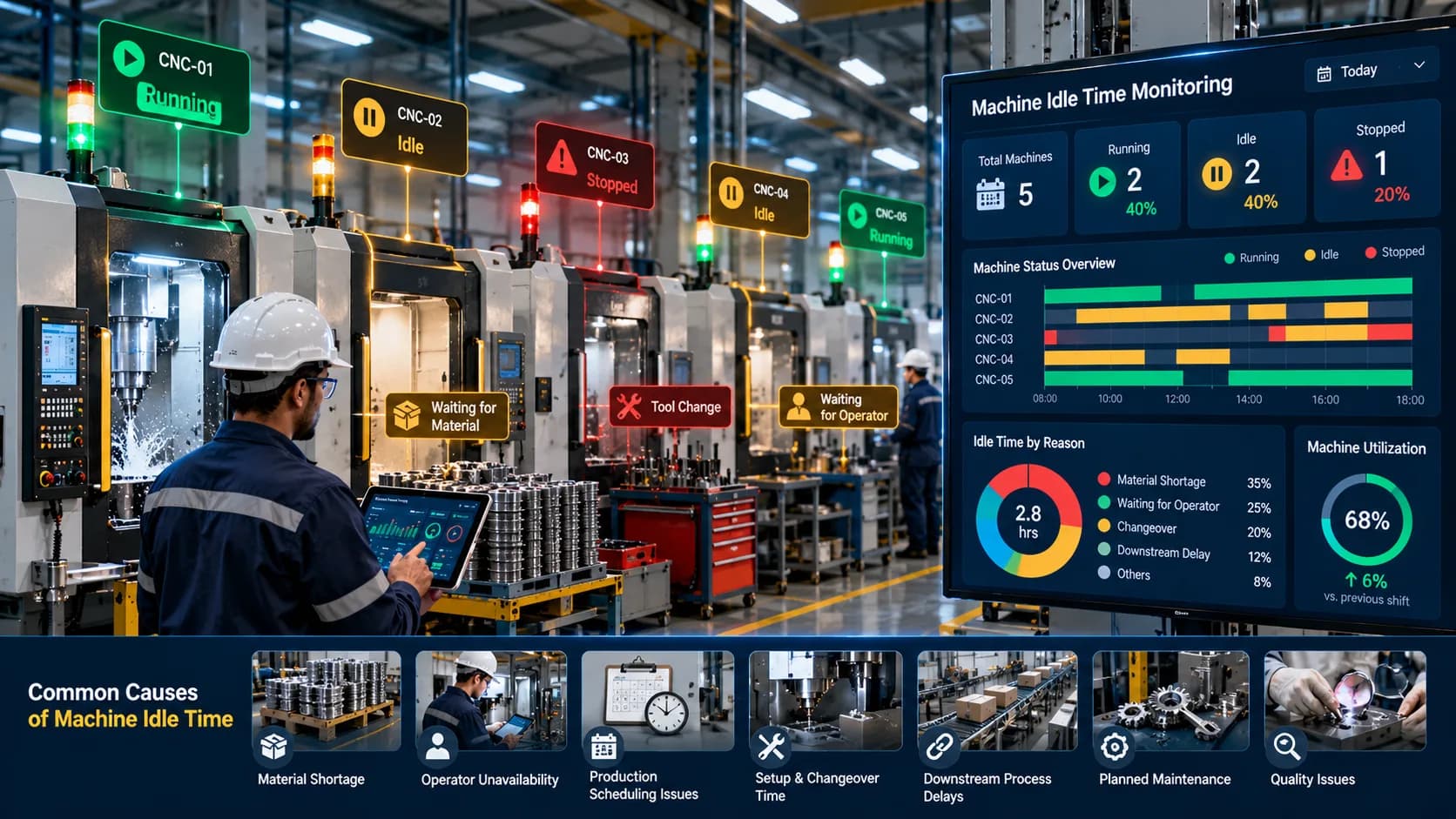
Common Causes of Machine Idle Time
Before attempting to reduce machine idle time, manufacturers need to understand why it occurs.
1. Material Shortages
Machines may remain idle when raw materials, components, packaging materials, or other required inputs are unavailable.
This can happen because of inaccurate inventory information, delayed material replenishment, supplier delays, or poor coordination between stores and production.
2. Operator Unavailability
Some machines require an operator to load materials, supervise processes, perform inspections, or initiate the next cycle.
When the required operator is unavailable, equipment may remain idle despite being ready to operate.
3. Production Scheduling Problems
Poorly coordinated production schedules can leave machines waiting for work.
This may occur when production orders are not released on time, priorities change frequently, or workloads are not distributed effectively.
4. Upstream Process Delays
A machine may depend on material or components from an earlier production stage.
If the upstream machine produces slowly or stops unexpectedly, downstream equipment may remain idle.
5. Downstream Bottlenecks
A machine may finish its work but be unable to continue because the next process cannot accept additional output.
This can occur when downstream equipment has limited capacity, storage buffers are full, or material transfer is delayed.
6. Changeover Delays
Switching between products may require tooling changes, adjustments, cleaning, setup, or verification.
When changeovers take longer than planned, the equipment remains unavailable for normal production.
7. Quality Inspections and Approvals
Production may pause while samples are inspected or quality decisions are made.
Some inspections are necessary, but poorly coordinated approval processes can create avoidable waiting.
8. Minor Operational Interruptions
Small issues such as incorrect material positioning, missing tools, repeated adjustments, or minor sensor interruptions can create short idle periods.
Although individual events may appear insignificant, repeated interruptions can accumulate into substantial lost time.
What Is Machine Idle Time Monitoring?
Machine idle time monitoring is the process of identifying, recording, measuring, and analyzing periods when equipment is available but not actively producing.
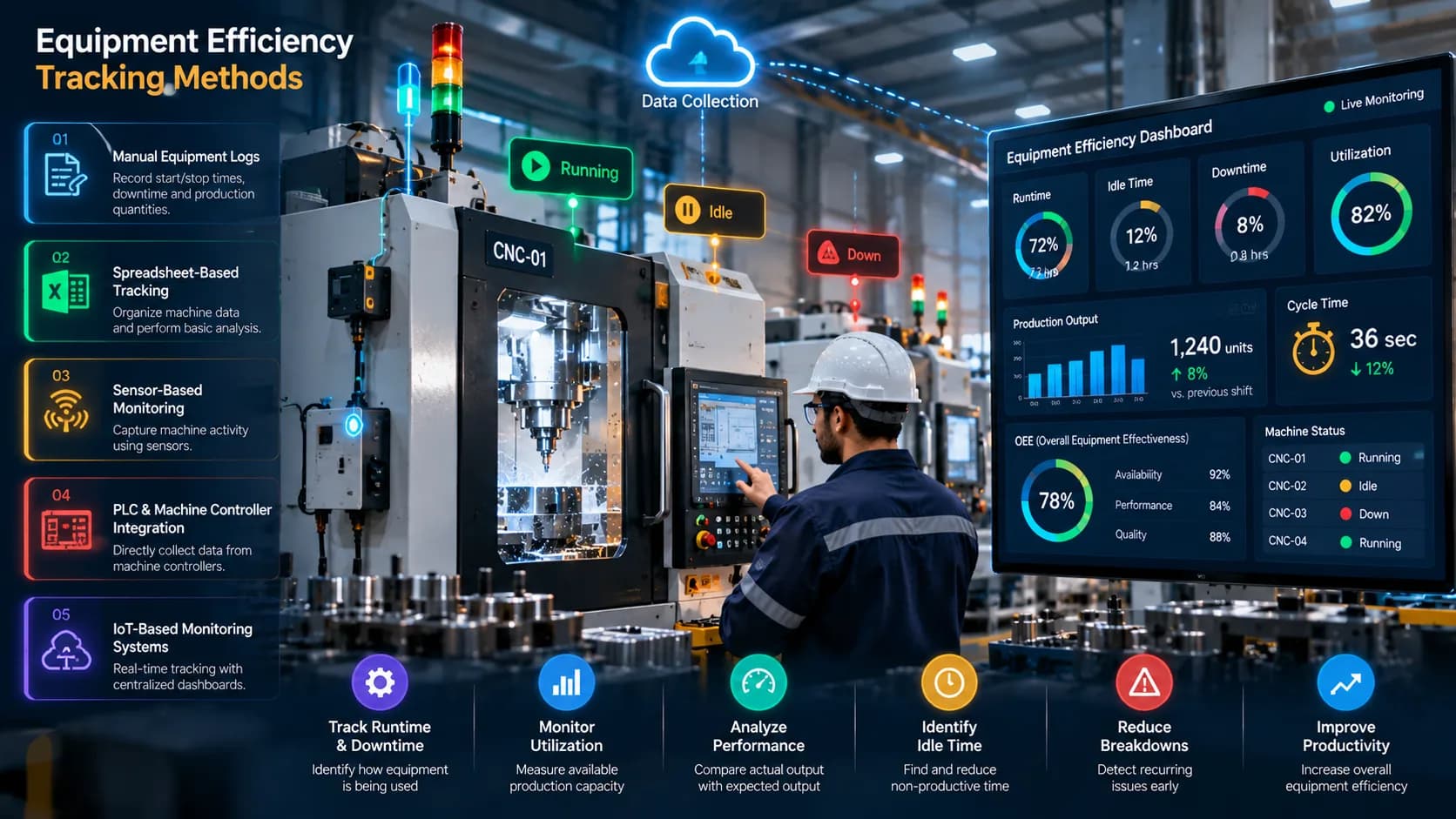
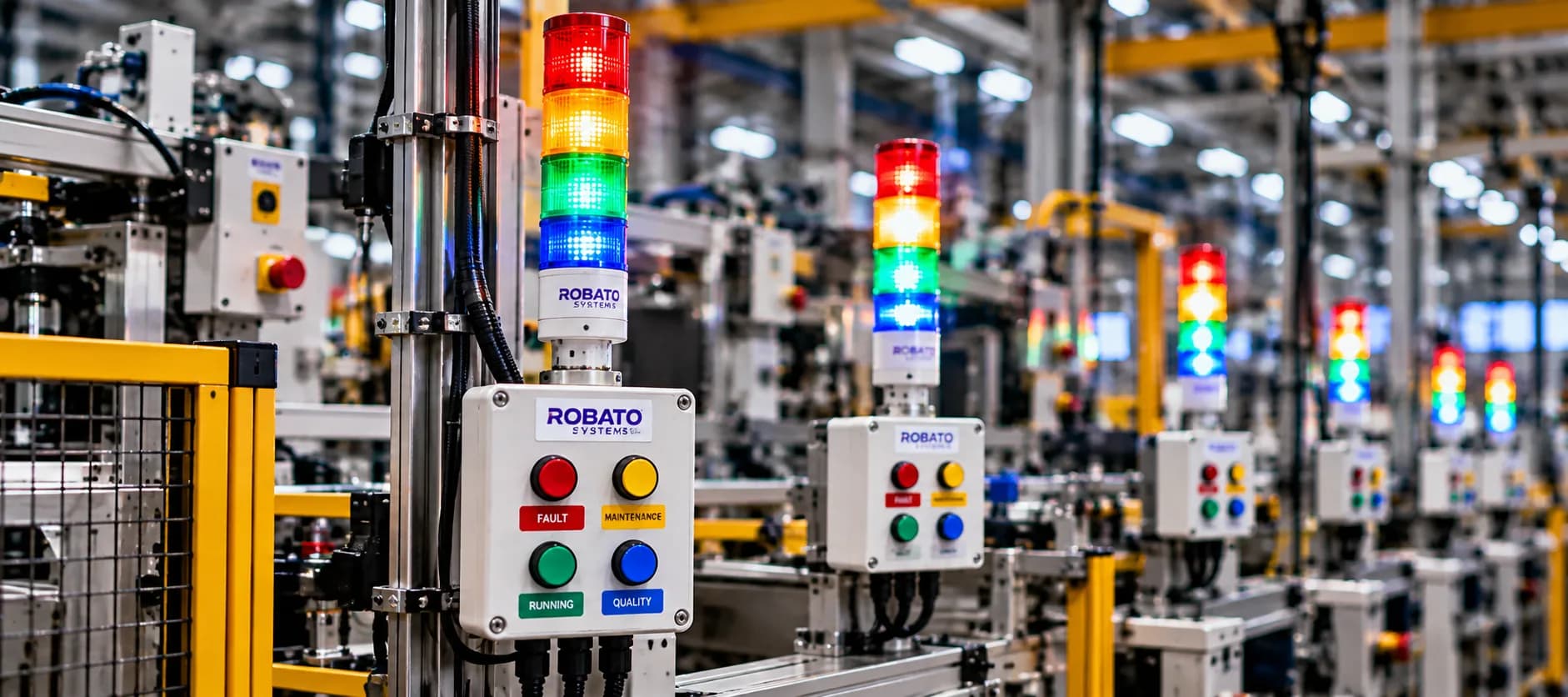
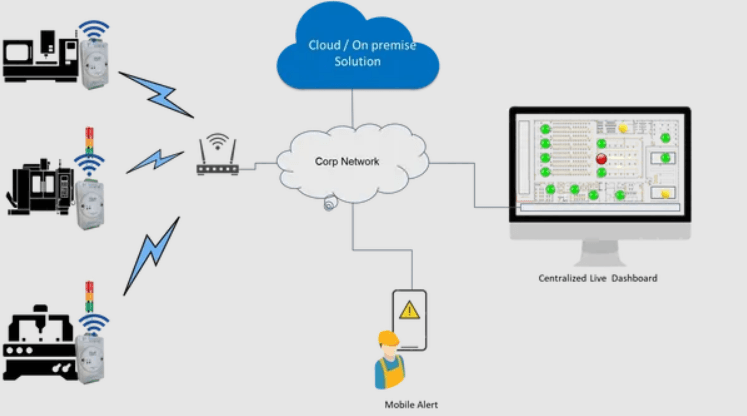
A monitoring system may use PLC signals, sensors, machine controllers, industrial gateways, or production-system information to identify machine states.
Depending on the system's capabilities, it can help determine:
When a machine becomes idle
How long the idle period lasts
How frequently idle periods occur
Which machines experience the most idle time
Which shifts have recurring waiting periods
Which production lines are affected
Whether idle time is increasing or decreasing
The most valuable systems also help classify the reasons behind idle events.
A machine status signal may reveal that equipment is waiting, but identifying the underlying reason may require operator input, material data, production scheduling information, or integration with other systems.
How Machine Idle Time Monitoring Works
Step 1: Collect Machine Activity Data
The monitoring system obtains operational signals from the equipment.
Depending on the machine, these may include running status, cycle completion, fault conditions, production counts, or other relevant signals.
Step 2: Define Machine States
The collected signals are interpreted using predefined rules.
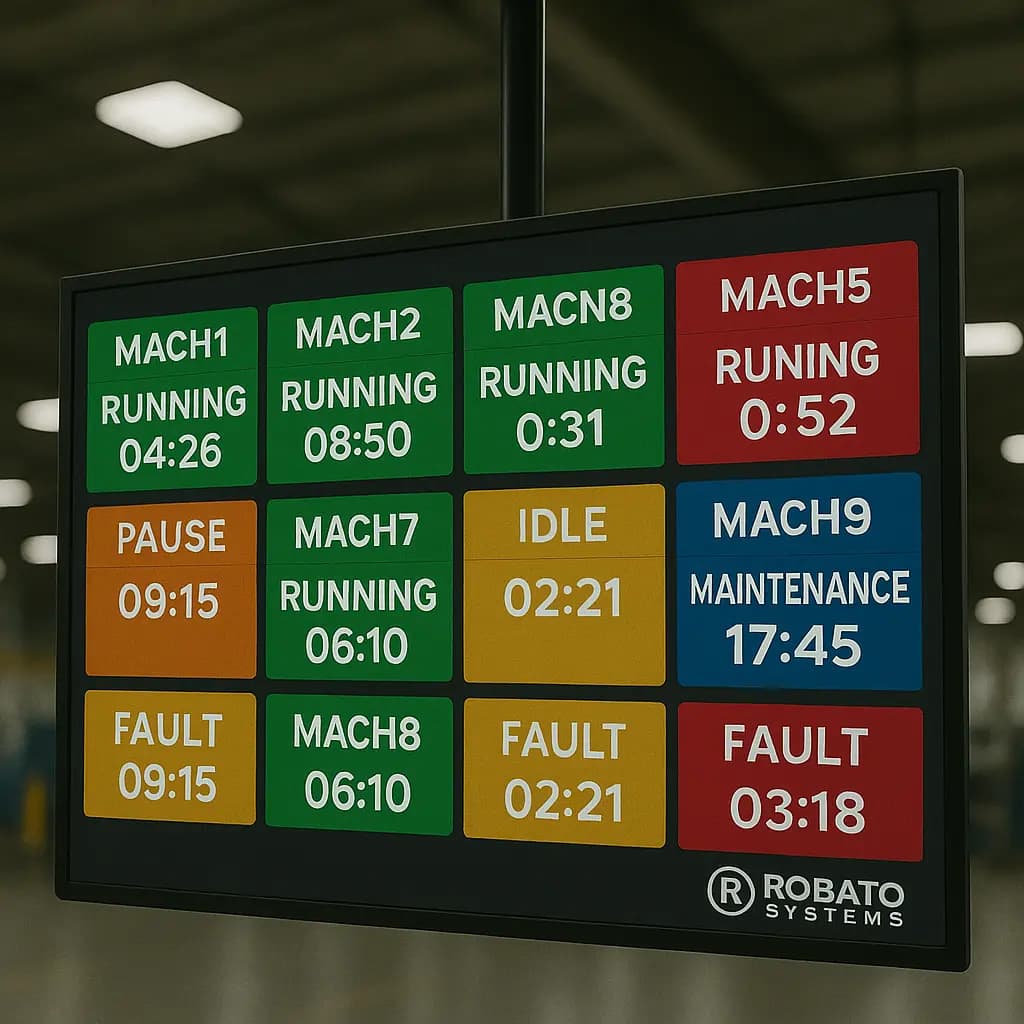
For example, a machine may be classified as running, idle, stopped, faulted, or under maintenance.
Clear definitions are essential because a machine that is ready but waiting for material should not necessarily be classified in the same way as a machine experiencing a mechanical failure.
Step 3: Record Idle Events
When the machine enters the defined idle state, the system records the start time.
When the machine resumes production or moves to another state, the end time is recorded.
The duration can then be calculated.
Step 4: Calculate Idle Time
Individual idle periods are added together to calculate the total idle time for a machine, shift, production line, or selected reporting period.
Step 5: Analyze the Data
Production teams review the recorded events to identify patterns.
For example, if idle periods frequently occur before the afternoon shift begins, the organization may need to investigate shift handovers, material preparation, or production scheduling.
Step 6: Implement Corrective Actions
Once the cause is understood, the factory can introduce appropriate improvements and continue monitoring to measure the result.
How to Calculate Machine Idle Time
A basic calculation is:
Total Machine Idle Time = Sum of All Recorded Idle Periods
Suppose a machine experiences these idle periods during one shift:
First idle event: 10 minutes
Second idle event: 15 minutes
Third idle event: 20 minutes
Fourth idle event: 5 minutes
Total idle time = 10 + 15 + 20 + 5 = 50 minutes
The machine recorded 50 minutes of idle time during that shift.
To understand the significance of this figure, compare it with the relevant available production time.
A commonly used calculation is:
Idle Time Percentage = Total Idle Time ÷ Available Production Time × 100
If the machine has eight hours of available production time, that equals 480 minutes.
Idle time percentage = 50 ÷ 480 × 100 = 10.42%
This calculation is meaningful only when the idle-time definition and available-time denominator are consistent. Planned breaks, scheduled maintenance, and other excluded periods should be handled according to the factory's reporting rules.
How to Reduce Machine Idle Time
Monitoring provides visibility, but reducing idle time requires practical operational changes.
1. Improve Material Availability
Ensure that required materials are available before production begins.
Possible improvements include:
Reviewing material requirements before each shift
Establishing replenishment triggers
Improving coordination between stores and production
Using inventory information to identify shortages
Preparing materials for upcoming production orders
The objective is to prevent machines from waiting for materials that should have been available.
2. Improve Production Scheduling
Production schedules should account for machine availability, material readiness, changeover requirements, and dependencies between processes.
Better scheduling can reduce waiting caused by incomplete production orders or poorly coordinated workloads.
3. Coordinate Operators and Machines
Review how operator responsibilities align with machine requirements.
Where operators manage multiple machines, analyze whether their workload creates repeated waiting periods.
Adjusting task allocation or coordinating activities may reduce unnecessary idle time without requiring additional equipment.
4. Reduce Changeover Time
Review the steps involved in switching between products.
Factories may reduce changeover-related waiting by preparing tools and materials in advance, standardizing setup procedures, and improving coordination between production and maintenance teams.
Not every changeover can be shortened, but unnecessary waiting and preparation delays can often be investigated.
5. Address Upstream and Downstream Bottlenecks
A machine may remain idle because another production stage cannot supply or accept material at the required rate.
Analyze the complete production flow rather than examining each machine in isolation.
Possible actions include adjusting schedules, balancing workloads, improving material transfer, or investigating recurring bottlenecks.
6. Improve Shift Handover
Incomplete handovers can delay production when the incoming team needs to identify machine status, confirm production priorities, or locate materials.
A standardized handover process can help ensure that the next shift has the information and resources required to begin work promptly.
7. Improve Tool and Material Preparation
Ensure that required tools, fixtures, consumables, and components are ready before they are needed.
This is especially useful for operations that involve frequent product changes or manual setup activities.
8. Investigate Repeated Short Stops
Small interruptions may appear insignificant when reviewed individually.
Use machine event records to identify frequent short stops and investigate their causes.
The appropriate response may involve process adjustments, improved material handling, better setup procedures, or equipment maintenance.
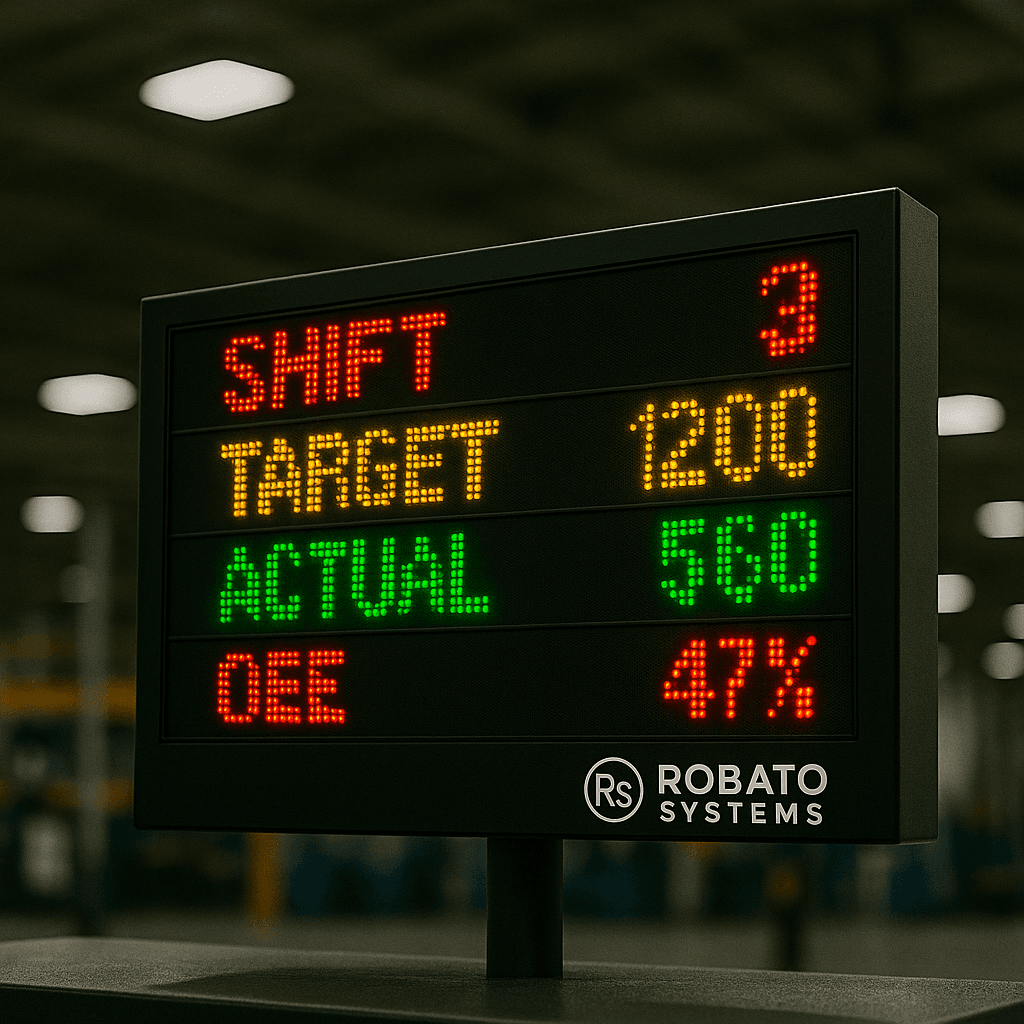
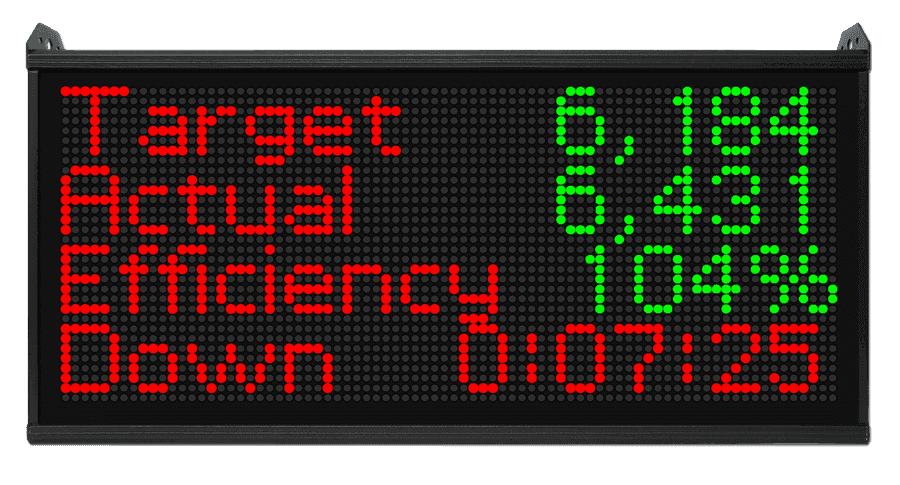
9. Use Real-Time Monitoring
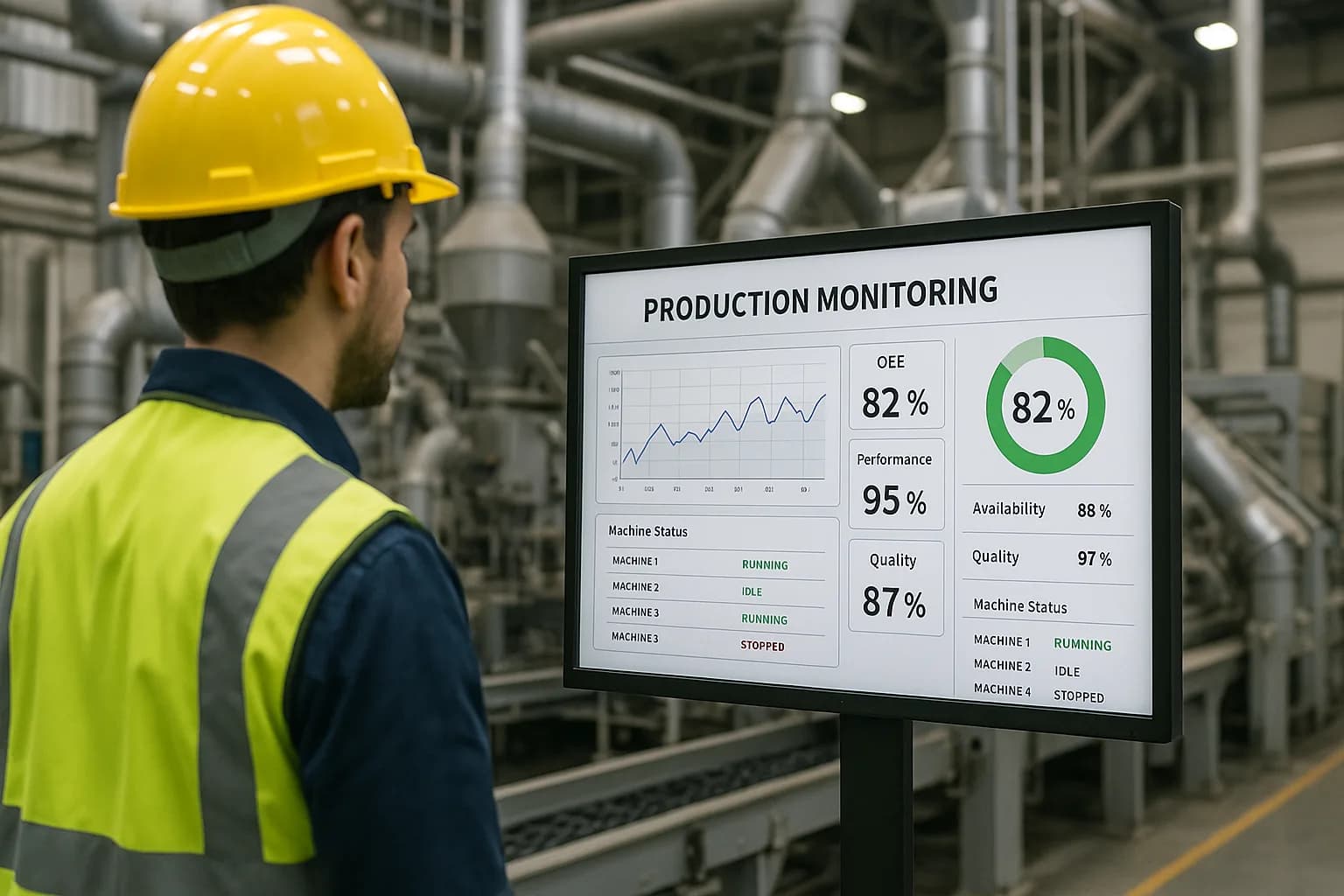
Real-time monitoring can make extended idle periods visible while production is still underway.
Supervisors can investigate whether an event requires material replenishment, operator assistance, schedule clarification, or another response.
10. Review Results After Each Improvement
Measure idle time before and after corrective actions.
This helps determine whether the change produced a meaningful improvement or whether additional investigation is required.
Using an Idle Time Dashboard
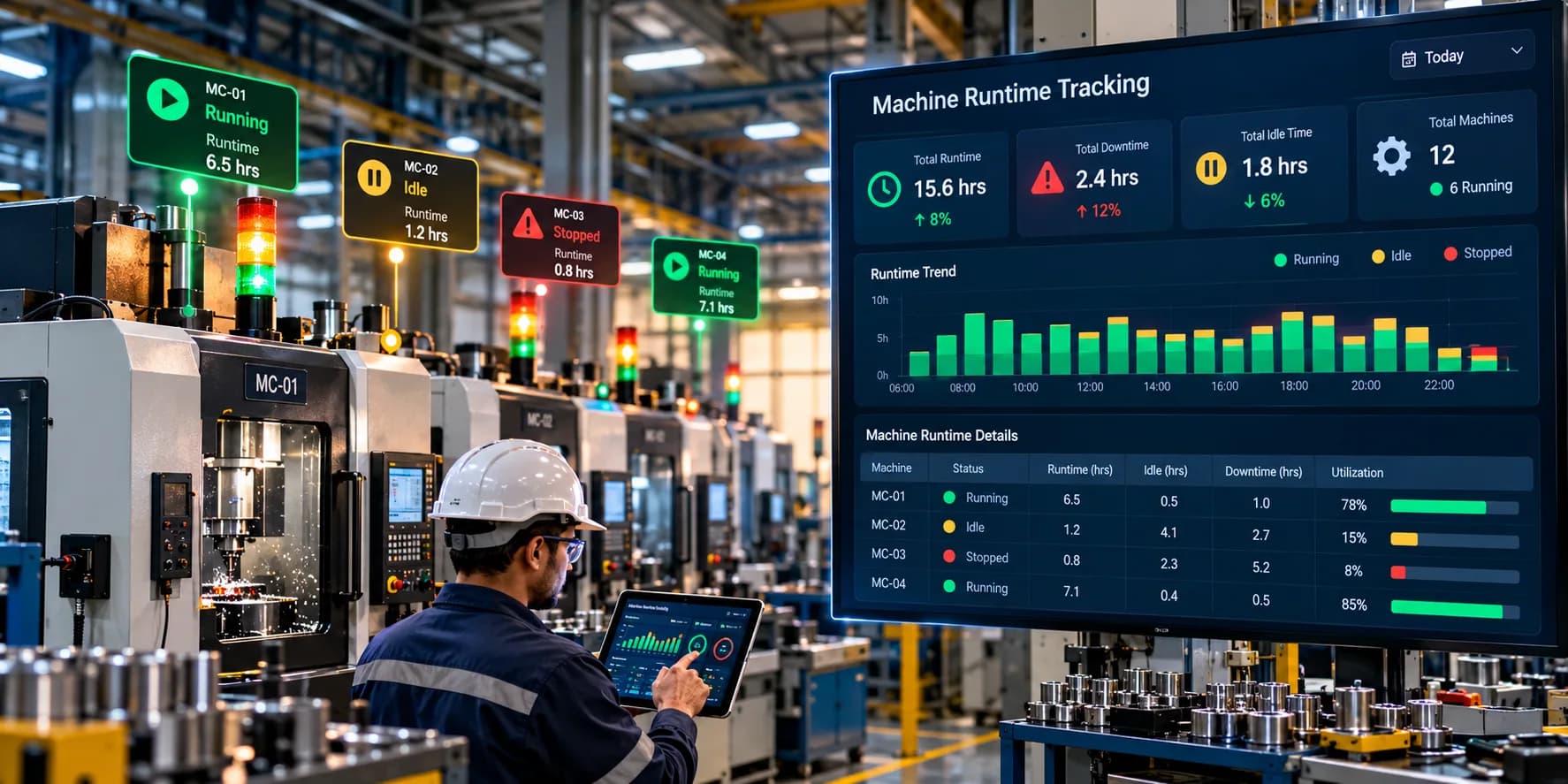
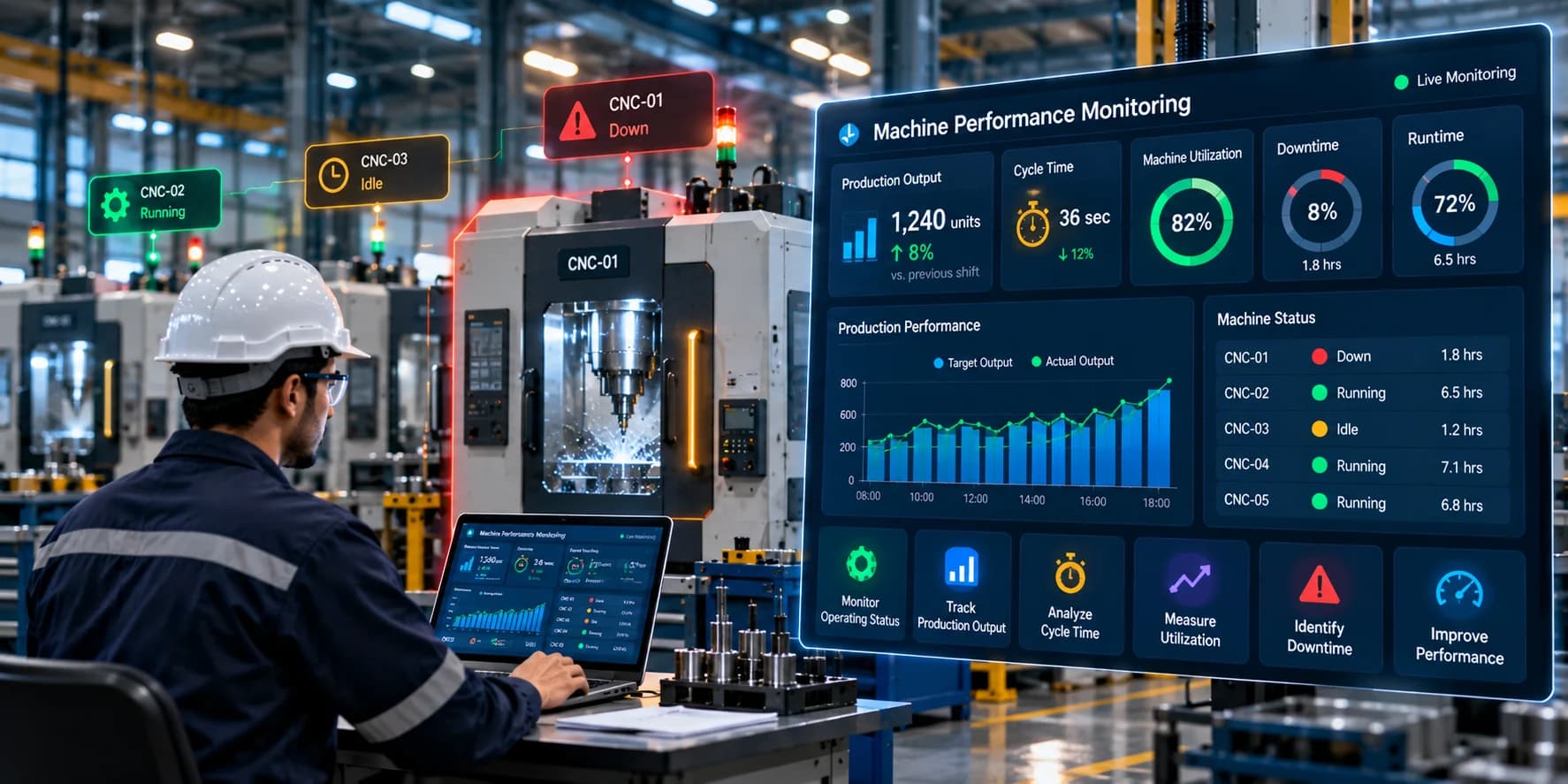
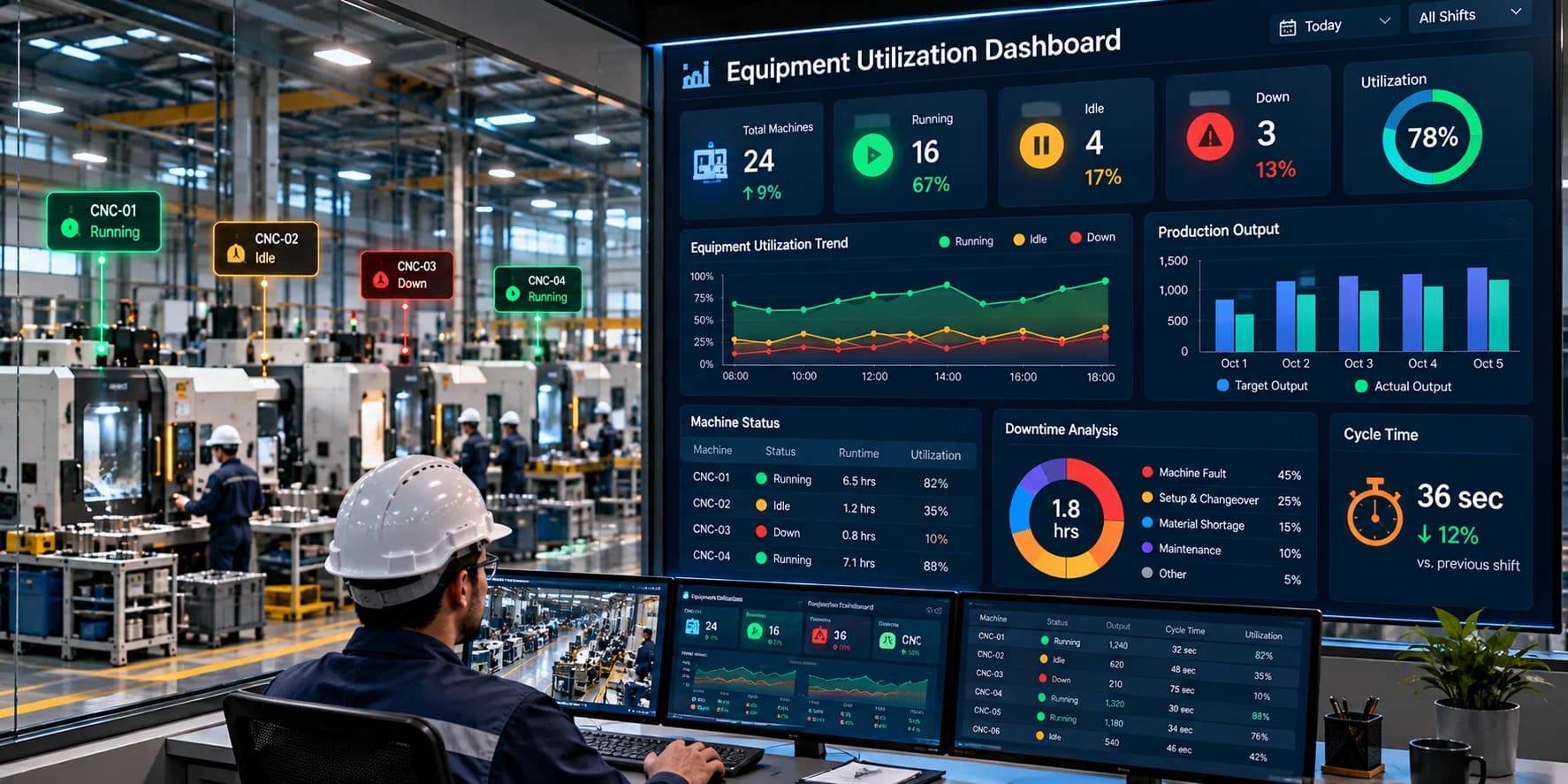
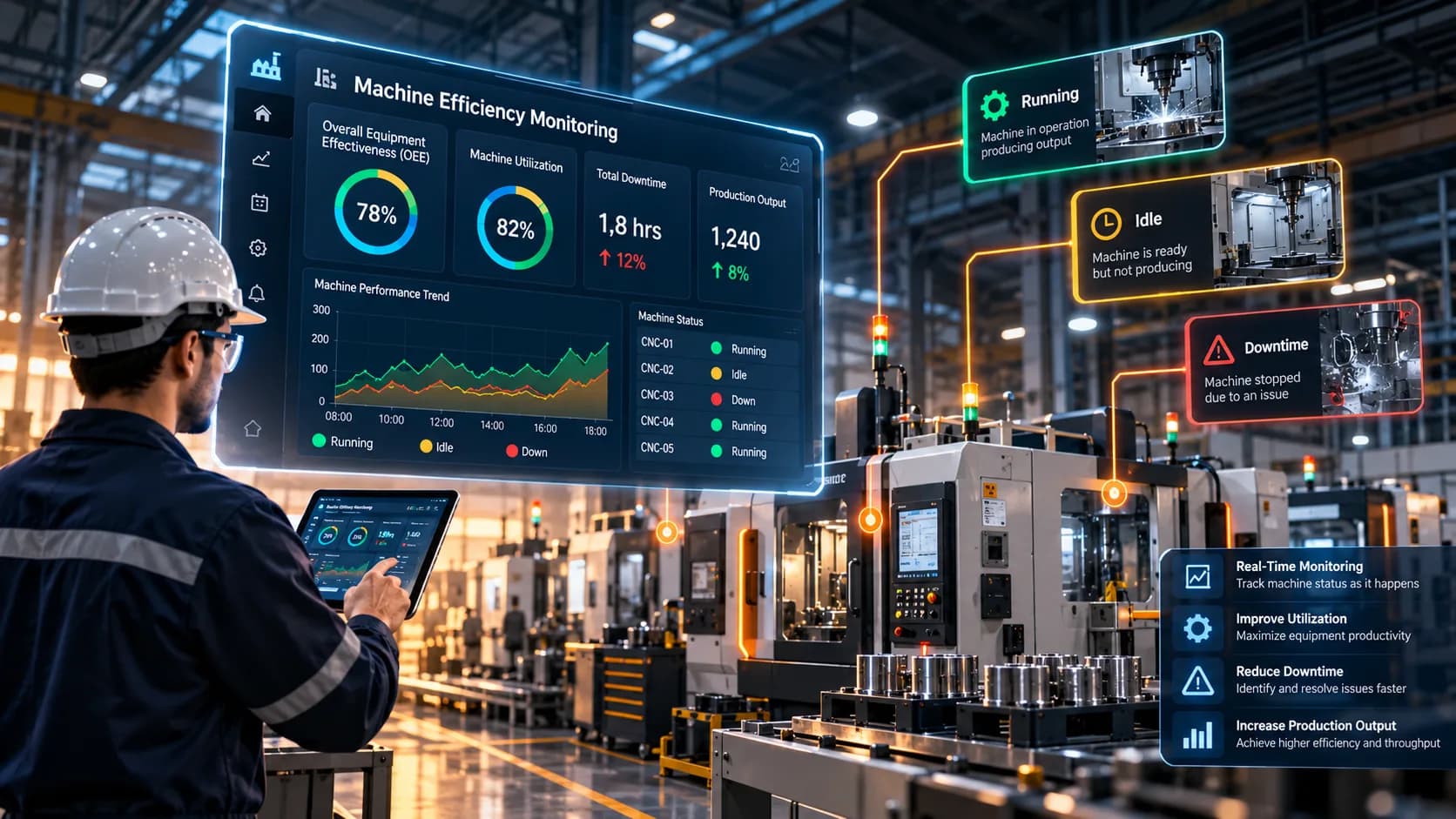
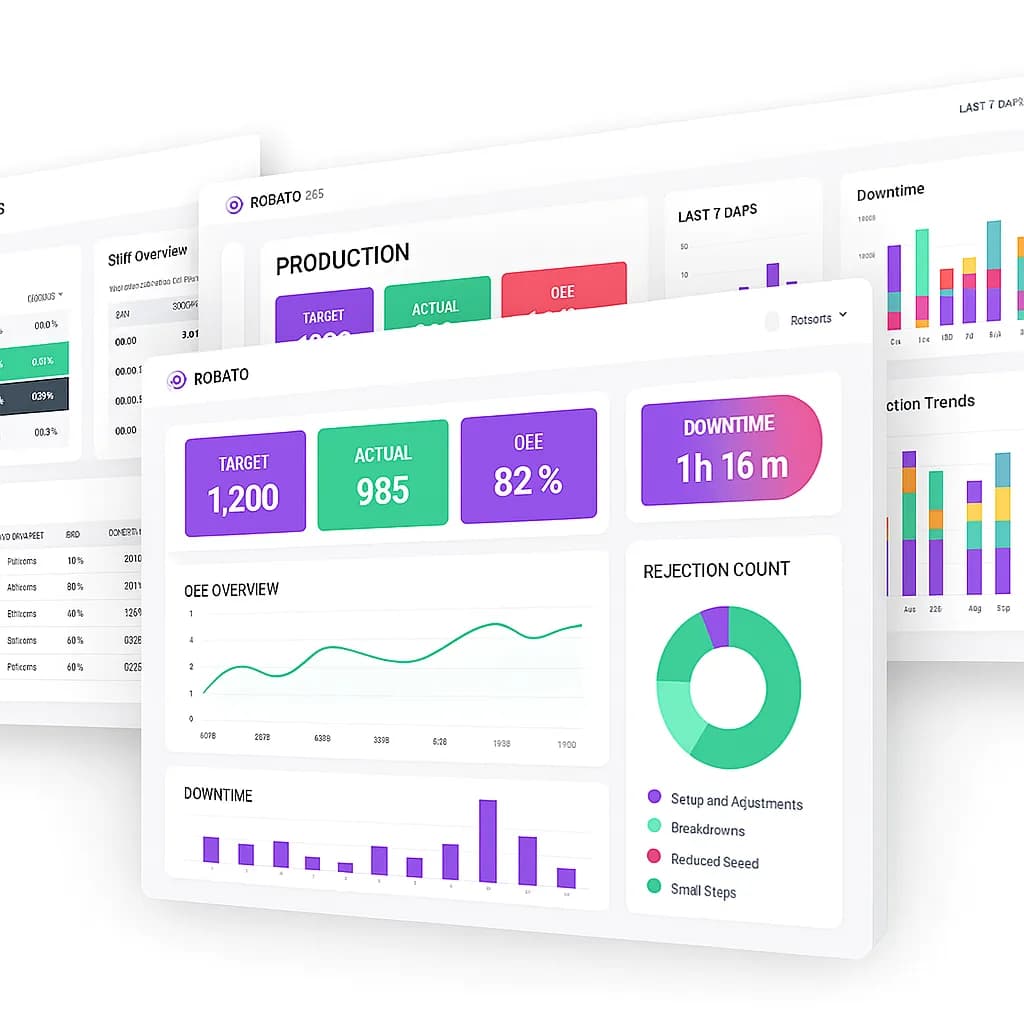
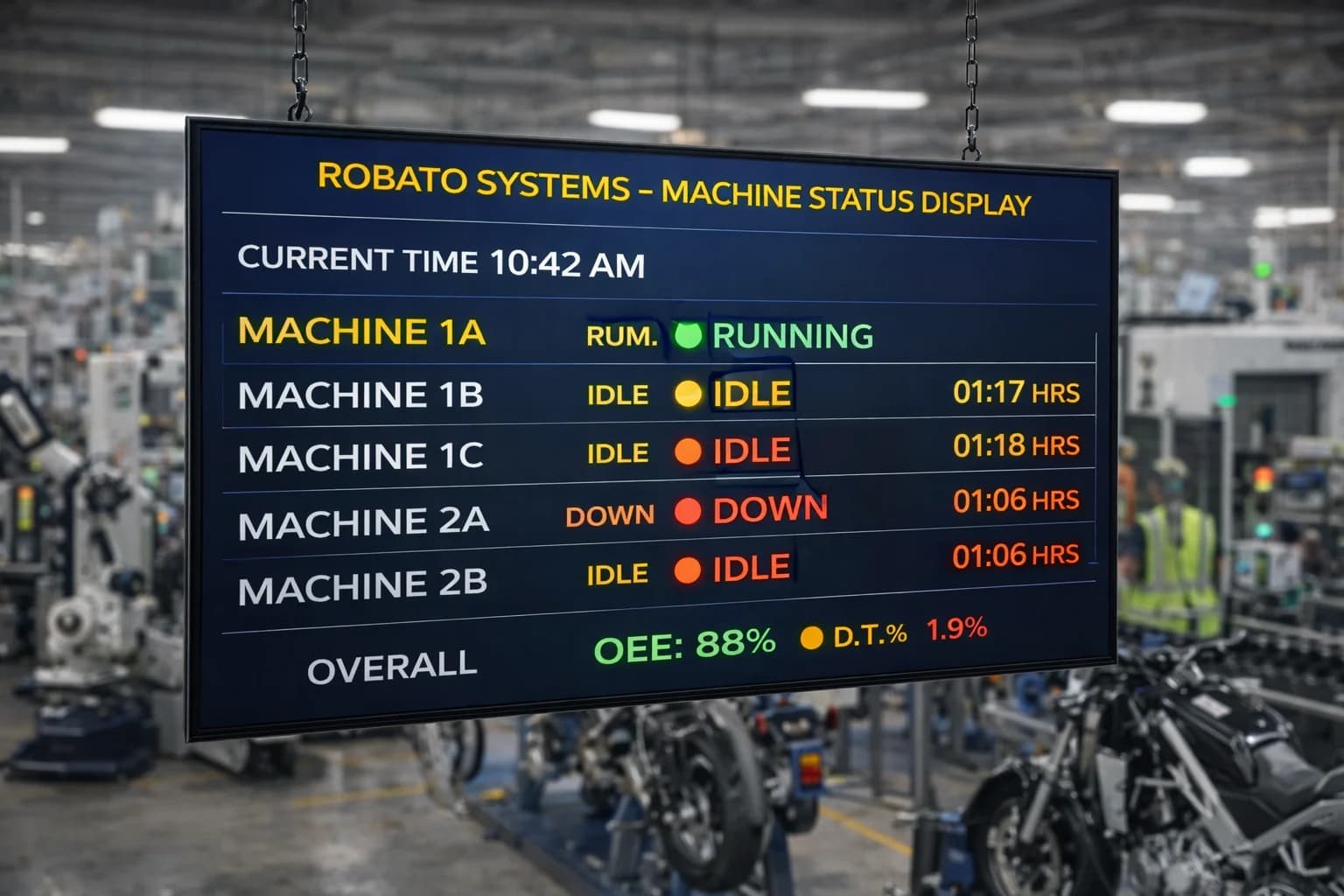
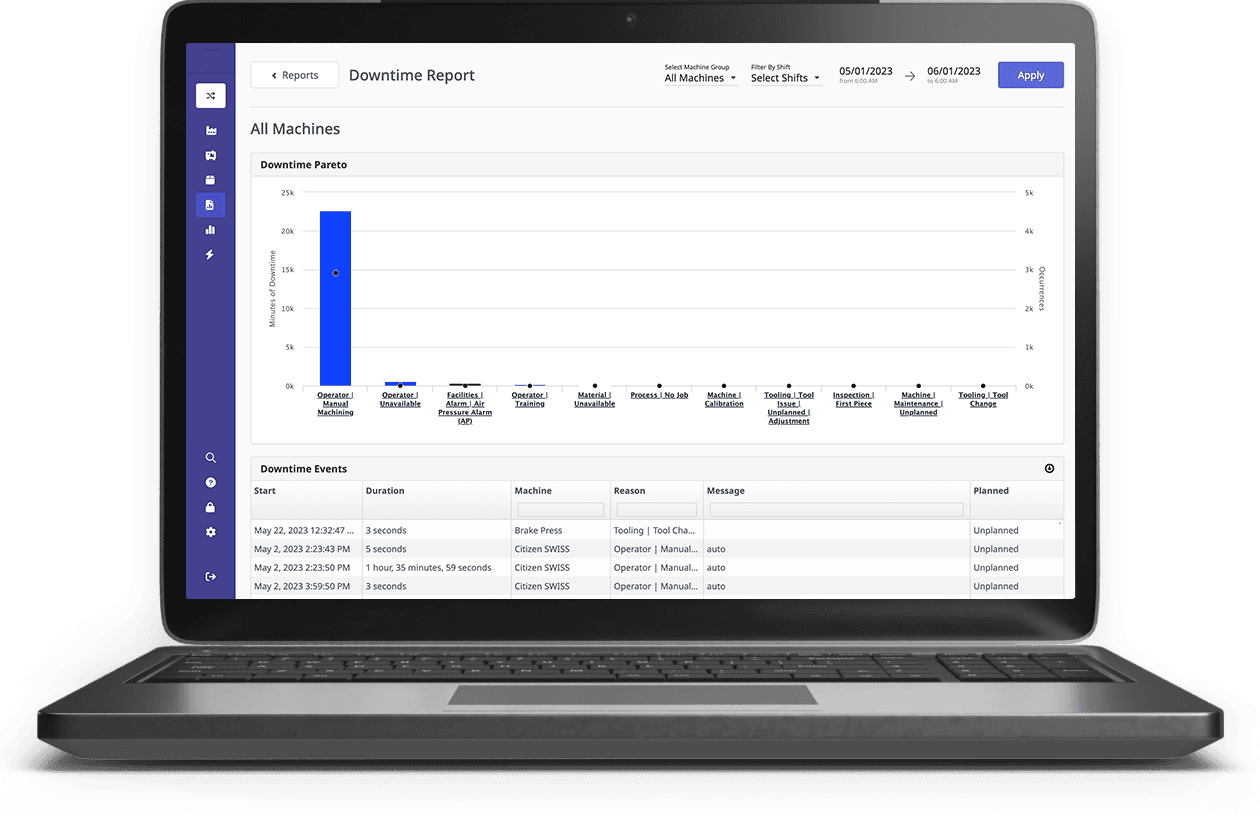
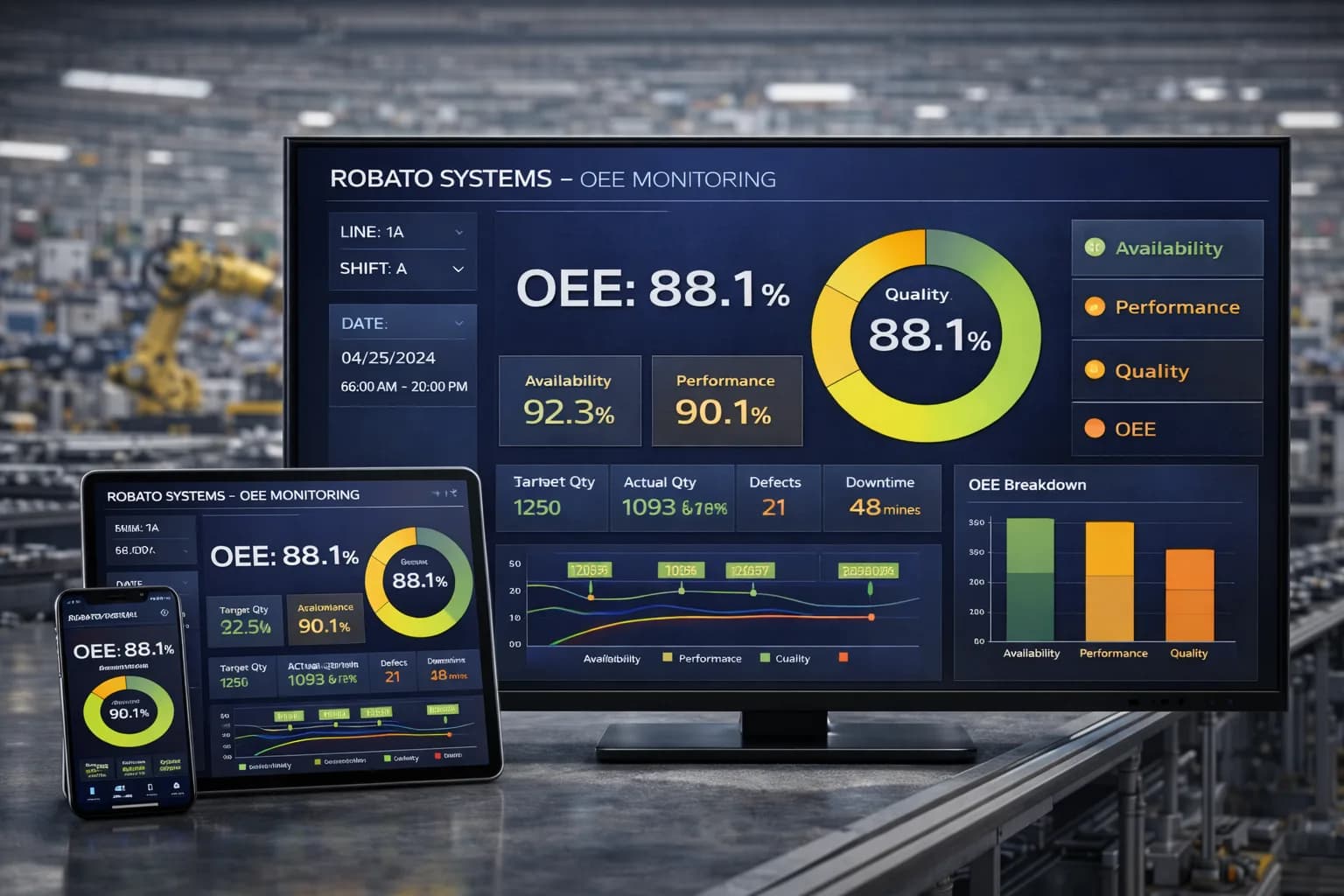
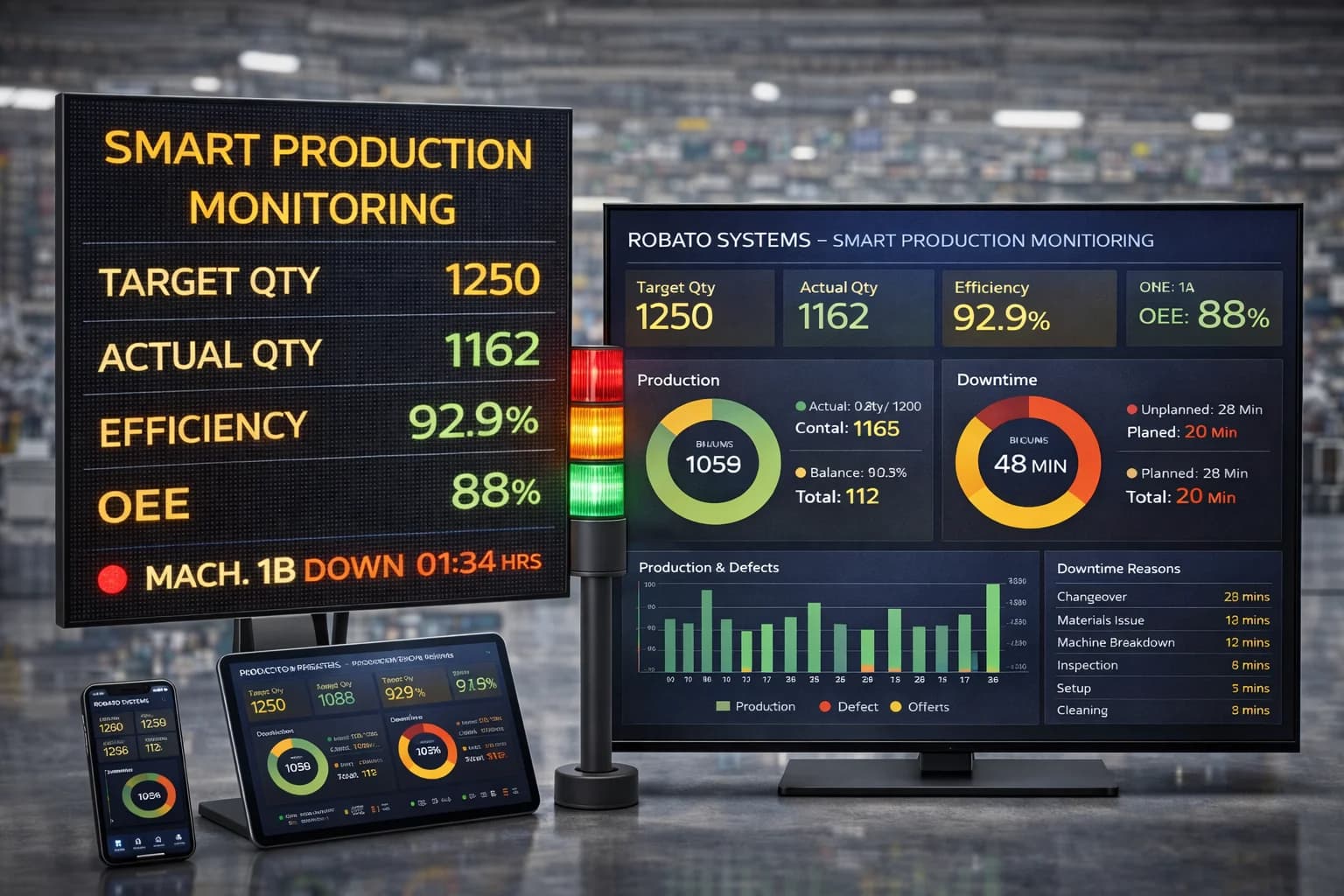
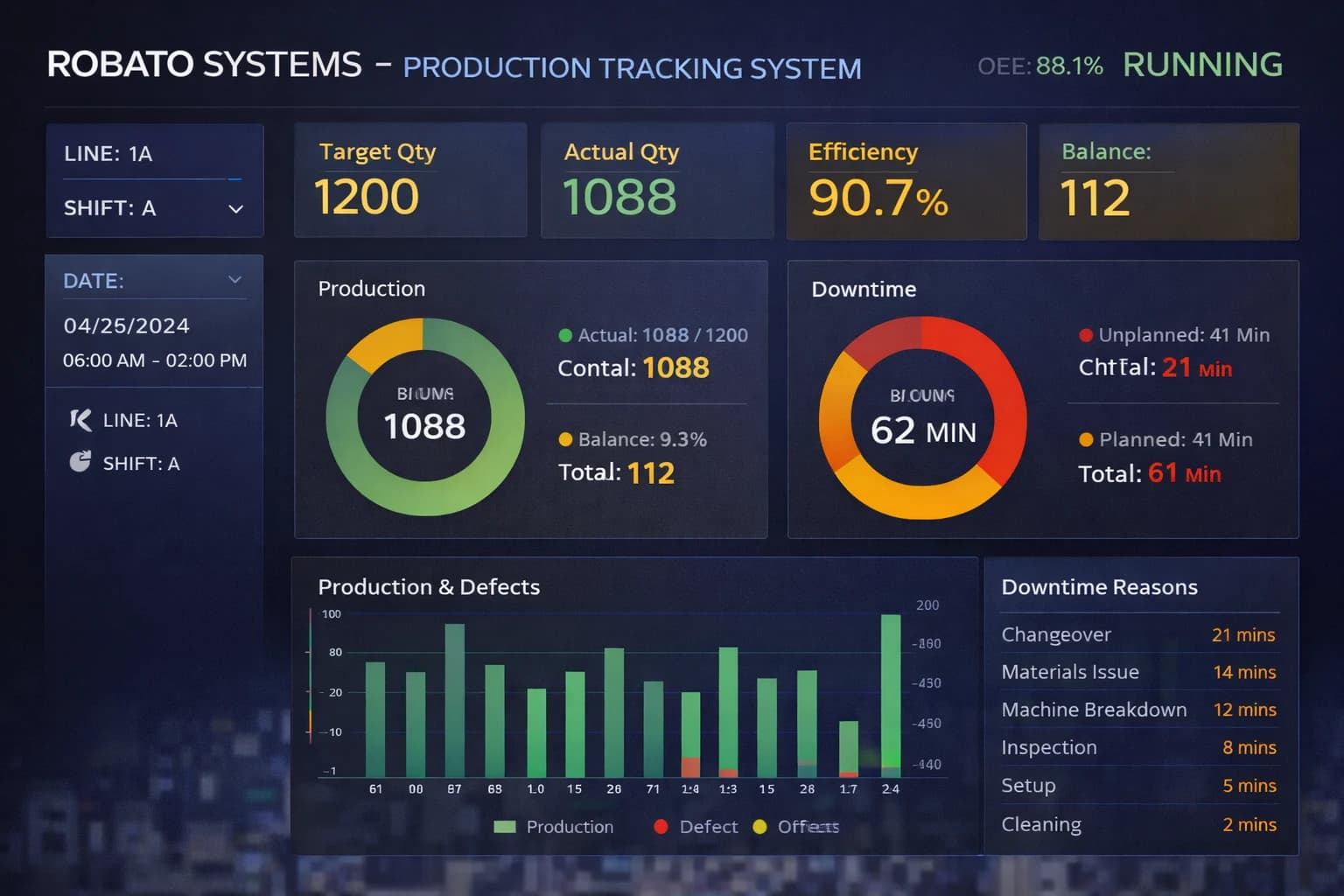
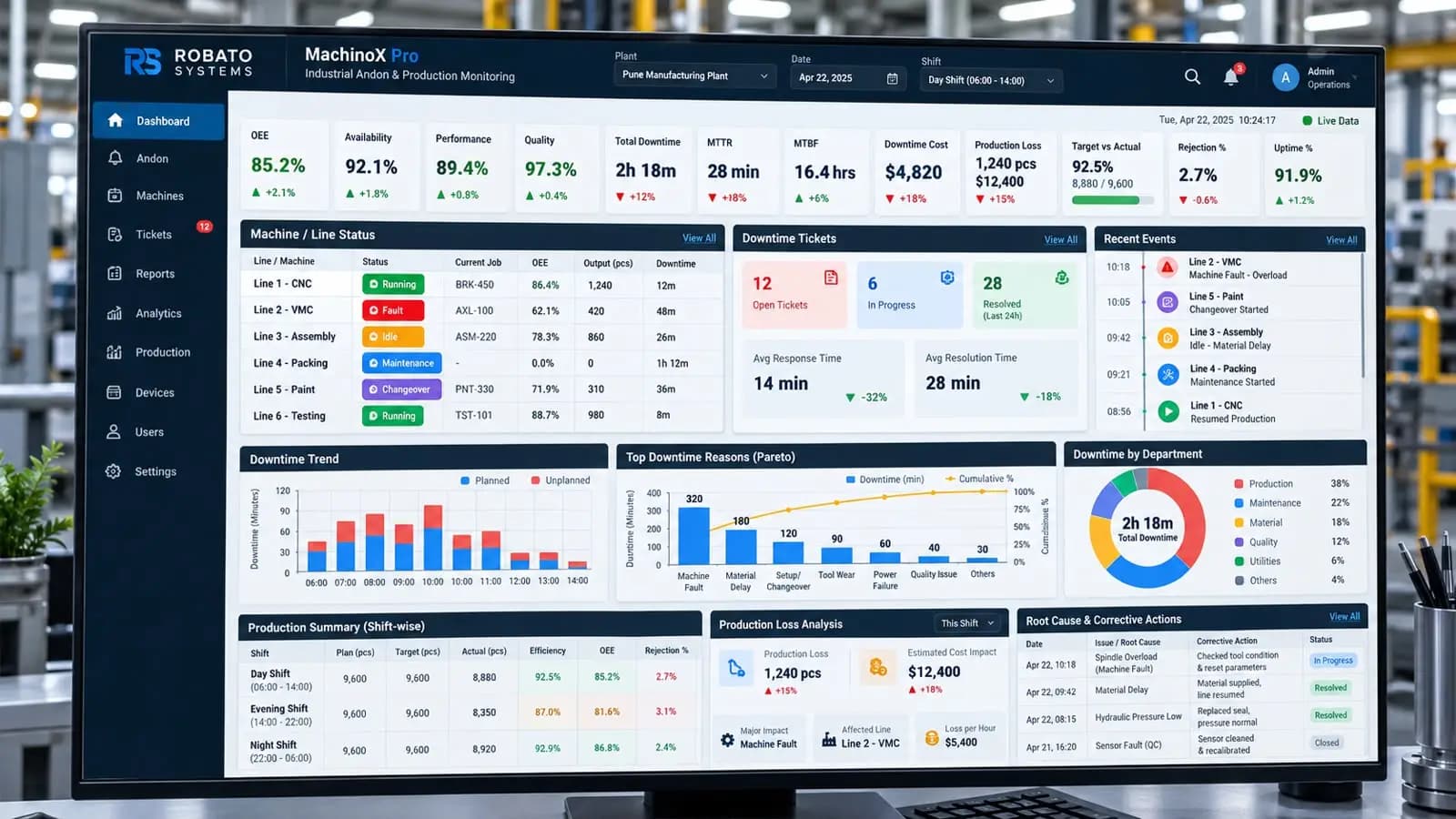
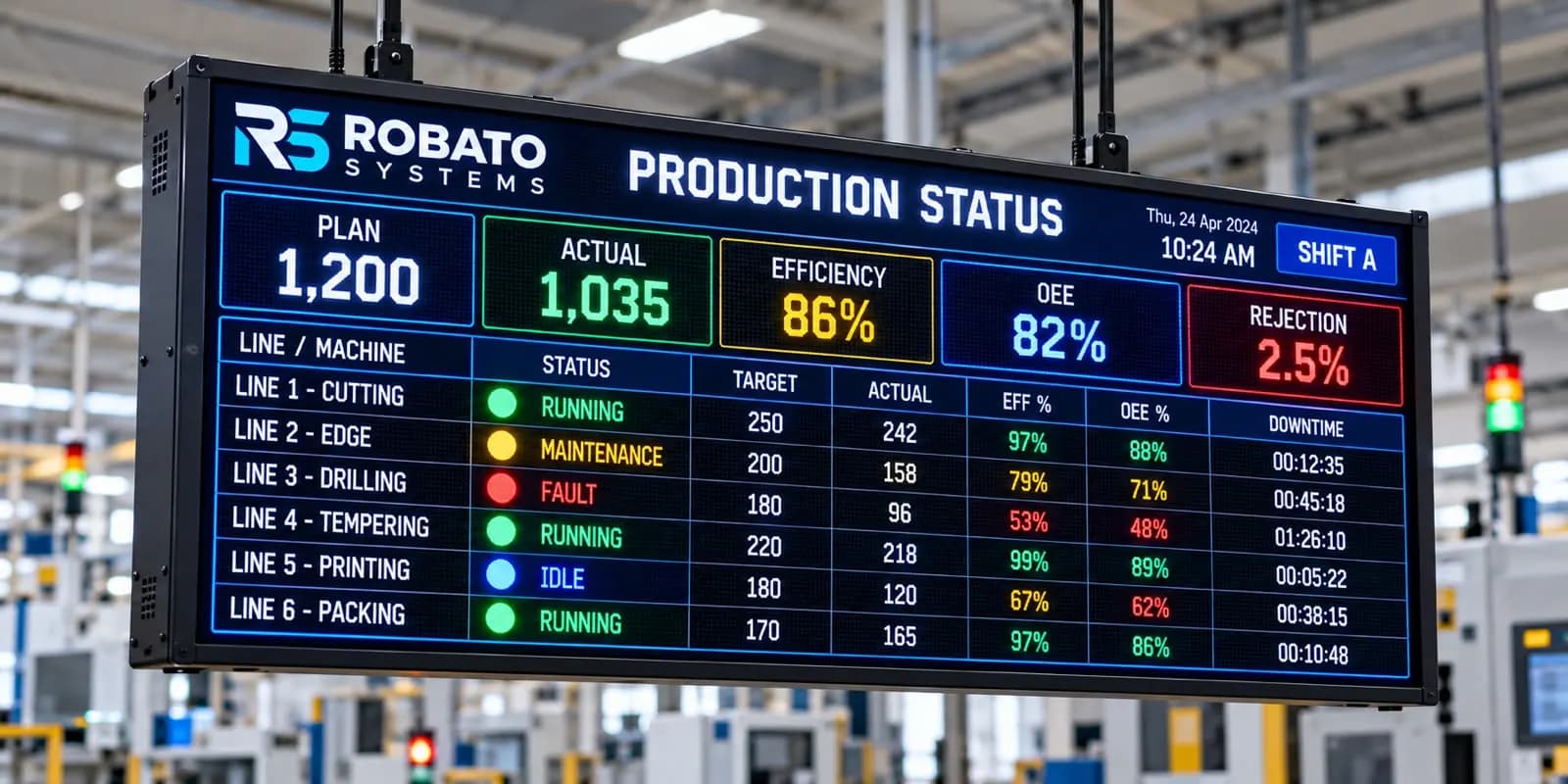
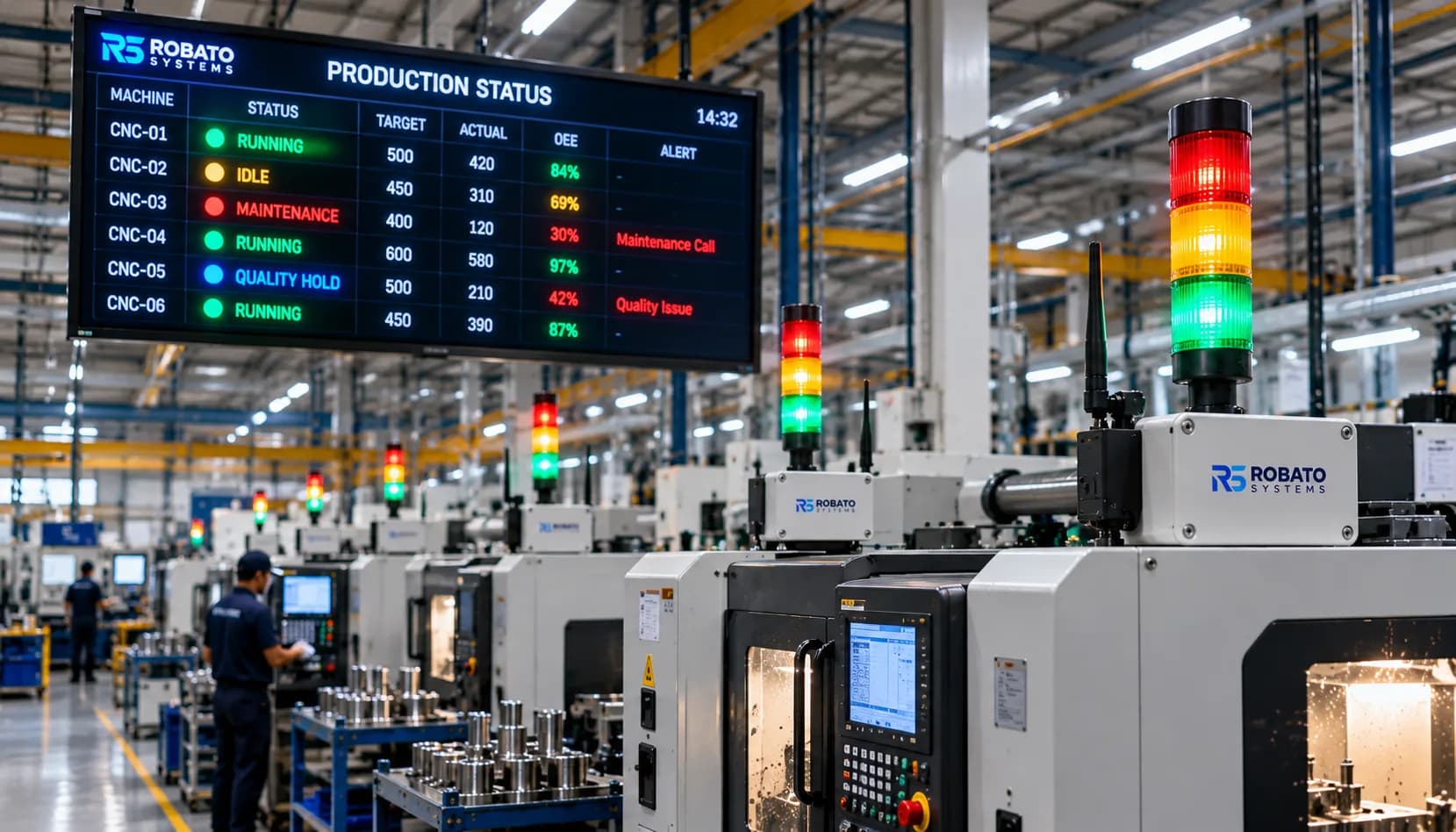
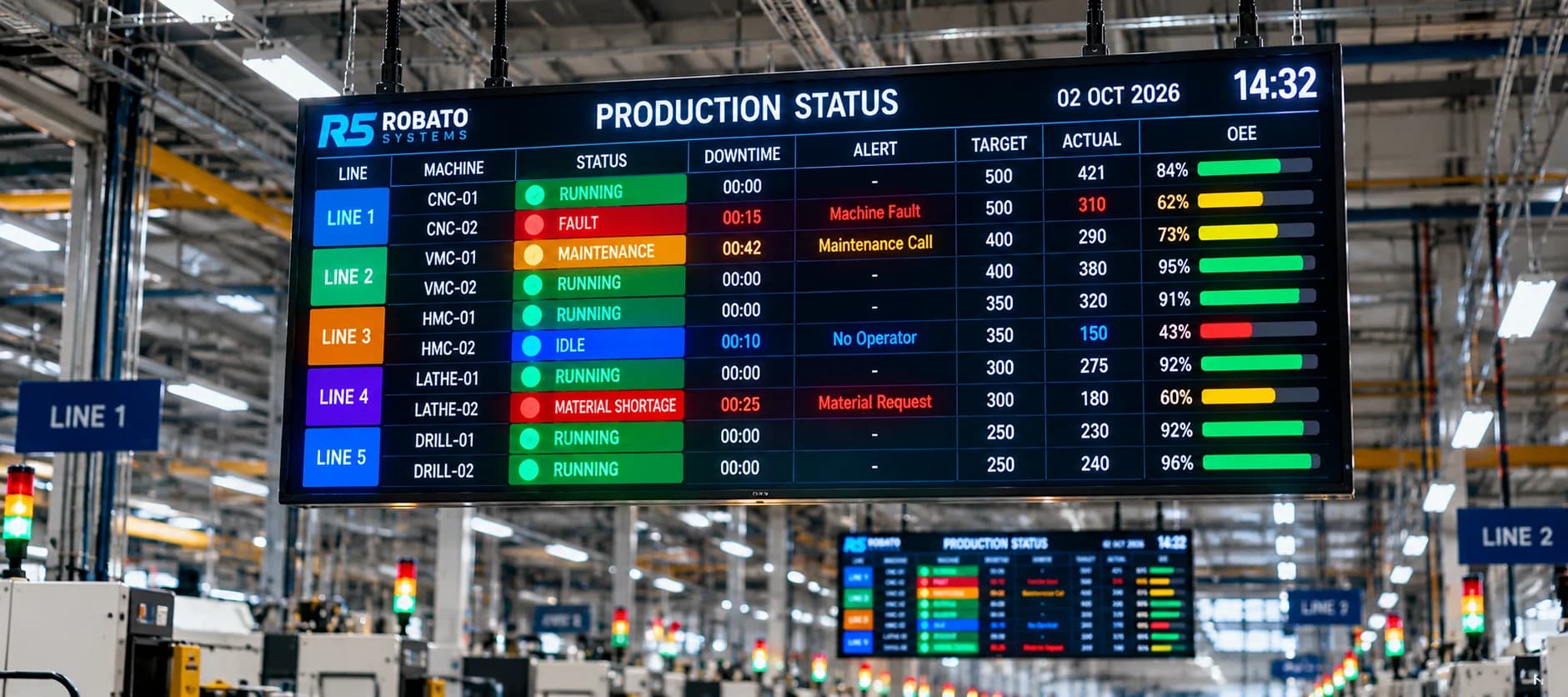
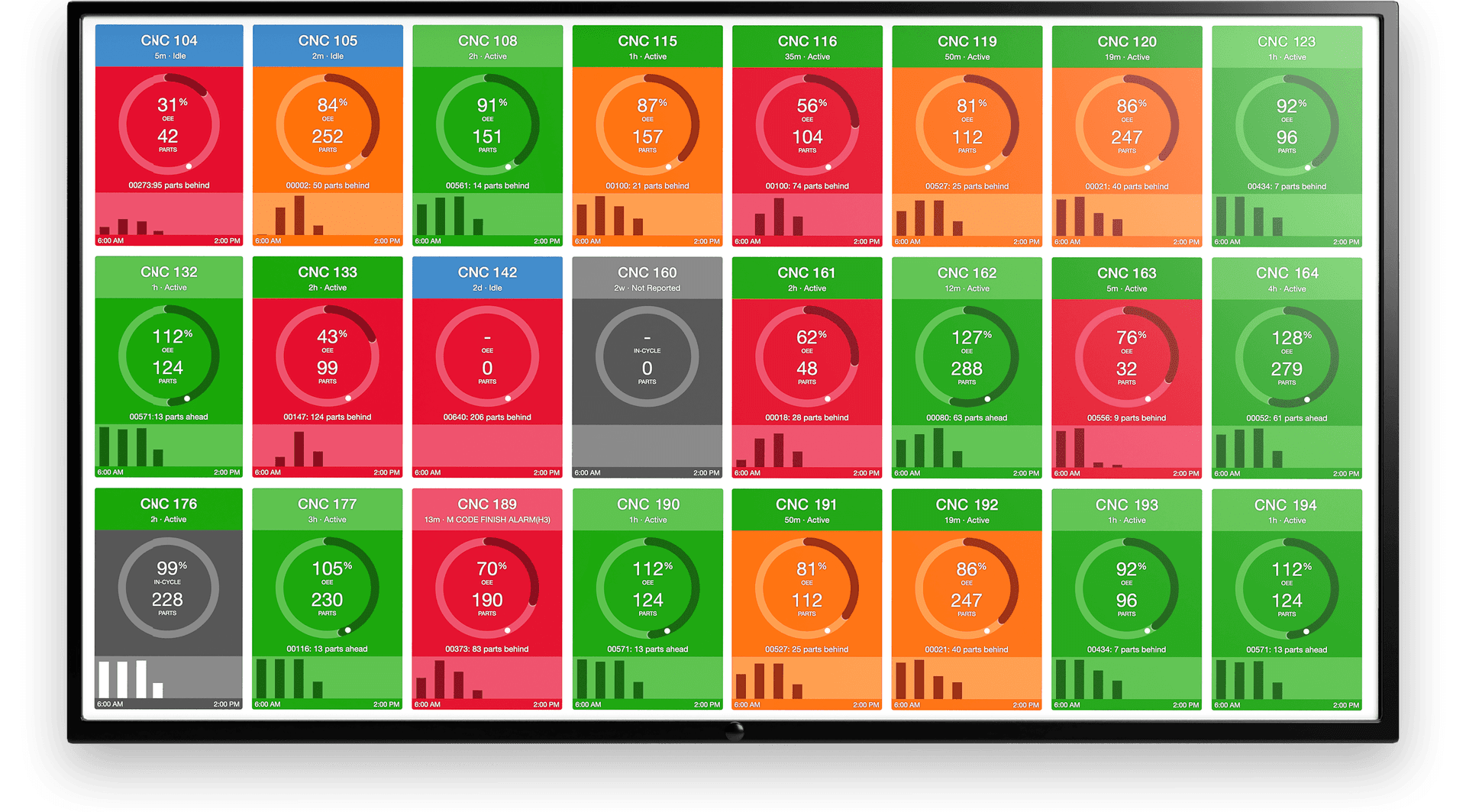
A machine idle time dashboard can centralize machine states and idle-event information.
Useful dashboard components include:
Current Machine Status
Displays which machines are running, idle, stopped, or in other configured states.
Total Idle Time
Shows the total idle duration for each machine during the selected reporting period.
Idle Time by Machine
Allows production managers to identify equipment with unusually high idle time.
Idle Time by Shift
Helps compare waiting periods across production shifts.
Idle Reason Analysis
Where reason codes are available, the dashboard can group idle time by causes such as material shortages, operator waiting, or production scheduling.
Historical Trends
Shows whether idle time is increasing, decreasing, or remaining stable over time.
Alerts
Some systems can notify responsible personnel when idle time exceeds a defined threshold.
Alerts should reflect actual operational requirements so that teams are not overwhelmed by notifications.
Machine Idle Time Monitoring for Multiple Production Lines
In factories with several production lines, idle time on one machine may affect the entire process.
For example, a downstream machine may remain idle because an upstream machine cannot supply enough components. Alternatively, an upstream machine may stop because the next workstation is already full.
A centralized monitoring system can help teams examine these relationships.
Useful comparisons include:
Idle time by production line
Idle time by machine type
Idle time by shift
Repeated waiting between process stages
Changes in idle time after scheduling adjustments
Idle time associated with particular products or production orders
This broader analysis can help manufacturers address process-level causes rather than focusing only on individual machines.
Common Challenges in Machine Idle Time Monitoring
Incorrect State Classification
A machine may appear idle even when it is completing a required process step.
Machine-state rules should reflect the actual operating process.
Missing Reason Codes
A monitoring system may record that a machine was idle without explaining why.
Operator inputs, production-system data, or additional signals may be needed to classify idle events accurately.
Legacy Equipment
Older machines may require additional sensors or gateways to provide suitable operating-state information.
Inconsistent Data
Incorrect timestamps, missing events, or unreliable machine signals can distort idle-time calculations.
Confusing Idle Time With Planned Waiting
Some production processes require cooling, curing, inspection, or other periods in which active production does not occur.
These periods should be classified appropriately instead of automatically being treated as avoidable losses.
Focusing on Percentages Alone
An idle-time percentage may appear high or low depending on the reporting period and production schedule.
Review the actual duration, operational context, and production requirements before deciding whether corrective action is necessary.
Best Practices for Machine Idle Time Monitoring
Define machine states clearly. Establish consistent rules for running, idle, stopped, fault, and maintenance conditions.
Record idle events automatically where possible. Reliable machine signals can reduce dependence on manual observations.
Capture reasons for idle periods. Combine machine-state data with operator inputs or other relevant information when necessary.
Separate planned and avoidable waiting. Not every period without production represents a problem.
Analyze repeated patterns. Recurring idle events often provide more useful improvement opportunities than isolated incidents.
Monitor both duration and frequency. A few long idle periods and many short idle periods may require different corrective actions.
Use role-based dashboards. Operators and supervisors should receive information relevant to their responsibilities.
Validate the data. Check timestamps, state transitions, and calculation rules regularly.
Assign responsibility for follow-up. Ensure that significant idle events are investigated by the appropriate production, maintenance, or planning team.
Measure improvement consistently. Compare performance using equivalent reporting periods and similar production conditions.
Frequently Asked Questions
What is machine idle time monitoring?
Machine idle time monitoring is the process of identifying and measuring periods when equipment is available but not actively producing. It helps manufacturers understand the duration and frequency of machine inactivity.
What is the difference between machine idle time and downtime?
Idle time generally refers to equipment that is available but waiting to produce. Downtime generally refers to equipment that is stopped or unavailable under the factory's reporting rules. The exact classification depends on the machine and the organization's definitions.
How do you calculate machine idle time?
Add the duration of all recorded idle events during the selected period. Idle-time percentage can then be calculated by dividing total idle time by available production time and multiplying by 100.
What causes machine idle time?
Common causes include material shortages, operator unavailability, production scheduling delays, changeovers, upstream or downstream bottlenecks, and waiting for tools or approvals.
Can machine idle time be monitored automatically?
Yes. PLCs, controllers, sensors, industrial gateways, and machine monitoring software can be used to identify idle periods when the required signals and state definitions are available.
How can factories reduce machine idle time?
Factories can investigate material availability, production scheduling, operator coordination, changeover processes, bottlenecks, and repeated short stops. The most effective actions depend on the underlying cause of the idle period.
Does reducing idle time always increase production output?
Not necessarily. Some idle periods are planned or required by the process. Reducing avoidable idle time may create additional production opportunities, but actual output also depends on machine capacity, product demand, cycle time, quality, and downstream constraints.
Can machine idle time monitoring work with older machines?
Yes. Depending on the equipment, sensors, PLC interfaces, or industrial gateways may provide the signals needed to identify machine states.
What metrics should an idle time dashboard include?
Useful metrics include total idle time, idle-time percentage, idle-event frequency, average idle duration, machine status, idle time by shift, and idle reasons where available.
Conclusion
Machine idle time can represent a significant source of lost production capacity, particularly when waiting periods occur repeatedly across machines and shifts.
Machine Idle Time Monitoring helps manufacturers identify these periods, measure their impact, and investigate the operational causes behind them.
By combining reliable machine-state data with production information and practical corrective actions, factories can improve material coordination, scheduling, workflow balance, and overall production visibility.
The objective is not to eliminate every pause. It is to distinguish necessary waiting from avoidable inactivity and address the causes that prevent equipment from being used effectively.
When idle-time monitoring becomes part of a consistent production improvement process, manufacturers gain a clearer understanding of where time is being lost and which changes are most likely to improve operational performance.